Some interesting excerpts from an upcoming paper I’ve summarised (from Bob Wears & Charles Vincent), discussing how too much reliance on resilient capacities can be counterproductive and potentially harmful.
Not discussing these findings here, but they note about how excessive reliance on adaptability, like workarounds, are indicative of first order problem solving.
That is, local goals are optimised (nurses find a needed medical device from another unit), but may inhibit overall system performance and learning (there’s still inadequate devices, or that other unit now has one less expected device).
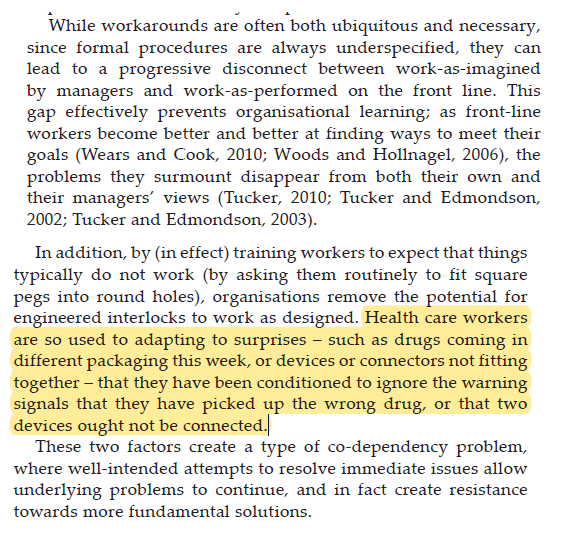
They argue that learning can be difficult because there may not actually be much visible history or insights to learn from, since ‘success’ becomes invisible.
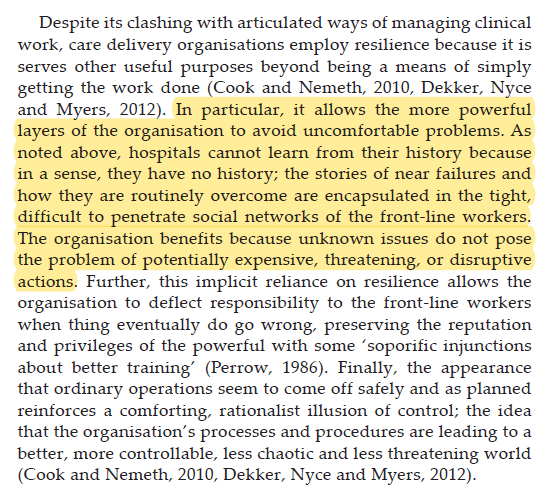
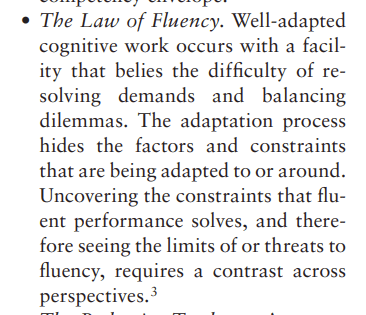
This is similar to the “law of fluency” as discussed by David Woods et al. (image 3). Whereas on the surface things appear to function really well, this belies all of the adaptations and challenges underneath the surface.

Sources:
Images 1 & 2: Wears & Vincent. Wears, R. L., & Vincent, C. A. (2019). Relying on resilience: too much of a good thing?. In Resilient health care (pp. 135-144). CRC Press
Image 3: Hoffman, R. R., & Woods, D. D. (2011). Beyond Simon’s slice: five fundamental trade-offs that bound the performance of macrocognitive work systems. IEEE Intelligent Systems, 26(6), 67-71.

 SafetyInsights.org
One thought on “The harm of too much ‘resilience’ and capacities”