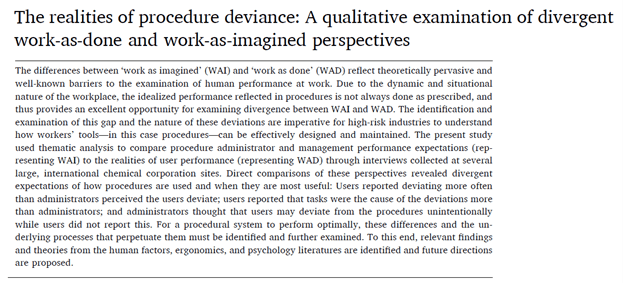
This study in an upcoming summary explored differences between how procedure administrators (representing work as imagined, WAI; the people who create or administer procedural systems) perceive the design and use of procedures versus the realities of procedure users (work as done, WAD) across several large, international chemical sites.
Some findings were that:
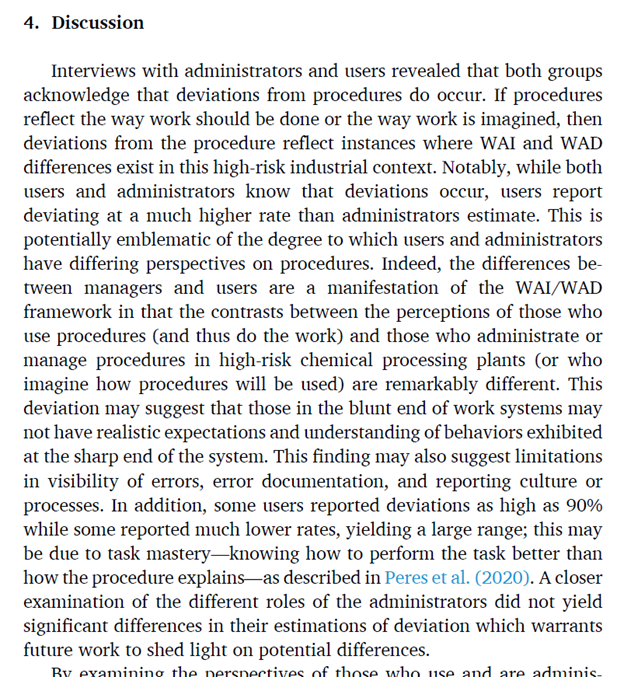
· Both administrators and users recognise that procedural departures occur, although procedural users report departing at a much higher rate than administrators; suggesting that “those in the blunt end of work systems may not have realistic expectations and understanding of behaviors exhibited at the sharp end of the system”
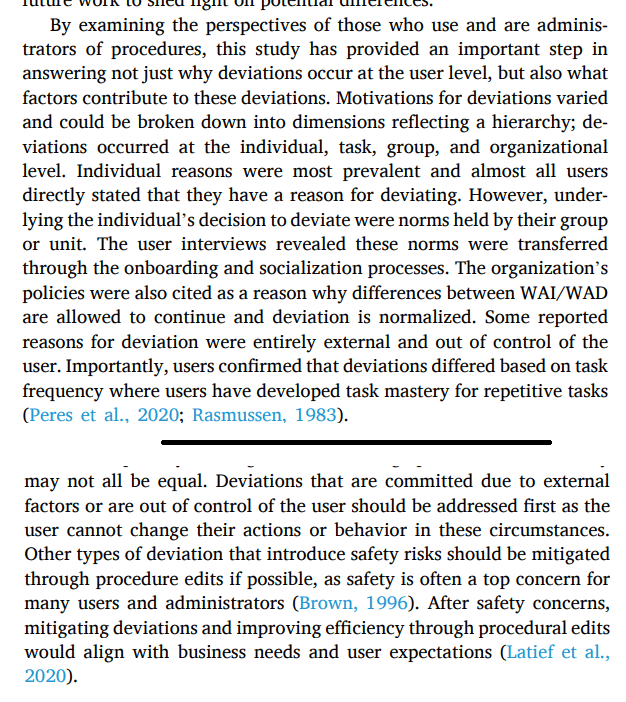
· Procedural departures (and hence, adherence) were found to be influenced by group/team properties, and whether team norms were to follow procedures or not
· Use of digital systems were reported by some to increase rule departure, due to the challenges of digital platforms (tablets etc.) in the field, versus the convenience of a printed copy
· Interestingly, while administrators were more likely to cite factors like inadvertent error, complacency or motivation on why users didn’t follow procedures, the users were more likely to indicate agency – e.g. they purposefully departed from the procedure in order to get the work done or, from their perspective, found a better way to perform the task
· And lots more findings covered (including what makes for effective procedures) in the summary and full paper.
Authors: Mendoza, A., Liu, S. N. C., Smith, A., Hendricks, J. W., Peres, S. C., & Sasangohar, F. (2024). International Journal of Industrial Ergonomics, 100, 103564.
Study link: https://doi.org/10.1016/j.ergon.2024.103564

 SafetyInsights.org
2 thoughts on “WAI vs WAD in high-hazard procedural systems”