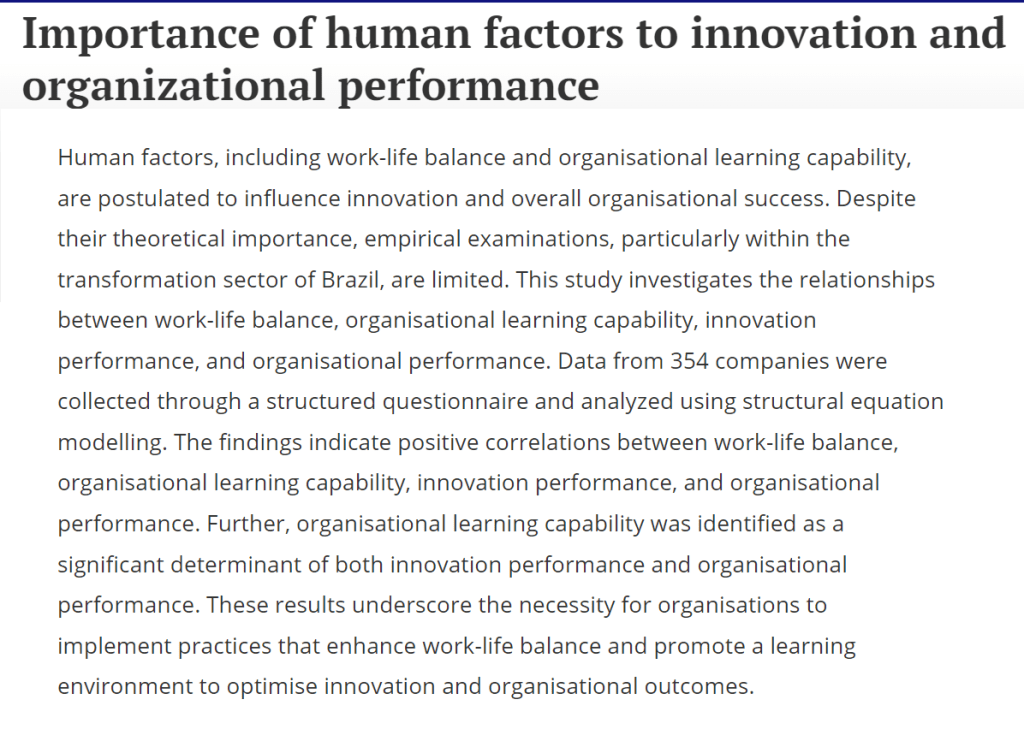
This study explored the relationships between work-life balance, organisational learning capability, innovation performance and organisational performance.
Data is from 354 Brazilian companies.
Providing background:
- They note the important role that innovation plays in helping organisations to remove competitive, like how COVID “underscored the importance of adaptability and innovation in navigating challenging times”
- Innovation goes beyond technological advancements and “also encompasses people-centric factors such as the promotion of a learning culture within organisations and work-life balance (WLB)”
- Organisational learning capability (OLC) also serves as “a powerful adaptive tool in unpredictable situations, enabling swift adaptation, the assimilation of new ideas, and the acquisition of fresh knowledge”
- Maintaining healthy and sustainable work-life balance is said to be fundamental for “nurturing creative professionals who remain motivated and engaged”
- Excessive stress can stifle innovation, and flexible working arrangements can help to positively impact worker lives by favourably influencing organisational learning and innovation
- These benefits are attributed to how work-life balance increases motivation, engagement and creativity in the workplace; the authors argue that the “freedom and autonomy granted to individuals and teams at their workplaces enhance learning and ideation processes”
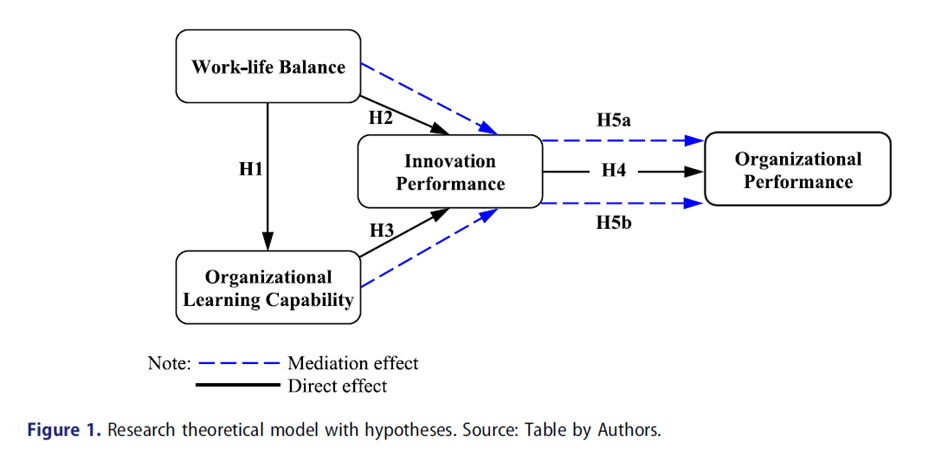
- Hence, there is a direct relationship between organisational learning practices and the innovation performance in a company
- Moreover, organisations that “excel in implementing such learnings become more adept at building relationships with customers and competitors, resulting in an increase in profitability”
- Some prior research showed positive outcomes from implementing a clear innovation strategy within the business, which was linked to improved financial performance, customer performance, internal business process performance and overall growth performance
- OLC implementation has also been shown to boost work engagement, facilitate knowledge sharing and enhancing organisational performance
Their research model is shown below:
Results
Overall, they found:
- Positive correlations between WLB, OLC, innovation performance and organisational performance
- OLC was found to be a significant determinant of both innovation performance and org. performance
- WLB enhances employee learning engagement, and can help to mitigate stress, foster improved organisational dynamics, facilitate enhanced communication and learning
- Moreover, additional resources for stress management, including mental health support, can augment WLB, thereby leading to enhanced OLC
- They argue that these results “underscore the necessity for organisations to implement practices that enhance work-life balance and promote a learning environment to optimise innovation and organisational outcomes”
It’s said that WLB-centric approaches enhance innovation, as reduced WLB conflicts correlate with increased professional motivation and creativity. Further, “Policies emphasising employee well-being and role management in both personal and professional spheres are recognised as catalysts for innovation”.
In the transformation sector, they argue that tailored WLB strategies are even more important, and can include flexible work scheduling, remote work provisions and stress management resources. Hence, WLB-centric provisions “not only facilitate work-life equilibrium but also foster an innovative organisational culture”.
Organisations that emphasise learning also demonstrate a propensity for innovation, and the role of OLC as a “catalyst for innovation” is supported by other research. They say that firms that prioritise learning “effectively harness knowledge to establish a competitive advantage”. These advantages may manifest more strongly during challenging periods, where organisations that excel at innovation “often exhibit superior operational performance”.
Hence, the learning and innovative orientations of organisations help to determine their market position, profitability and growth trajectory.
WLB practices within an organisation may also play a preventative role against mental ill-health effects on professionals, e.g. via anxiety and depression. Thus, boosting professional well-being and WLB are instrumental in countering mental fatigue and burnout syndrome.
Because of the mediating effect of innovation performance between OLC and organisational performance, it “becomes imperative for organisational leaders to foster an environment conducive to learning”.
Overall, the findings confirm that innovation significantly enhances organisational performance, and this is augmented when companies employ WLB and OLC practices. These findings were said to be particularly relevant for organisations in non-technological and labour-intensive industries.
Finally, they argue that these findings are important for highlighting the non-technological side of innovation, e.g. “praising the human side of innovation through the importance of WLB and OLC issues”.
Authors: Vânia Cristina Ferreira, Giancarlo Gomes & Felipe Mendes Borini (2023). Technology Analysis & Strategic Management.
Study link: https://doi.org/10.1080/09537325.2023.2293855
LinkedIn post: https://www.linkedin.com/pulse/importance-human-factors-innovation-organizational-ben-hutchinson-cb3bc

 SafetyInsights.org
One thought on “Importance of human factors to innovation and organizational performance”