A cracking read from Bob Wears and Charles Vincent, exploring how we can come to over-rely on the adaptability of people and systems.
I’m using a lot of direct quotes.
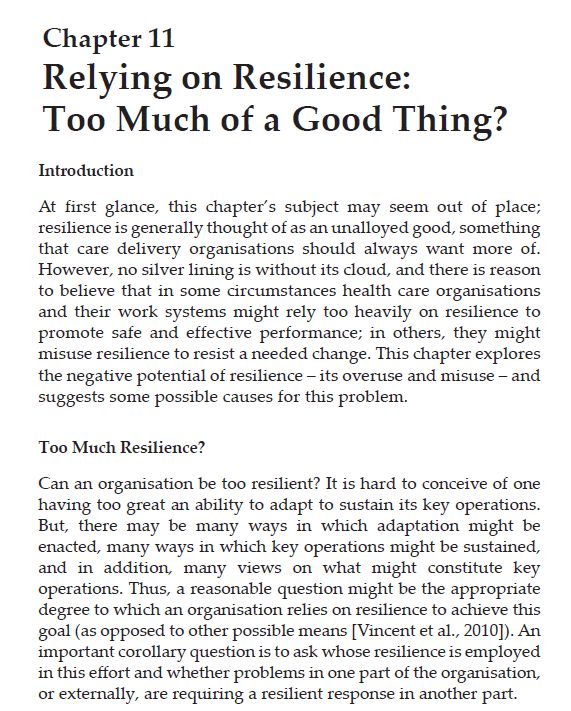
They note that while “resilience is generally thought of as an unalloyed good …no silver lining is without its cloud” and that in some circumstances, “work systems might rely too heavily on resilience to promote safe and effective performance; in others, they might misuse resilience to resist a needed change”
Can an organisation have too much capacity for resilience?
For one, resilience may be inappropriately deployed “wastefully or even dangerously”.
As examples:
· An organisation may depend on resilience too much for achieving routine success, “frittering away a valuable adaptive resource on the everyday that might better be husbanded for greater or less tractable threats”
· Too much time and effort may be spent in adapting to issues that aren’t real challenges, thus “degrade its own ability to sustain key operations in a sort of disorderly, continuous boiling”
· Organisations may employ resilience unevenly across organisational levels, creating a co-dependency instead of addressing fundamental challenges; e.g. “front-line resilience leads to short-term ‘fixes’ that put off more fundamental, long-term solutions”,
· A focus on resilience and capacity may allow “upper management to protect itself from inconvenient truths and shift accountability for failures to frontline workers”
They provide an example of a drug called Propofol, widely used for procedural sedation because of its safety profile and rapid action. This drug, as of this paper’s publication, was said to be in critically short supply.
Alternatives to propofol exist but are less desirable since they lack the combination of speed and safety, and practitioners are less comfortable using alternatives due to their infrequent use.
The hospital in their example located a supply of propofol in pre-packaged syringes, instead of in vials (the latter of which is more typical). Propofol has a characteristically milky white appearance, compared to most other injectables which are clear.
Another commonly used drug in the emergency department, an antibiotic, is also milky white and comes in pre-packaged syringes. This antibiotic is for intramuscular application only, while propofol is IV. Injection of propofol into muscles can induce muscular necrosis, whereas IV injection of the antibiotic can be fatal.
They say that while “Managers understood the potential for confusion between the two preparations” they nevertheless went ahead with the propofol vials supply based on some reasonings, like:
· in many cases these drugs aren’t used in the same areas (except for the ED),
· they added labels to the propofol syringes,
· sent an email to staff warning about the change,
· and “trusted that the staff would be able to work it out”.
Hence, the organisation, balancing competing demands, introduced “a potential risk, on the assumption that ‘the staff can sort it out”. In this example the authors argue that while the goal of resilience wasn’t explicitly a goal, the implicit dependence on resilience is present.
They say that this example illustrates “the cross-level complexities of resilience and the potential to fail by working at cross purposes (Woods and Branlat, 2011a)”.
That is, this hospital “solved an overall problem by increasing the demand for resilient adaptation on one group of workers in an acute-chronic trade-off: the short-term problem of a present drug shortage was resolved by risking the long-term problem of a fatal misadministration in the future”.
Hence, a focus on the resilient capacities of “ED staff (to deal with the ‘surprise’ of the lookalike
packaging) allowed the organisation to choose a riskier option than it otherwise might have”.
Resilience: Too much of a good thing?
They argue that resilience may act as compensation for poor reliability. It’s said that in complex systems like in healthcare, many health care problems and processes have an “irreducible variability”.
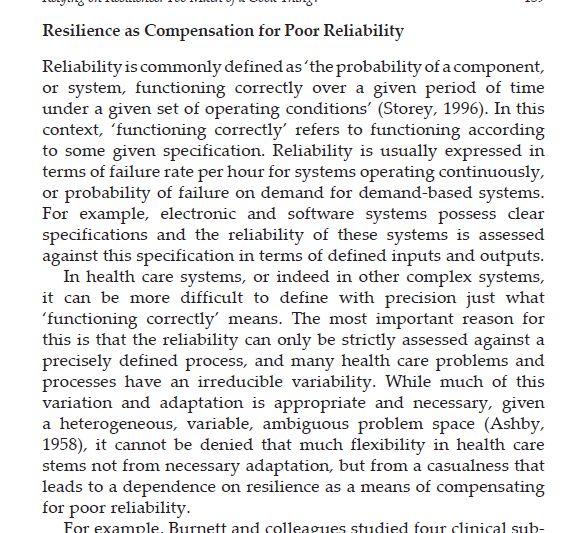
While much of this variability and subsequent adaptation is necessary given an “heterogeneous, variable, ambiguous problem space”, it can’t be denied that “much flexibility in health care stems not from necessary adaptation, but from a casualness that leads to a dependence on resilience as a means of compensating for poor reliability”.
Research that evaluated reliability of healthcare processes (defining reliability as 100% fault free operation, e.g. all required info was available for a clinician at the time of a patient’s appointment), found that reliability was between 81 to 87% for all sub-systems studied. Hence, “the clinical sub-systems studied failed on 13–19 percent of occasions. About 20 per cent of reliability failures were associated with a potential risk of harm”.
These levels of reliability are indicative that the underlying processes ,roles and responsibilities are inadequate for the tasks they serve.
If these levels of reliability are typical across healthcare institutions, then “doctors must deal with missing clinical information for three in every 20 outpatients seen; missing or faulty equipment in one of seven operations performed; and that nurses and pharmacists must waste time correcting problems and searching for records or equipment for four or five patients every day on a typical 30-bed ward”.
Responding Resiliently: Workarounds and Adaptations
Staff reported some workarounds they had developed in response to poor system reliability. Risks couldn’t be directly assessed for many workarounds, but risks were nevertheless taken in some cases; e.g. making clinical decisions without info, transferring used sharps to sharps bins in remote locations.
These types of workarounds are examples of first order problem solving – adapting immediate work to cope with basic inefficiencies of the system [** See links in comments for Tucker & Edmondson’s work on first vs second order problem solving].
Clinical staff are extremely proficient at first order problem solving, but their expertise “in compensation can inhibit more fundamental system change”. Further, clinicians are said to display resilient behaviour in adapting to and recovering from potentially dangerous situations, “but for the most part, resilience was only required because reliability was poor”.
Workarounds are said to often be both “ubiquitous and necessary”, because formal procedures are always underspecified and can lead to a progressive disconnect between work-as-imagined and work-as-performed.
This gap inhibits organisational learning since workers become better at finding ways to adapt and meet their goals, the “problems they surmount disappear from both their own and their managers’ views”.
They discuss how by training workers to expect that things typically do not work, e.g. to adapt, to draw on resilient skills, “organisations remove the potential for engineered interlocks to work as designed”.
Healthcare workers are said to be so used to adapting to surprises, like drugs arriving in different packaging, devices and fittings not connecting and more, that they have been “conditioned to ignore the warning signals that they have picked up the wrong drug, or that two devices ought not be connected”.
Excessive resilience is expensive in the long run
Relying too greatly on resilience and adaptation is said to be expensive in the long run. For example:
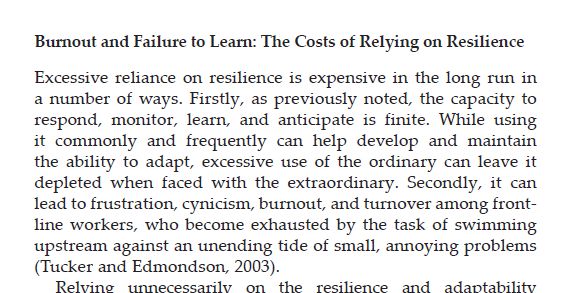
· The capacity to respond, monitor, learn and anticipate is finite, hence relying on this approach for systems to function can leave capacities depleted when “faced with the extraordinary”
· It can lead to frustration, cynicism, burnout among frontline workers who are exhausted from “swimming upstream against an unending tide of small, annoying problems”
· It can lead excessively to first order problem solving, e.g. a nurse obtaining a device from another unit, solving that immediate work need, while introducing a loss in another part, which then needs to be compensated for
· First order problem solving needs to be coupled with second order problem solving – actually addressing the underlying issues and informing leaders that things need to be resolved
· Hence, “Resilience can, therefore, act against an organisation’s longer-term interests by burying problems that are thus never resolved”
In concluding, it’s said that “hospitals cannot learn from their history because in a sense, they have no history; the stories of near failures and how they are routinely overcome are encapsulated in the tight, difficult to penetrate social networks of the front-line workers”.
The organisation benefits from this silence since unknown issues don’t pose a problem of potentially expensive and disruptive change.
The reliance on resilient capacities also allows an organisation to “deflect responsibility to the front-line workers when thing eventually do go wrong, preserving the reputation
and privileges of the powerful with some ‘soporific injunctions about better training’ (Perrow, 1986)”.
Finally, the “appearance that ordinary operations seem to come off safely and as planned reinforces a comforting, rationalist illusion of control; the idea that the organisation’s processes and procedures are leading to a better, more controllable, less chaotic and less threatening world”.
Link in comments. I’ve also linked to another paper from Wears about the “tragedy of adaptability” which has a similar theme.
Authors: Wears, R. L., & Vincent, C. A. (2019). Relying on resilience: too much of a good thing?. In Resilient health care (pp. 135-144). CRC Press.

LinkedIn post: https://www.linkedin.com/pulse/relying-resilience-too-much-good-thing-ben-hutchinson-ogcoc
First vs second order problem solving: https://www.linkedin.com/pulse/when-problem-solving-prevents-organizational-learning-ben-hutchinson
The tragedy of adaptability: https://www.linkedin.com/pulse/tragedy-adaptability-ben-hutchinson

 SafetyInsights.org
2 thoughts on “Relying on Resilience: Too Much of a Good Thing?”