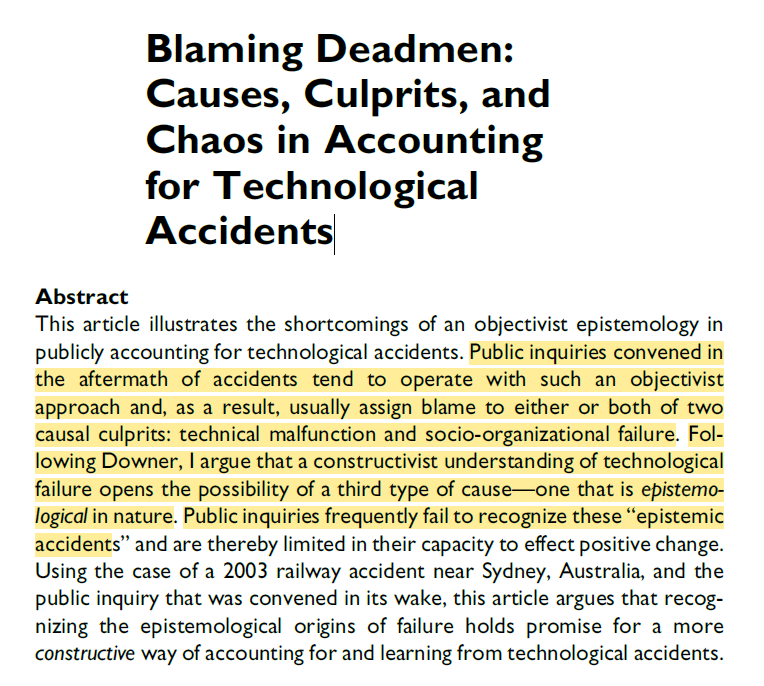
This was a fascinating read, exploring objectivist and constructivist explanations and reflections around the public inquiry into the Waterfall train accident; and namely how a myopic objectivist focus on rational decision-making and technology may lead to blame and a weak understanding of sociotechnical & social systems.
I can’t do it justice.
Some of the key arguments were that:
· Major investigations run the risk of taking objectivist and rationalistic perspectives, based on principles that technology, and also decisions, are seen as “objectively knowable … [and] definitively calculable”, and as a result of errors which “should have been foreseen and, ideally, prevented”
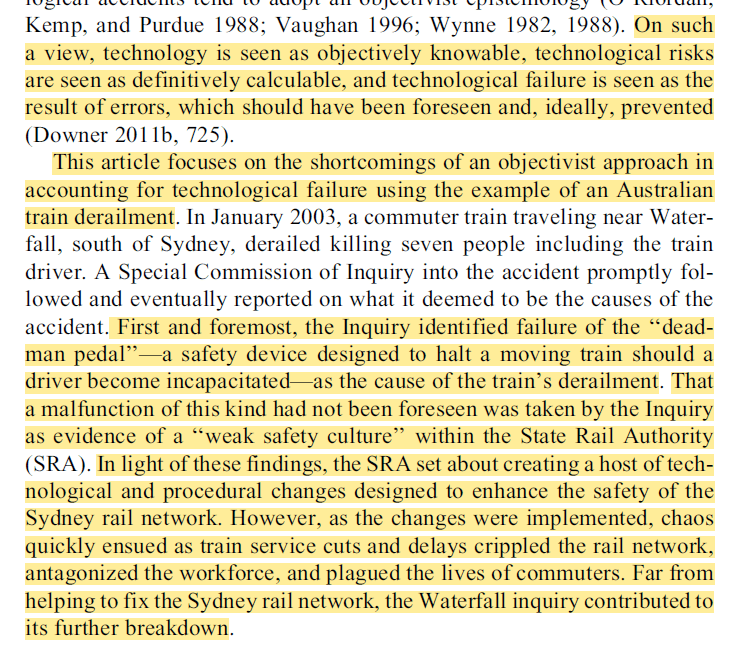
· These approaches may under-explore or outright reject the inherent unruliness of technology, and the inherent uncertainties and ambiguities present in complex sociotechnical systems
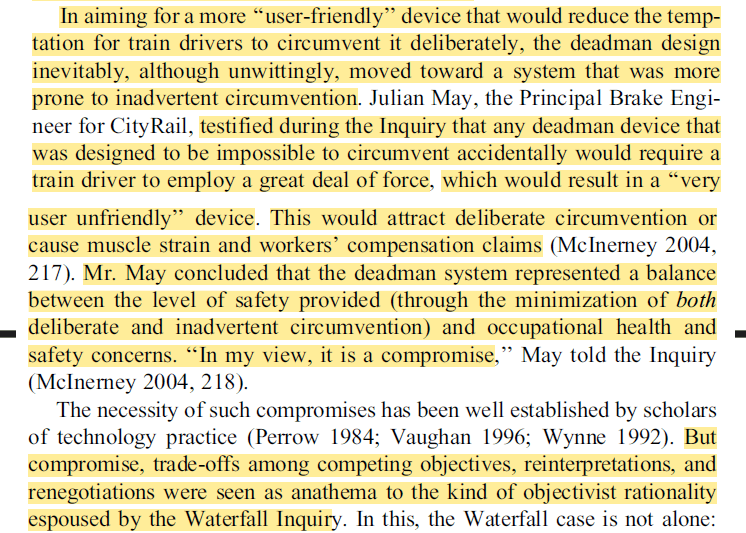
· While the deadman switch on the Tangara train was designed to be a compromise between ergonomics (avoiding too much driver strain) versus safety criticality – the inquiry “disregarded the importance of contextualized definitions and ‘‘bounded rationality’’ in organizational decision making, and insisted instead on a form of universal, perfect rationality, exemplified by the authority of the Oxford English Dictionary”
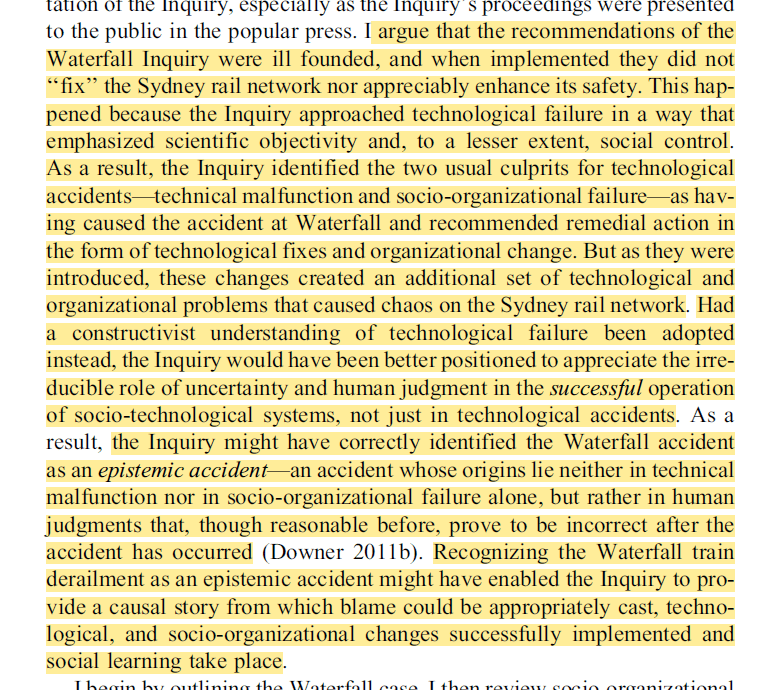
· Further, the inquiry “privileged objectivist assumptions and legalist rationality over a more contextually specific, constructivist understanding of technology
· While “warning signs” were ambiguous prior to the accident, the inquiry with its objectivist logic of legalist rationality, saw the warning signs prior to the accident as clear and obvious and wilfully ignored; disregarding the role of ambiguities and uncertainties in normal, daily technological operations
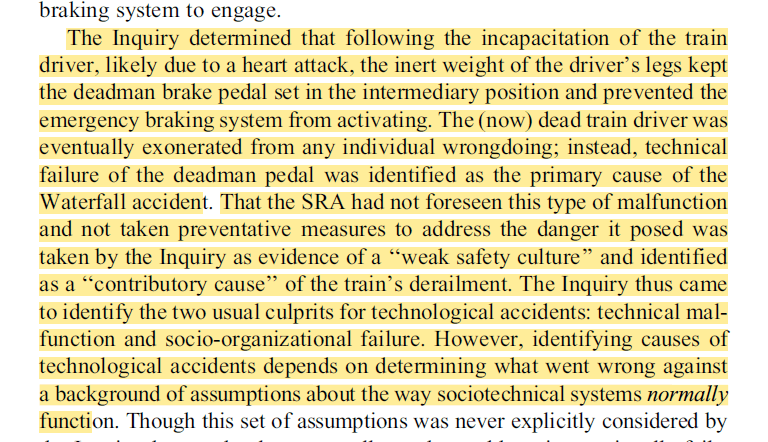
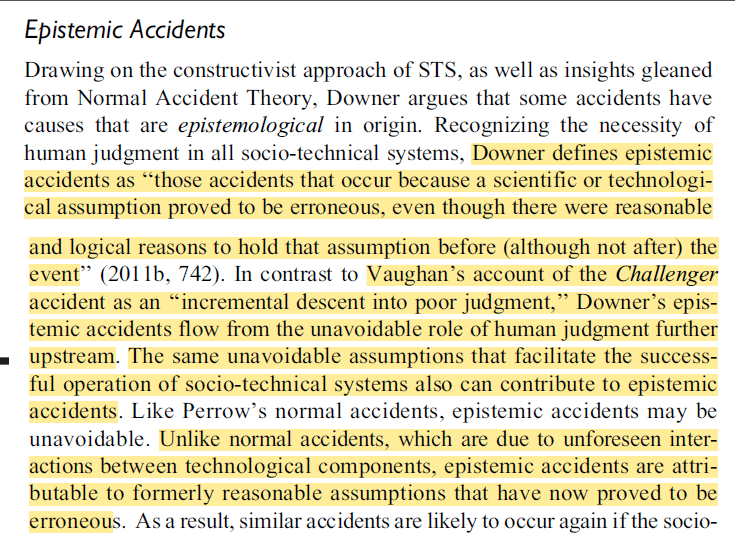
· While the inquiry’s objectivist rationale pointed to the unreasonable or illogical ignorance of the deadman switch and warning signs, the constructivist perspective highlights that the prior decisions appear to have been both reasonable and logical, even though some of the assumptions were not correct
· Moreover, while the inquiries recommendations were well-intentioned, they “were levelled primarily at workers at the bottom of the institutional hierarchy of the SRA: train drivers”, and created among the workforce a perception that “the workforce is the problem”
Summary posted soon.
Ref: Kenny, K. E. (2015). Blaming deadmen: Causes, culprits, and chaos in accounting for technological accidents. Science, Technology, & Human Values, 40(4), 539-563.

Study link: https://doi.org/10.1177/0162243914559288

 SafetyInsights.org
3 thoughts on “The folly and blame of objectivist and rationalistic investigations – the Waterfall train accident”