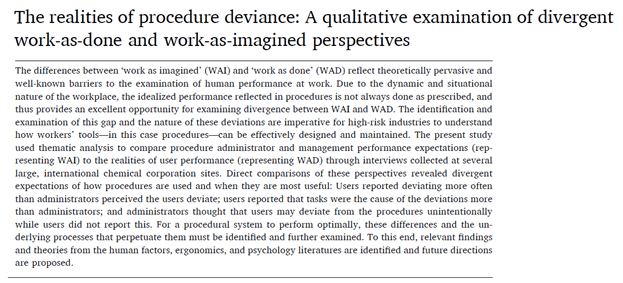
This studied, via interview, differences between how procedure administrators (representing work as imagined, WAI) perceive the design and use of procedures versus the realities of procedure users (work as done, WAD) across several large, international chemical sites.
Providing background:
· While procedure use/departures are mentioned across many major accidents, procedure users in some data reported that procedures were often out of date or were inaccurate
· Organisational barriers also impact procedure use, like cost and time, and also mistrust among users
· Some organisations have a practice of “initiating procedure changes only after a major incident or near miss were identified as contributors to deviation and general dissatisfaction with procedures”
· Other data found that procedures may “often [be] developed without input from the users of the procedures, creating a disconnect between those who write or manage procedures and those who use them”
· Assumptions of procedure writers/administrators who may not be experienced in actually performing the task may assume things about the task, like the sequencing of steps etc., whereas people who do the task may know that steps can be done in different orders
Results
Frequency of procedure deviation
Procedure administrators and procedure users reported procedural departure rates from between 0% to 90%.
Users estimated their own departures much higher than the administrator’s estimates (e.g. the actual procedure users estimate that they don’t always follow procedures more than the administrators think that users depart from procedures).
Most administrators recognised that procedures aren’t always followed, while one expected complete compliance at all times.
The data found no correlation between users` job tenure and departure estimates.
Procedure departures were reported to occur also at the team or unit level, where 19% reported that their departures “occurred in the context of a team or unit where all users deviated in a shared manner for common procedures”.
Reasons for departures from procedures
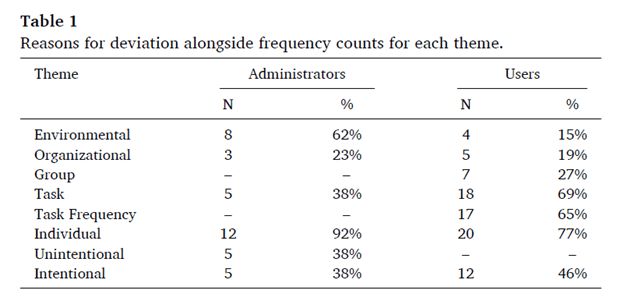
For reasons why people departed from procedures, administrators interestingly more commonly said that it’s due to unintentional user errors. In contrast, the actual procedure users reported more intentionality in their departures “characterized by the work group, and differences between frequent and infrequent tasks”.
Environmental factors contributing to deviation
Most administrators and some users reported environmental factors for rule departures, like weather, environment or barriers related to the design or layout of the facility, accentuated by factors like use of paper procedures, damaged by poor weather and dirt or mud.
Users who found environmental issues also cited the use of digital systems as contributing to departures, like with tablets or computers get dirty, broken or used outside when raining.
Organizational factors contributing to departures
Around 23% of administrators and 19% of users cited organisational reasons or mandates from the company for deviating.
Administrators mentioned how company quotas and time pressure contributed. Users focused more on departures that occur due to a disconnect between “those who write the procedures and those who complete the task”. Hence, users reported that they “must deviate from what is written when there are errors in their procedures”.
Task-related factors contributing to deviation
Some administrators and most users cited task frequency was related to the degree of procedural departure. Hence, frequent and routine tasks were more likely to involve procedural departures.
Individual factors contributing to deviation
Almost all administrators and most users cited individual differences and motivations that result in procedural departure.
Administrators cited reasons like users may personally choose to deviate due to complacency, confidence or motivation. Conversely, “Users mentioned deviating because they believe the task can be done better in their own estimation, even if it is in a different way than how the procedure lays out the task”.
Group factors contributing to deviation
Some users mentioned that their work group or those with whom they directly worked with each day influenced their procedural use. For instance, departure is more likely when working with other users and having only one procedure present.
Perceptions of “high quality” procedures
The data was evaluated based on how each group perceived the quality of procedures.
These were:
· Effectiveness: almost all administrators and several users discussed procedure ‘effectiveness’, here they discussed how high quality procedures help users to get the job done
· Detailed: Over half of administrators and a third of users cited procedures needing to be detailed. Having enough detailed info so users of procedures could complete the job safely and correctly was more heavily emphasised by administrators than users
· Efficiency: Around half of administrators and users believed that procedures should be efficient, allowing users to efficiently complete their tasks
· Ordered/sequenced: A few administrators and some users cited the need for high quality procedures to be ordered and sequenced
· Considering intended audience: 46% administrators and 31% users believed that it’s important for procedures to be written while considering the intended audience
· Safety and regulation emphasis: This theme emphasising the importance of procedures containing safety information and regulations was present only during administrator interviews; users didn’t mention this is an important facet for high quality procedures
Discussing the findings, several differences between WAI and WAD were observed in a high-risk industrial setting. In sum:
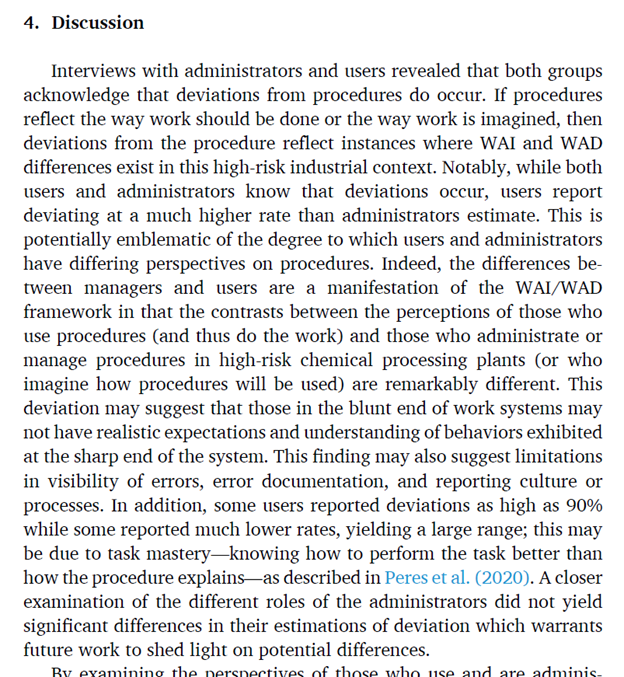
· Both administrators and users recognise that procedural departures occur, although users report deviating at a much higher rate than administrators; suggesting that “those in the blunt end of work systems may not have realistic expectations and understanding of behaviors exhibited at the sharp end of the system”
· Individual reasons were the most prevalent explanations for why users depart from procedures.
· However “underlying the individual’s decision to deviate were norms held by their group or unit” and that “these norms were transferred through the onboarding and socialization processes”
· Two themes were unique to administrators, being that high quality procedures should be informative and emphasise safety
Authors: Mendoza, A., Liu, S. N. C., Smith, A., Hendricks, J. W., Peres, S. C., & Sasangohar, F. (2024). International Journal of Industrial Ergonomics, 100, 103564.
Study link: https://doi.org/10.1016/j.ergon.2024.103564
LinkedIn post: https://www.linkedin.com/pulse/realities-procedure-deviance-qualitative-examination-ben-hutchinson-q5ncc

 SafetyInsights.org
3 thoughts on “The realities of procedure deviance: A qualitative examination of divergent work-as-done and work-as-imagined perspectives”