How well does hazard reporting fulfil its purported goals in practice?
I finally got around to summarising this interesting study from Jop Havinga, Kym Bancroft and Drew Rae which explored this question.
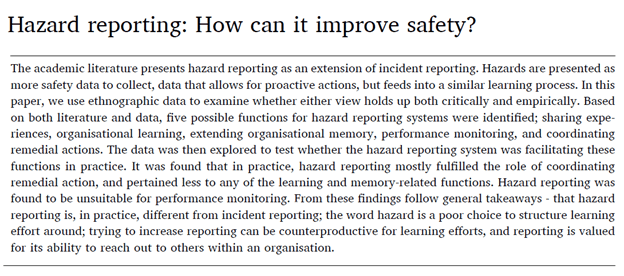
Namely, using ethnographic data they studied how aligned hazard reporting is to: 1) sharing experiences, 2) organizational learning, 3) extending organizational memory, 4) performance monitoring, 5) coordinating remedial actions.
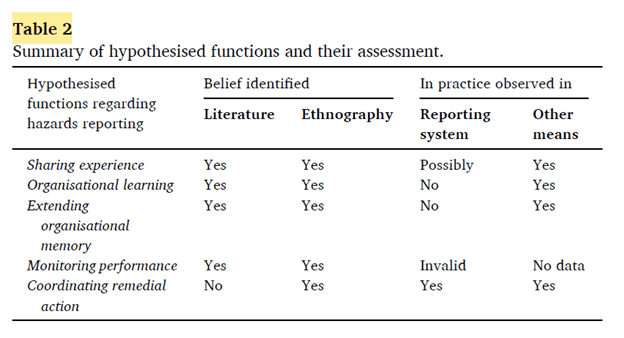
Some key findings were that:
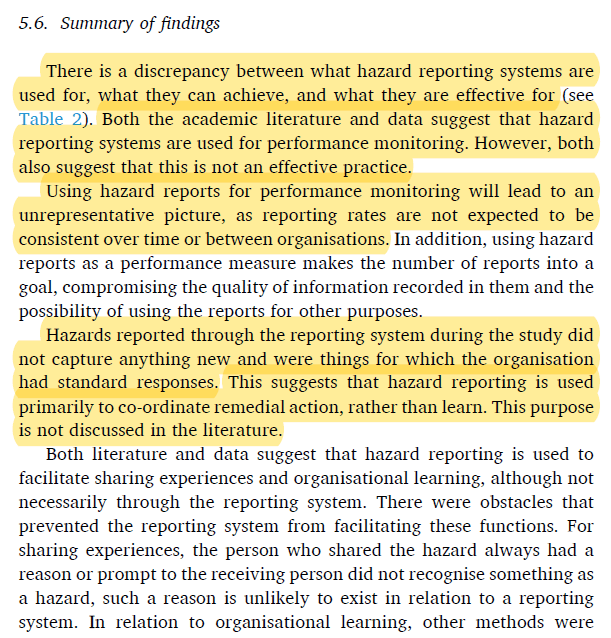
· “There is a discrepancy between what hazard reporting systems are used for, what they can achieve, and what they are effective for”
· Whereas hazard reporting is purported to be used for performance monitoring, the data “suggest that this is not an effective practice”
· That is, using hazard reports for performance monitoring “will lead to an unrepresentative picture”
· Use of hazard reports as a performance measure “makes the number of reports into a goal, compromising the quality of information recorded in them”
· Hazards reported in the reporting system “did not capture anything new and were things for which the organisation had standard responses”
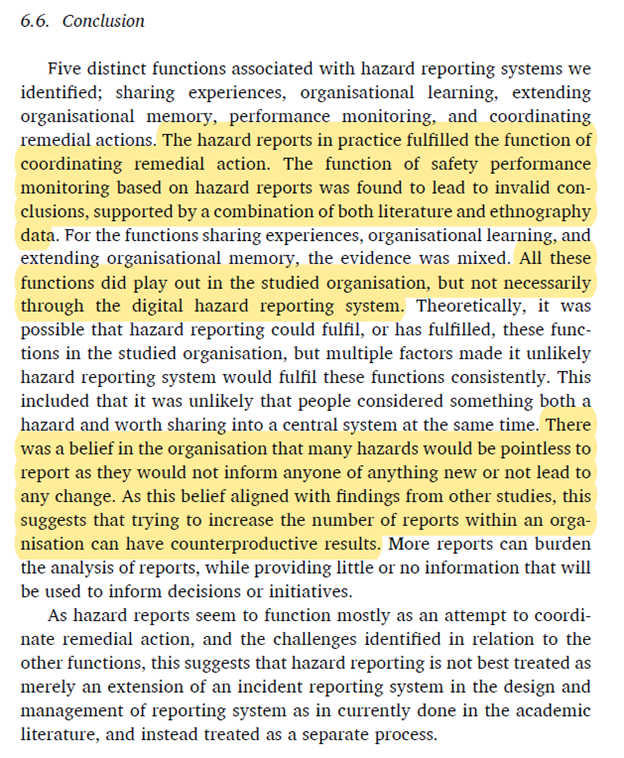
· And results suggest “that hazard reporting is used primarily to co-ordinate remedial action, rather than learn”
· No evidence was found that hazard reports extended organisational memory
Hazard reporting systems, hence, may be “better served by a system optimised towards coordinating remedial action, as opposed to a system set up to analyse the report for deeper lessons”.
It’s said “Hazard is a poor starting point for learning” and that sharing reports or stories can facilitate learning, but “the term “hazard” might not be the best identifier for a reporting system focussed on learning”.
Summary posted soon.
Authors: Havinga, J., Bancroft, K., & Rae, A. (2021). Safety science, 142, 105365.
Study link: https://doi.org/10.1016/j.ssci.2021.105365

 SafetyInsights.org
One thought on “Are hazard reporting systems a “poor starting point for learning”?”