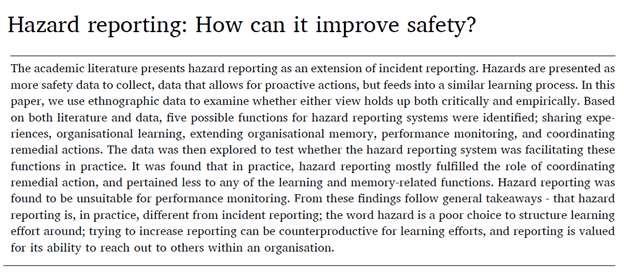
This study, drawing on ethnographic data, examined whether hazard reporting acted as a type of extended incident report, allowing for more proactive action.
I can’t do this justice, so recommend you read the paper. Note: I’ve skipped a lot of the paper.
Data came from a broader 3-month ethnographic project at a water distributor-retailer in Australia.
They note that while it may be true that organisations can learn from hazard reports, and under-reporting can hamper learning, “it does not necessarily follow that increasing the number of reports always increases learning or that it is good for safety”.
Based on a review of the literature, they identify five areas that hazard reporting systems were meant to facilitate or enhance within organisations.
Results
Each of the five proposed hazard reporting areas will now be discussed in the context of the findings.
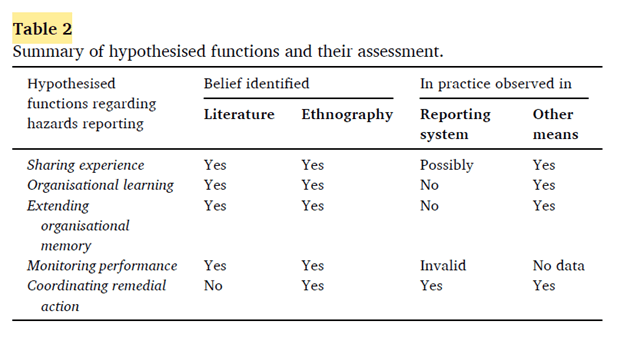
1. Sharing experiences
Reports are supposed to be used to enable experiences that can be shared with other individuals or groups.
Within the departments observed, the researchers saw people sharing incident stories to improve the knowledge or understanding of the operators who received the info. Stories were shared and discussed between work crews.
Most of the shared stories observed by the researcher “were between operators, or operators and contractors, and were around tricky work situations they had encountered”. Here, “The researcher could not find any signs that these stories had been reported into the digital reporting system”.
Operators discussed the situations, what made that situation difficult and how they responded; none of these stories were found to be centred on the presence of a unique or new hazard. The stories instead “were about cases where operators had to adjust because they had to work under tighter constraints than usual, wanted to avoid hindering the public, or had a difficult time making sense of the situation”.
Stories also involved actual injuries, near deaths and near misses. The stories about near misses “were observed to travel faster than the formal reporting system facilitated”.
In one instance of a circulated digital message, the supervisors had already discussed the event with each other in-depth; these stories “did not capture hazards, and it was not clear whether the reporting system facilitated the sharing of the stories, or whether the reporting system only recorded the incidents that would have been shared regardless of the reporting system”.
2. Organisational learning
Hazard reports are purported to enhance organisational learning.
Based on this data, “There was no indication that the hazard reporting system contributed to identifying new hazards and improvements in terms of systematic changes”.
Further, there were no observed cases where hazard reports “captured anything that was not already considered to be a hazard before the report was made”.
Based on some hazard reports, it was observed that the report would indicate that a hazard was present but “not that something should be considered a hazard that was not considered a hazard before, nor that things should be organised differently in the future”.
That is, remedial action following such issues “restored the system to the old norm, rather than establish a new norm”.
One example cited was that a hazard report didn’t “make the experienced operators aware of a danger they did not already know to avoid”, however “it helped the experienced operators realise that something could be improved in their current work area”; although in that example, the authors discuss how the issue may be classified as a missing barrier rather than as a hazard.
No evidence was found that the hazard reporting led to organisations learning to consider new things as hazard. Specifically:
· Reports captured elements that were used to flag the presence of a hazard, but not something should be considered a hazard
· Examples were found where dangerous conditions were communicated and shared outside of the hazard system and this led to long-term improvements
· However, “while it is possible to achieve organisational learning through hazard reporting, the hazard label and a focus on sharing things considered ‘unknown’, leads people to only share a subset of all things that they recognise as issues or improvement opportunities through a hazard reporting system”
3. Extending organisational memory
Another purported belief is that reporting systems can extend organisational memory, by acting as a “collective memory which can be consulted when exploring ideas or making decisions”.
While there was observed to be a belief about the role of reporting systems for long-term memory, “no evidence was found that digitally reported hazards contributed to this”.
Operators believed that their submitted hazard reports would go into a general database, but didn’t write them with the intention for it to act as a long-term learning process.
The authors also wrote that “For hazard reporting specifically, there was no expectation, nor any indication that this extended the organisation’s memory”. It’s noted that reports focused on everyday work that the reports may have helped expand what was considered in the analysis of hazards, but the authors argue that “this would be better described as expanding the organisation’s working memory, rather than increasing the duration of its long-term memory”.
4. Monitoring performance
Another purported aim of reporting was to act as a type of performance monitor, to assess whether safety is improving or decreasing over time.
Anecdotal evidence was used for this area, because the organisation in question had started to move away for using hazard reports in this way of memory. Based on multiple stories from various groups, “relying on hazard reports for performance monitoring did not work as intended”.
A key issue identified was that hazard reports as indicators meant “reporting hazards had become a goal in itself …Workers, supervisors and middle managers all had stories about putting in hazards they considered inconsequential, and ridiculous to report, just to increase the numbers”.
It’s observed that all examples of hazards entered into the database “were minor deviations from the norm, like rubbish left outside, and spills. These hazards were considered common and expected to happen over time”.
The prior literature and these findings “challenge the validity of using hazard reports as an indicator for performance monitoring” and that “using the number of hazard reports as an indication of safety has a chance of making reporting hazards into a goal by itself, which leads to reports that are considered less useful”.
5. 5. Coordinating remedial action
This item relates to workers associating hazard reports with something that needed to be actioned over something that needed to be analysed and further investigated. That is, “Reportable hazards were not sources of risk inherent to the design of the job, but deviations that were not supposed to be there in the first place and therefore needed to be remedied”.
The hazard reporting system was observed to function in this way. It’s said that managers and operators didn’t expect that these reports would be analysed or that something generalisable would be learned from the report, but rather something would be actioned as a result.
Participants in the study viewed a successful hazard system as one that coordinated action to address an issue. And although this was the main purpose operators used the system for, they didn’t view it as the best way to achieve that purpose.
Summary of findings
The authors note that:
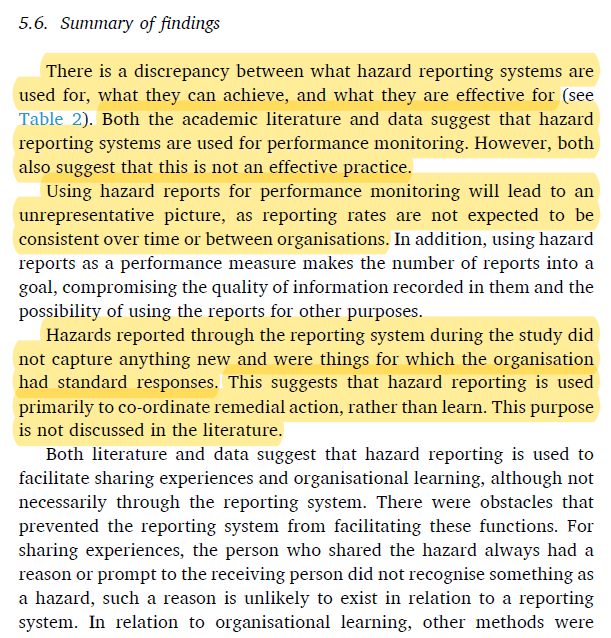
· “There is a discrepancy between what hazard reporting systems are used for, what they can achieve, and what they are effective for”
· Research and this data indicates that hazard reporting systems are used for performance monitoring, but aren’t effective for this practice
· That is, “Using hazard reports for performance monitoring will lead to an unrepresentative picture, as reporting rates are not expected to be consistent over time or between organisations” and turns reports in a goal
· Hazard reports observed in this study also didn’t capture anything new and were “things for which the organisation had standard responses”
· And results suggest “that hazard reporting is used primarily to co-ordinate remedial action, rather than learn”
· No evidence was found that hazard reports extended organisational memory
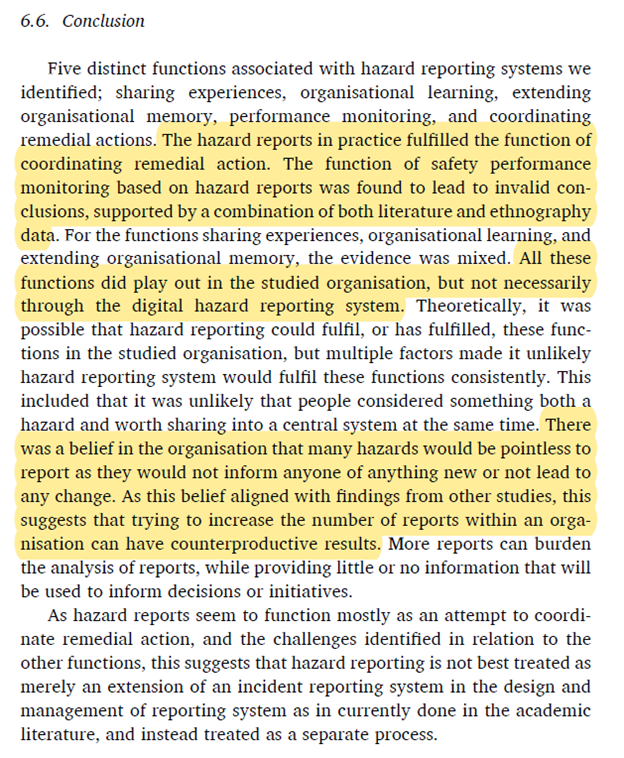
Hazard reports require a different response to incident reports and were “generally about issues that were familiar and well understood by the organisation” and because effective responses had already been devised, “hazard reports might not generate the most value by being fed into the same process as incident reports”
Hazard reporting systems, hence, may be “better served by a system optimised towards coordinating remedial action, as opposed to a system set up to analyse the report for deeper lessons”
It’s said “Hazard is a poor starting point for learning” and that sharing reports or stories can facilitate learning, but “the term “hazard” might not be the best identifier for a reporting system focussed on learning”
Findings also suggest that “it less likely hazard reports make significant contributions to the safety learning process in organisations” and “ In addition to less rich nature of hazard reports, we found it is unlikely something to be identified to be worth reporting as a hazard into a digital reporting system”
Operators shared outside of their crew to instigate improvements if they saw opportunities to improve, irrespective of whether something was considered a hazard, technically or socially
If an organisation aims to learn and improve, then “asking for ‘hazards’ misses useful information, as reporters do not consider all issues to be hazards”
“The number of things that render a hazard useful to report are limited, and improvement possibilities do not have to focus on something associated with a hazard”
Increased reporting may be counterproductive to learning, as they also come with time to file, receive and follow-up on. Hence, “it is the norm that there are more incidents reported than there are resources to analyse them”.
Authors: Havinga, J., Bancroft, K., & Rae, A. (2021). Safety science, 142, 105365.
Study link: https://doi.org/10.1016/j.ssci.2021.105365
LinkedIn post: https://www.linkedin.com/pulse/hazard-reporting-how-can-improve-safety-ben-hutchinson-zcahc


 SafetyInsights.org
One thought on “Hazard reporting: How can it improve safety?”