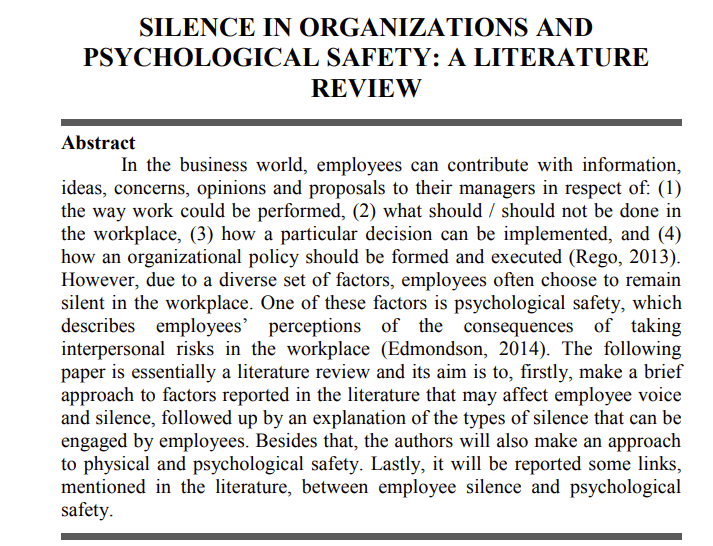
What is the relationship between different types of employee voice and silence, and how are these influenced by psychological safety?
This systematic review may interest you – as it explored those questions.
Not a summary, as you can read the full paper via the link.
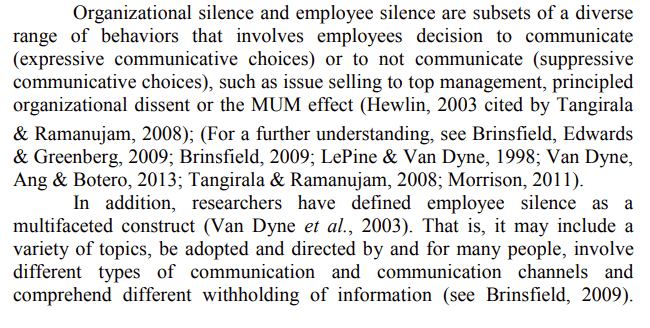
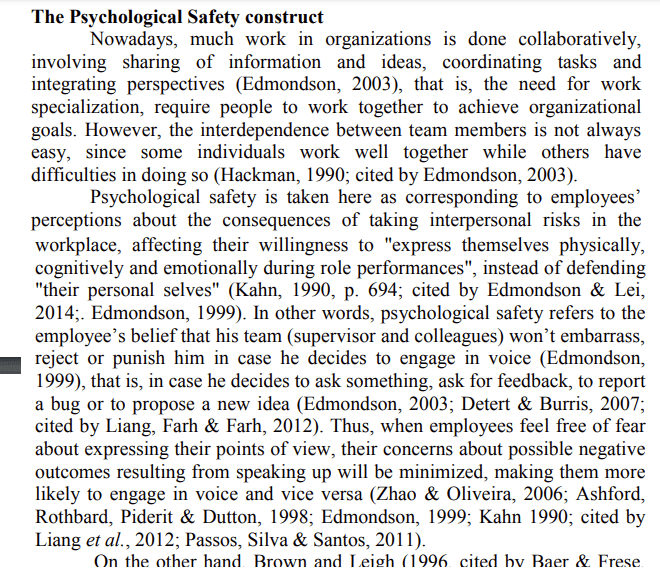
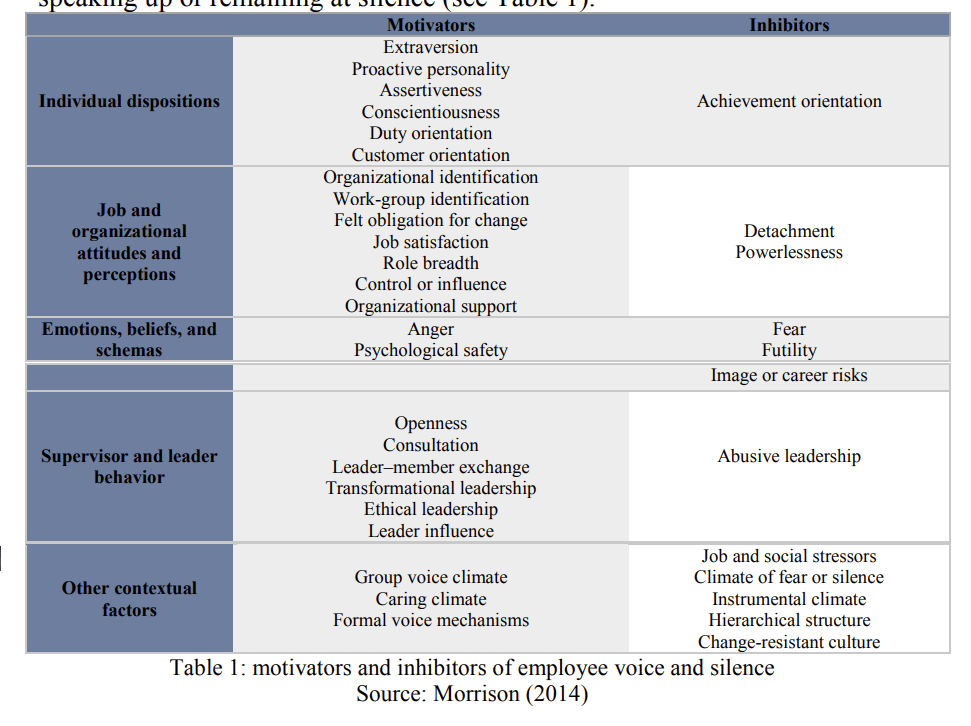
First, they identified several motivators and inhibitors of employee voice and silence, including:
· Individual dispositions
· Job and organisational attitudes and perceptions
· Emotions, beliefs, and schemas
· Supervisor and leader behaviour
· Other contextual factors
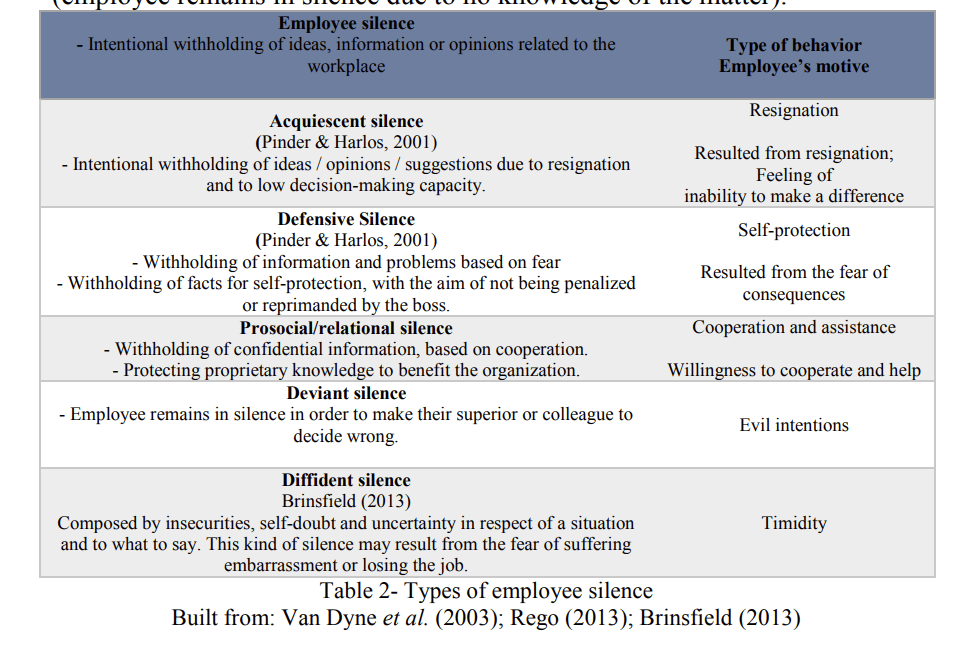
They also identify different type of employee silence, being:
· Acquiescent silence
· Defensive silence
· Prosocial/relational silence
· Deviant silence
· Diffident silence
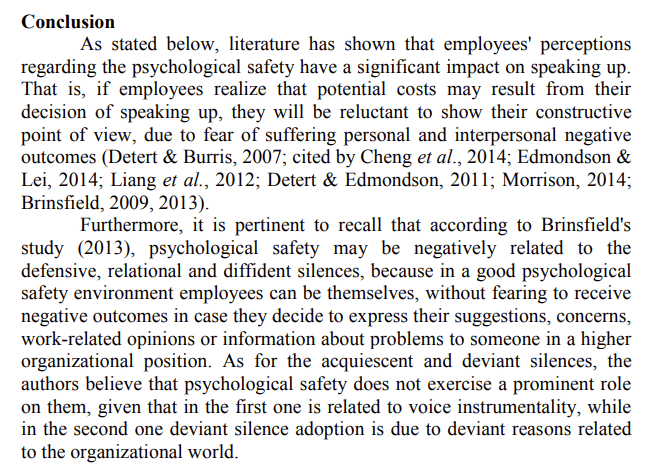
They argue that psychological safety may be negatively related to defensive, relational and diffident silences because “in a good psychological safety environment employees can be themselves, without fearing to receive negative outcomes in case they decide to express their suggestions, concerns, work-related opinions or information about problems to someone in a higher organizational position”.
The authors don’t believe that psychological safety isn’t prominently related to acquiescent and deviant silences.
Ref: Pacheco, D. C., Moniz, A. I. A., & Caldeira, S. N. (2015). Silence in organizations and psychological safety: a literature review. European Scientific Journal, (Special Edition), 293-308.
Study link: https://repositorio.uac.pt/bitstream/10400.3/3725/1/6156-17924-1-PB.pdf
Other posts on silence/voice:
- https://safety177496371.wordpress.com/2022/10/21/the-asymmetry-of-voice-silence-or-the-sounds-of-silence/
- https://www.linkedin.com/pulse/staying-silent-safety-issues-conceptualizing-silence-ben-hutchinson
- https://www.linkedin.com/pulse/making-soft-intelligence-hard-multi-site-qualitative-study-ben
- https://www.linkedin.com/posts/benhutchinson2_what-factors-prevent-senior-executives-from-activity-7173061372530814976-KksX?utm_source=share&utm_medium=member_desktop

 SafetyInsights.org
2 thoughts on “Silence in organizations and psychological safety: a literature review”