This post continues material from the CIEHF’s manual on ‘Human factors in barrier management’.
The next set of concerns the authors have with how barriers are constructed, and the role of people perceived is that:
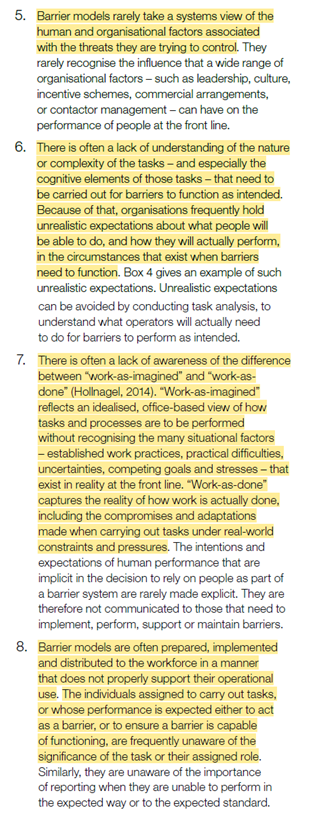
5. Barrier systems rarely take a systems view of human and organisational factors that influence barrier performance
6. The cognitive elements of tasks are rarely considered and hence, organisations hold unrealistic expectations of what people will or won’t recognise or do, what they will or won’t assess, nor “how [people] will actually perform, in the circumstances that exist when barriers need to function”
7. There’s often a lack of awareness between WAI and WAD, where WAD “captures the reality of how work is actually done, including the compromises and adaptations made when carrying out tasks under real-world constraints and pressures”
Hence, “The intentions and expectations of human performance that are implicit in the decision to rely on people as part of a barrier system are rarely made explicit”
8. Barrier models are often developed as paperweights, constructed separately to the people expected to use them, nor properly communicated and consulted with
The authors continue their arguments on why “human error” isn’t useful as a threat to barrier integrity, nor top events. Further, the spectrum of performance variability is necessary in order to understand performance in a complex system.
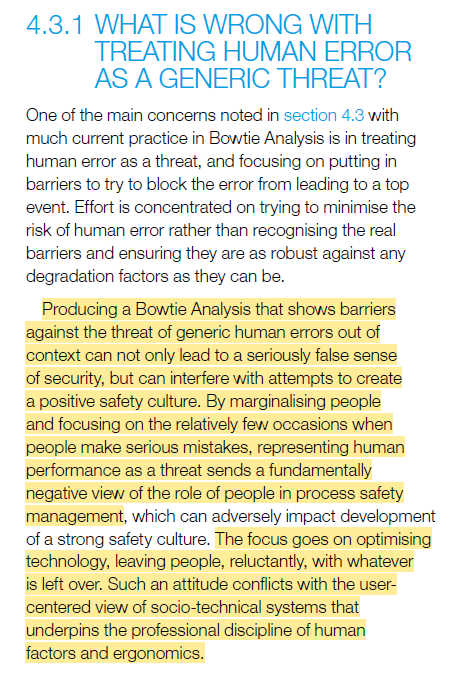
They suggest that too much focus goes into trying to micro-manage performance, sending a negative message of their role in creating safe performance.
Moreover, there’s a risk that “The focus goes on optimising technology, leaving people, reluctantly, with whatever is left over. Such an attitude conflicts with the user-centered view of socio-technical systems”.
And, most importantly, this approach “misses the opportunity to build flexibility and adaptability into systems through a deeper understanding of the ways people contribute to resilience and avoid undesirable consequences”.
Image 3 shows an example, from their perspective, of how performance expectations should be articulated for a barrier – including human-centred considerations.
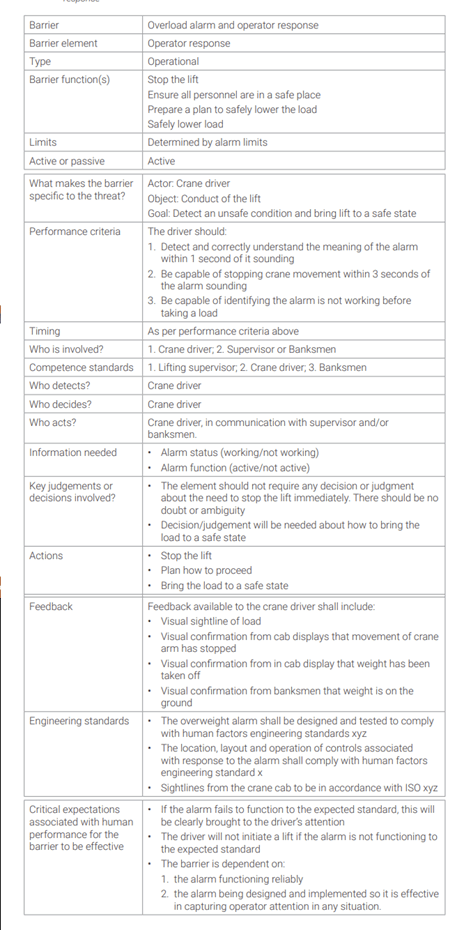
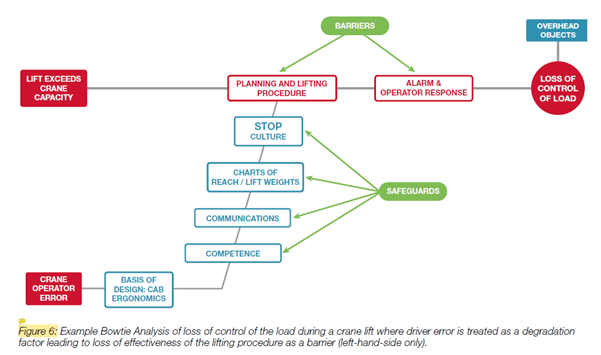
Image 4 shows a sample bow tie using their thinking. I’m still not entirely convinced of the performance considerations (particularly from, say, FRAM or cognitive work analysis); but it is what it is.
Link to post 1:
Refs:
Human factors in barrier management. Chartered Institute of Ergonomics & Human Factors, 1-64. 2016
Study links:
https://ergonomics.org.uk/asset/A2F56D6D%2D6D62%2D4C0F%2D9BCAC72AB8888637/
LinkedIn for post 1: https://www.linkedin.com/posts/benhutchinson2_what-is-the-role-of-people-in-creating-safety-activity-7185749634642817025–sko?utm_source=share&utm_medium=member_desktop

 SafetyInsights.org
One thought on “Human performance and barrier thinking part 2”