This study analysed 10 years of serious and fatal incident investigation reports from four international construction companies to:
i) Assess the reliability of their Critical Controls (CCs)
ii) Assess the factors that affect the reliability of CCs
I’ve skipped a lot – so check out the full paper.
Providing background:
· The authors in a prior paper proposed that the construction industry should focus more on risk treatment and applying a CC approach to preventing fatalities, and learn from similar programs in oil & gas and mining
· CCs are “specific safety barriers, which (i) directly prevent the unplanned release of energy, which cause major accident events, (ii) directly prevent the escalation of event consequences or (iii) are unique controls within an event pathway event”
· Several factors influence the reliability of controls, including organisational psychological mechanisms (e.g. confirmation bias, normalisation of warnings, group think/consensus)
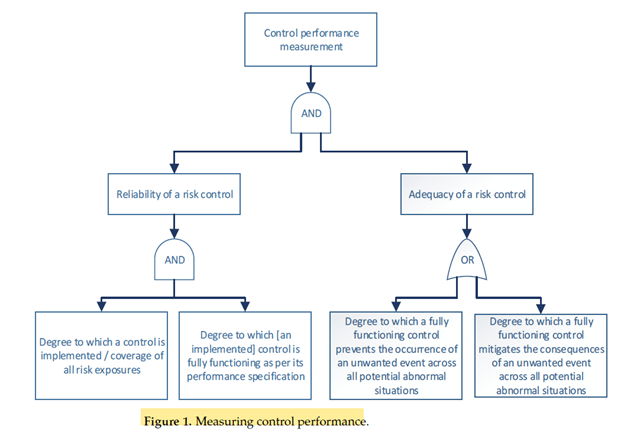
· Prior work identified control performance as a product of reliability in the control to perform within the work environment and the adequacy of the control to prevent or mitigate unwanted events
· Based on regulatory data, its highlighted that between 85 to 90% of construction fatalities “are events occurring from common high-risk activities, where controls that prevent the incident are defined within organization safety management systems, but still result in single to two-person fatalities”
· And these fatalities “continue to be caused by the same high-risk activities and hazards due to
· failures in control reliability and less from novel or abnormal situations, where they are not
· defined or are inadequate in preventing the novel events conditions”
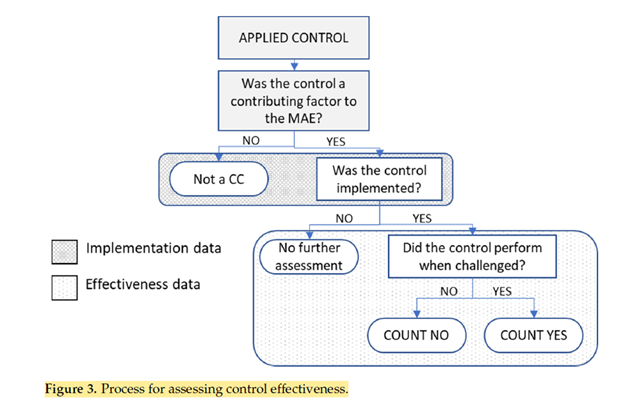
· They argue that “In the simplest form, the effectiveness of a risk control is the ratio of the number of failures of the control when challenged to the number of occasions the control was challenged”
· Control reliability is also a factor relating to the type of barrier being used and the “interdependency on human action and the effectiveness of the safety management system supporting the reliability of the barrier”
· Their process for measuring and assessing control performance are shown below – check out the paper for the full description
Results
Based on the sample, 186 serious and fatal event investigation reports were collated between 2011 – 2019.
The most frequent major accident events (MAE) included driving interactions, lifting operations (dropped load), uncontrolled energy release, and falls due to access/egress from plant or unstable ground.
CC performance measures
Implementation of CCs across all MAE categories was found to be an average of just 57% (but with considerable variation).
Hence, just 42% of CCs were assessed as implemented and effective on average.
Effectiveness of CCs when implemented averaged 41%.
When implementation and effectiveness were assessed by MAE, mobile equipment and lifting operations had the strongest CC implementation rate. Stored energy had the lowest implementation rate overall.
Below highlights average control performance.
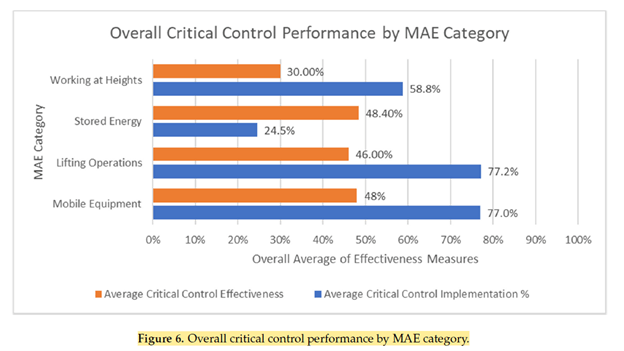
Engineering controls had the strongest rate of implementation, and engineering and administrative procedural CCs had similar effectiveness ratings. Engineering controls have greater monitoring by field construction personnel as part of monitoring integrity, so hence they tend to be better implemented.
While stored energy CCs consistently rated lower than other MAEs for implementation, they delivered a higher rate of effectiveness.
In summary:
· “All four major-accident event categories were found to have a high proportion of weakly or not implemented Critical Controls and, therefore, were not effective in preventing the release of hazardous energies”
· The CCs that were rated as ‘weak’ (indicating <50% reliability), were considered unreliable as they “failed more times than the CC was effective”
· When considering all of the findings, “the CCs that had a high reliance on human performance (e.g.,
· operating plant and vehicles, inspections, maintaining exclusion zones) had a higher rate of failure … which aligns to hierarchy of control principles”.
Authors: Selleck, R., Hassall, M., & Cattani, M. (2022). Determining the reliability of critical controls in construction projects. Safety, 8(3), 64.
Study link: https://doi.org/10.3390/safety8030064
LinkedIn post: https://www.linkedin.com/pulse/determining-reliability-critical-controls-projects-ben-hutchinson-9bmuc

 SafetyInsights.org
One thought on “Determining the Reliability of Critical Controls in Construction Projects”