What can moles & birds teach us about why organisations struggle to learn the contextually relevant lessons and prevent major accidents?
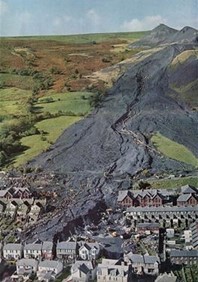
A 1966 accident provides insights. A huge mining spoil tip collapsed (~33 m tall & 229k cubic meters), following heavy rain. The spoil tip was located on a mountain slope next to the Welsh town of Aberfan. The resulting slurry avalanche struck a school and houses; killing 116 children and 28 adults.
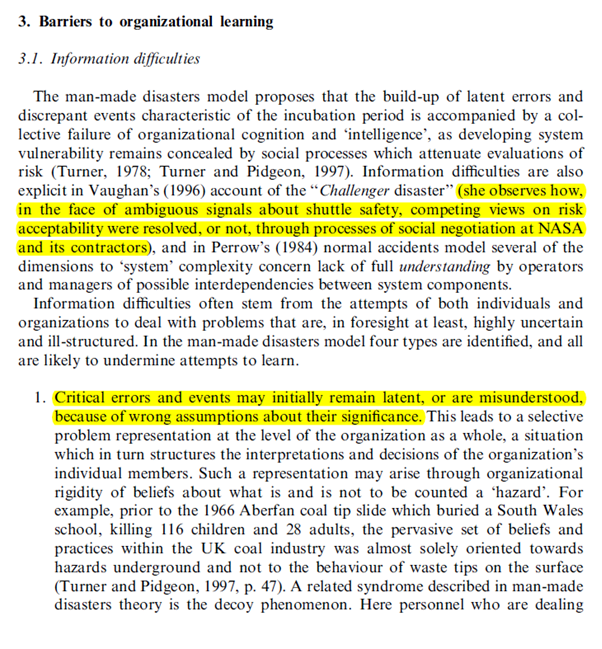
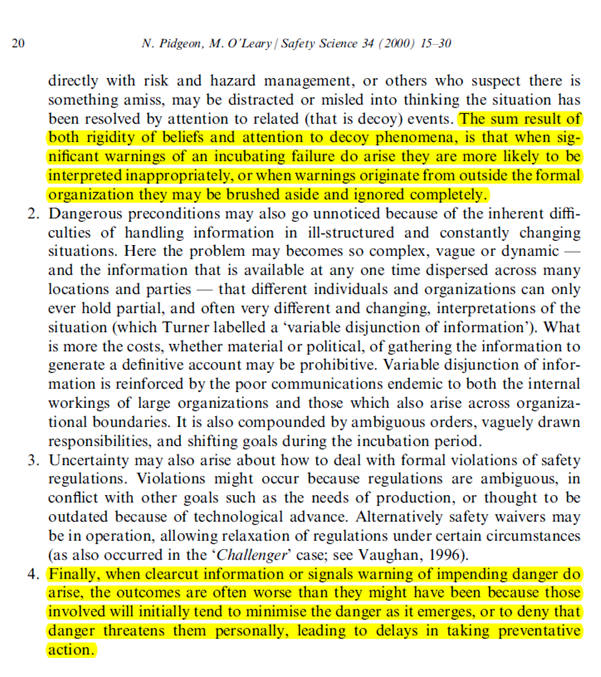
Pidgeon & O’Leary (2000, Safety Science, 34), drawing on Barry Turner’s man-made disaster theory, provide context on how organisations can become blind to these types of danger (see attached images).
I don’t want to cover all of these factors, but one notable factor was that the mining industry at the time were noted to be almost exclusively focused on underground hazards rather than above-ground; that is, large piles of spoil above ground were essentially invisible as safety concerns.
It’s not that the organisation didn’t care about safety – it did – but in hindsight wasn’t focusing on the critical factors that led to this particular disaster. Turner, in part, explained this is a ‘perceptual horizon’ (which describes the things that are seen as important or significant to individuals and organisations) and ‘decoy phenomena’ (which describes how organisations when attending to certain issues or hazards are distracted from other more relevant issues or misled into believing that the issue has now been resolved; issues act as decoys from other more pertinent issues relating to that failure – usually known in hindsight).
Vaughan (1996, p.394) also commented on a similar phenomenon in the origins of the Challenger shuttle accident, noting that NASA’s routines and cultures “created a way of seeing that was simultaneously a way of not seeing”.
The Aberfan tribunal (1967, p.48) provides a poetic example of how organisations, in trying to do the right thing, can be become largely blind or misled to their exposure to significant failure:
“We found that many witnesses… had been oblivious of what lay before their eyes. It did not enter their consciousness. They were like moles being asked about the habits of birds.” (emphasis added)

Ref: Pidgeon, N., & O’Leary, M. (2000). Man-made disasters: why technology and organizations (sometimes) fail. Safety science, 34(1-3), 15-30.

Link to the LinkedIn post: https://www.linkedin.com/posts/benhutchinson2_what-can-moles-and-birds-teach-us-about-why-activity-6902737418483585025-wyZR?utm_source=share&utm_medium=member_desktop

 SafetyInsights.org
One thought on “Mini-post: Moles, birds and major accidents: The story of Aberfan”