Oof, this is a tad awkward for the conspiracy movements.

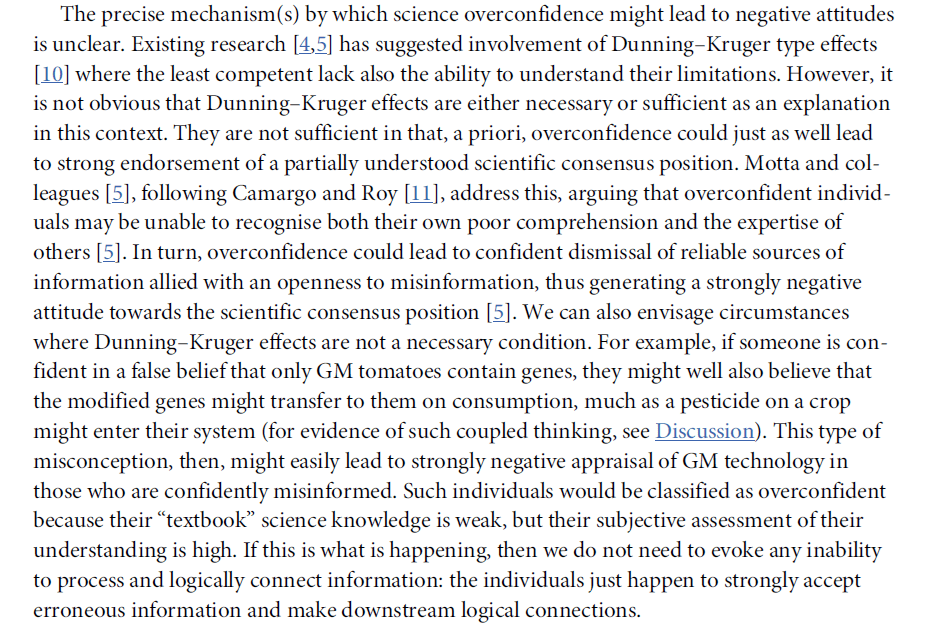
This study found that people with more negative attitudes and trust towards science were more likely not to actually understand the science (in this case, genetically modified foods).

Key findings:
- People with strongly positive or negative attitudes towards genetics more strongly believe that they well understood the science
- However, only those positive towards science was their self-confidence actually warranted
- That is, people who were self-confident on their knowledge but negative towards science didn’t understand the science
- The Dunning-Kruger effect is likely neither “necessary or sufficient as an explanation in this context”
The study is open access so you can read it for yourself.
Of course, there’s several notable caveats and limitations.

If you’re interested in this type of research, I’ve linked to several other studies in the comments exploring how people who follow a conspiracy movement of “do-your-own-research”, were more likely not to understand the research, and some other research on the spread of mis- and dis-information on the internet.
Ref: Fonseca, C., Pettitt, J., Woollard, A., Rutherford, A., Bickmore, W., Ferguson-Smith, A., & Hurst, L. D. (2023). People with more extreme attitudes towards science have self-confidence in their understanding of science, even if this is not justified. PLoS Biology, 21(1), e3001915.
Study link: https://doi.org/10.1371/journal.pbio.3001915
My site with more reviews: https://safety177496371.wordpress.com
Other conspiracy/mis-information studies:
3. https://www.linkedin.com/pulse/dark-triad-covid-19-vaccine-hesitancy-role-conspiracy-ben-hutchinson

 SafetyInsights.org
One thought on “People with more extreme attitudes towards science have self-confidence in their understanding of science, even if this is not justified”