This was a brief discussion paper about why people don’t always follow rules, but from the perspective of healthcare practitioners within the NHS.
The findings themselves aren’t new or unique to healthcare but it’s good to see the perspective of the people that are required to follow all of the guidelines.
I think many of us will recognise the same factors within our organisations, in some form.
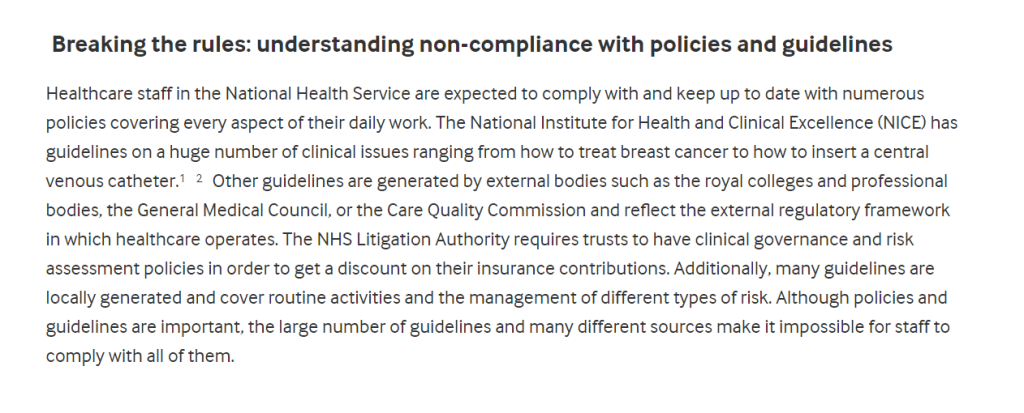
First the sheer volume of guidelines and multitude of guidelines from different sources “make it impossible for staff to comply with all of them” (p1, emphasis added).
Highlighting the volume, authors identified between 192 – 457 guidelines/policies on the intranets of three central London NHS acute trusts.
Noted is that in addition to these trust specific guidelines, staff are required to understand & comply with local, professional & governmental policies & guidelines.
They give an example of an elderly patient admitted for emergency surgery for a fractured femur, noting that an estimated 75 clinical guidelines & trust-wide policies cover the various stages of management.
A second example considers a clinical director of anaesthetics who wants to ensure clinical staff are aware & compliant with relevant guidelines, finding 21 organisations that publish guidelines related to anaesthesia.
They estimate guidelines/policies cover 80 different topics with >4,000 guidelines buried in complex websites, saying that “the complexity of the current system makes it difficult for a clinical director of anaesthesia to find all relevant policies and guidelines, still less to disseminate and implement them … Full compliance is in practice impossible“ (p2, emphasis added).
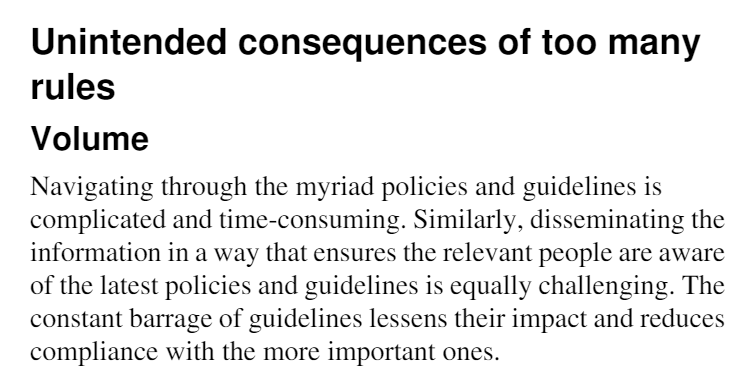
Authors then discuss the unintended consequences of too many rules.
The complicated & time-consuming process of navigating through the myriad of policies makes it difficult to make sure people are aware of the latest revisions, stating that “The constant barrage of guidelines lessens their impact and reduces compliance with the more important ones” (p2).
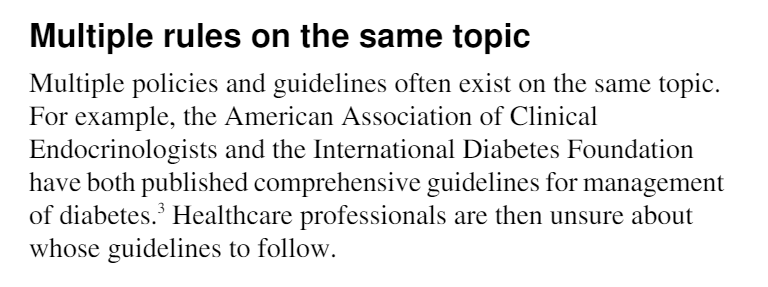
Also discussed are the multiple rules on the same topic which often exist, e.g. the management of diabetes, leaving healthcare professionals “unsure about whose guidelines to follow” (p2).
Naming & accessibility of policies are another issue. Some are located on hospital intranets while others on specific department drives. These locations assume that staff have easy access to computers (which may not be the case) and importantly requires them to know the name of the policy they are searching for & where to find it. Authors assessed operating theatres and found that very few of the staff knew that the policies were stored on a separate “J drive”.
Obscure wording of some policies was also problematic, citing the example of an “Acceptable Use Policy” and asking what do you think its purpose is? Acceptable use of what? This seems to be widespread.
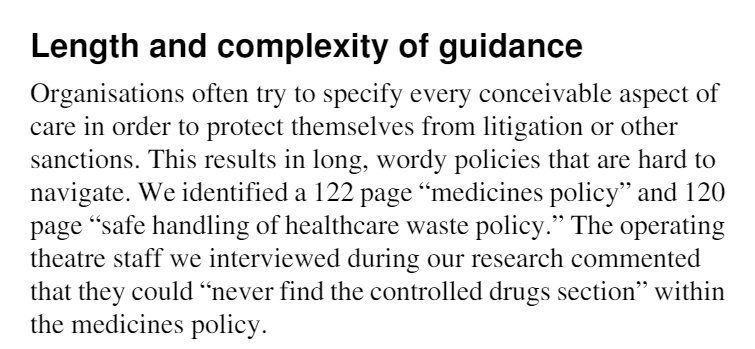
Another issue is the length & complexity of guidances. In attempts to try & specify every conceivable aspect of care in order to protect themselves from litigation, it results in lengthy policies that are hard to navigate.
They cite examples of a 122 page “medicines policy” & 120 page “safe handling of healthcare waste policy”. The op theatre staff that were questioned said they could never find the “controlled drugs section” within the medicines policy.
Another issue was too many trivial policies. These were said to be created as a knee jerk reaction to a specific incident. Examples including the wearing of crocs in theatres, how to answer a telephone & how to politely meet & greet visitors to the hospital.
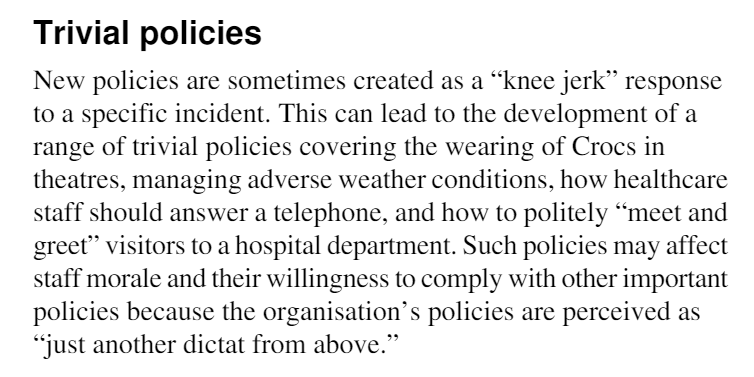
Authors say that “Such policies may affect staff morale and their willingness to comply with other important policies because the organisation’s policies are perceived as “just another dictat from above” (p3).
Finally, version control was another lingering issue. An example of a recent report into an accidental death noted that a more detailed protocol was available than was used during the work leading to the death, but didn’t give the name or location of the critical document.
In moving forward, the authors argue that the length, complexity, accessibility, volume & lack of consultation with healthcare professionals (when writing/reviewing guidelines) makes it difficult for them to follow all critical guidelines.
Despite these issues, “many employers will discipline staff for non-compliance if a patient is harmed”.
They argue that more reliance on human factors research & practice is needed to develop usable policies that support rather than burden staff. The more prescriptive the rules are that are imposed on workers, the less likely they are to be complied with.
Also noted is that people are naturally adaptable and tend to improvise, “which makes some non-compliance inevitable” [and noting that the adaptation is often necessary to navigate around time/resource blocks].
Authors: Jane Carthey, Susannah Walker, Vashist Deelchand, Charles Vincent, William Harrop Griffiths, 2011, BMJ
Study Link: https://doi.org/10.1136/bmj.d5283
Link to the LinkedIn article: https://www.linkedin.com/pulse/breaking-rules-understanding-non-compliance-policies-ben-hutchinson

 SafetyInsights.org