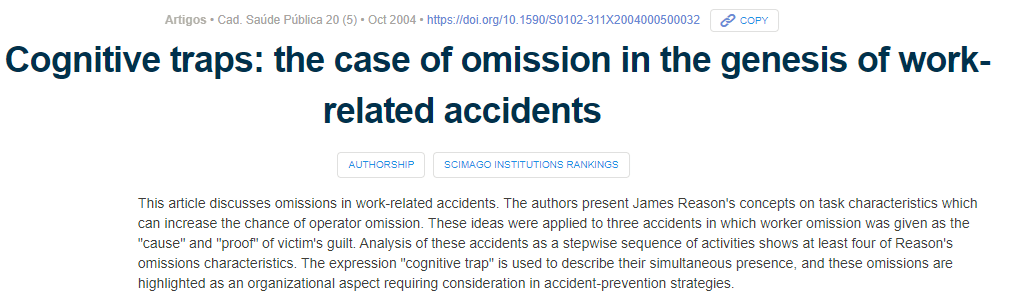
This study unpacked three workplace events, comparing each organisation’s investigation report to the researcher’s own evaluation from a cognitive trap (error trap) perspective.
Note: I translated this from Portuguese via Google, so there could be mistakes.
Providing context they note:
· Criticism has emerged against “concepts that presuppose the existence of direct relationships between failures, inappropriate behaviors or human errors, and accidents in the workplace”
· Modern constructions of accident causality tend to adopt more systemic views that go beyond the psychological aspects of the individuals involved in the event
· They note that prior work, like that from Reason, defined an error as a “generic term that encompasses all those occasions in which a planned sequence physical or mental activities fails to achieve a desired result and when these failures cannot be attributed to chance”
· Reason introduced the idea of both active and latent factors
· They also observe the delineation, from this perspective, from types of ‘errors’ and ‘voluntary deviations’, which Reason referred to as violations
· It’s said that while error refers to an individual’s cognitive processes, violations refer to “external, socially defined norms and standards”
· They argue that violations “must also be approached as special types of errors, whose origins need to be analyzed with a view to identifying latent conditions that gave rise to them”
· Some have criticised the notion of violations, like Dekker who argued it is a value-laden judgement [** I also dislike the term]
· Moreover, over a large number of adverse events it’s said to be difficult to distinguish what is intentional and what isn’t [** Moreover, many workarounds are intentional, but for good reasons]
· They talk about other conceptualisations in this space like performance variability, which centres more on the systemic and cognitive dimensions; where the work context is rather seen as dynamic and variable
· Drawing on Reason et al., it’s noted that human performance isn’t a separate and isolated function of human psychology, but connected to the environment, which can then influence cognitive processes and the probability of omissions
· Resultingly, Reason et al. argue that several factors increase the probability of omissions,
a) task steps or activities that carry a high information load, especially relating to immediate memory,
b) steps or objects that are out of sight or inaccurate,
c) steps triggered by weak or ambiguous signals,
d) functionally isolated steps in the previous example,
e) steps that follow the main objective of the task (e.g. once the core task is completed, steps that follow may be omitted),
f) steps that are repeated,
g) change in relation to routine,
h) steps following interruption
· These effects may also combine in unexpected or combined ways
· They state that “activities that include more than one of them were called by Reason an “error trap”; this study uses the term ‘cognitive traps’
· In practice, investigations “almost always” result in attribution of blame or responsibility to the worker for missing something
I’ve skipped the detailed descriptions of each case study.
Results
Case 1:
This involved a fatal fall from an elevator. The opening and closing of the door was manual and didn’t have a device to block elevator function if the door was open.
When leaving the elevator for the platform, a worker didn’t close the door, which collided with the platform.
Quoting the paper, during the company’s investigation “it was found that, for the company, the “cause” of the accident had been the omission of the injured party, now deceased: “it was he who he didn’t close the door”.
Case 2
This event occurred during the removal of part of a universal plate from a lathe during maintenance. During the activity a pipe from outside the lathe fell and struck the maintenance worker’s hand.
According to the company’s investigation “the failure to place the fixing pipe was the “cause” of the accident, which consisted of the plate falling inside the lathe, hitting the worker’s hand”.
A production inspector also shouldn’t have participated in the task.
Case 3
This accident occurred while a technician was carrying out maintenance on a large milling machine. The company’s investigation noted that the accident “would have been “caused by an unsafe act carried out by the injured party”, which omitted steps from the prescription”.
Interpretation of cognitive traps
The authors argue that each of these investigations blamed the workers when each had cognitive traps embedded within the work.
In the first case, they say that closing the elevator door constituted a functionally isolated step from the previous steps, e.g. opening the door. Hence, closing the door doesn’t extrinsically “warn” that it must be closed”.
The task of closing the door was said to be “barely visible and triggered by a weak signal” [* I think that’s what they were saying, it’s sometimes difficult to know given the translation].
Based on Reason’s work, the visibility and sequence of work steps are intertwined, such that the presence of the open door “in itself, does not make visible the next step – closing it –, which depends on the worker remember that it does not close automatically”.
Moreover, only very old elevators have this manual feature, which is a change in relation to travel routines that people normally have with elevators.
Further, the omission occurred during another task (walking) to the intended location, which based on cognitive processing demands, “tends to mobilize the worker’s attention towards the activity he or she must perform”.
Finally, closing the door “has no relation to its main objective, with greater capacity to capture your attention”.
In the second case, they list several features which favoured the omission, like the falling pipe being outside the lathe’s body and barely visible, the pipe placement had no functional relationship with the previous step.
Removing the plate was also said to have been a different practice compared to usual.
The task was associated with more than one step, whose characteristics were cognitively demanding; which they described as an embedded cognitive trap.
In the third case, they highlight that the worker was performing activities that he wasn’t familiar with; a “factor highlighted as [one] of the most powerful error-provoking [conditions]”
Also the functioning of the mill during the maintenance was unexpected, which “corresponds to what Dekker calls automation surprise”. Automation surprise is where the system does something unexpected by the user.
This usually appears in the presence of many factors in the following circumstances:
a) the system acts without immediate prior user input (e.g. it functions with programmed logic),
b) the system offers little feedback about its behaviours (or provides more feedback about the way or state you are in rather than what you are trying to achieve),
c) new situations.
They also found that the step of turning off the machine wasn’t functionally connected with the previous step of activating the control of manual advance. The machine also didn’t “provide feedback on unobeyed commands. Under these conditions, only prior knowledge of the machine’s characteristics could protect the worker”.
They also propose that in any of the three cases, interruption by a colleague or other unexpected factor, as well as excessive time pressure could have increased the chance of omission.
Conclusion
In all of the three cases, it “appears that the initial approaches of company professionals refer to the victims’ behaviors to attribute blame to them”, where this was more evident in case 2 where “the victim “confessed” to the omission”.
They argue that the lack of consideration of the contextual factors made stem, in part, from the difficulties in approaching the “human dimension of sociotechnical systems”.
They recommend that the perimeter of analysis be widened. They also argue that “in the case of omissions, approaches focused in the behaviors and/or errors of workers offer little or no contribution in terms of prevention, since they tend to leave the conditions that give them untouched”.
Authors: Binder, M. C. P. (2004). Cognitive traps: the case of omission in the genesis of work-related accidents. Cadernos de Saúde Pública, 20, 1373-1378.
Study link: https://doi.org/10.1590/S0102-311X2004000500032
My site with more reviews: https://safety177496371.wordpress.com
LinkedIn post: https://www.linkedin.com/pulse/cognitive-traps-case-omissions-genesis-work-accidents-ben-hutchinson-yzkfc

 SafetyInsights.org
2 thoughts on “Cognitive traps: the case of omissions in the genesis of work accidents”