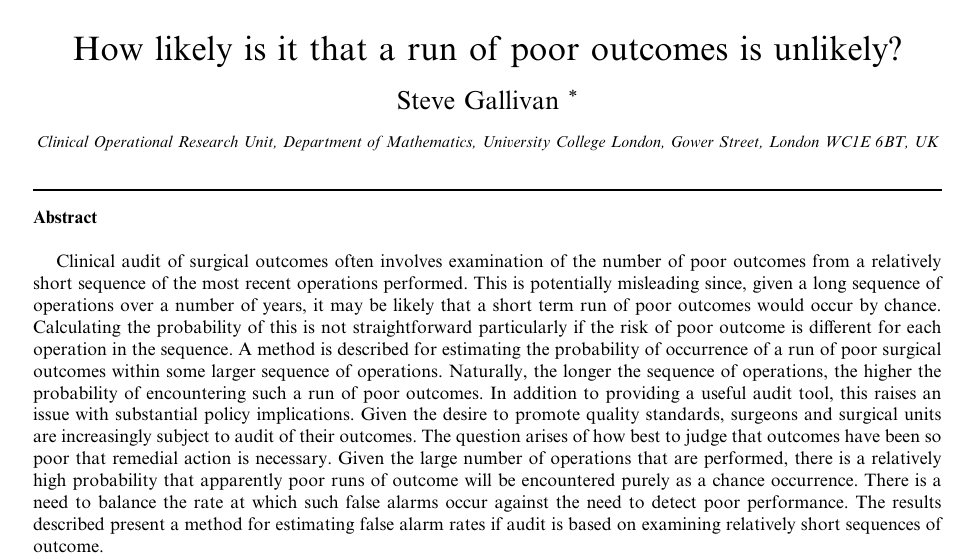
I found this paper interesting – it evaluated the likelihood of a run of poor outcomes (mortality during surgery).
Although it focuses on surgery, I think we could take lessons from the probabilities about runs of incidents in any other industry (e.g. construction incidents) – and the problem of knee-jerk reactions to statistical random variability (** welp, our MTIs have increased from 3 last month to 5**).
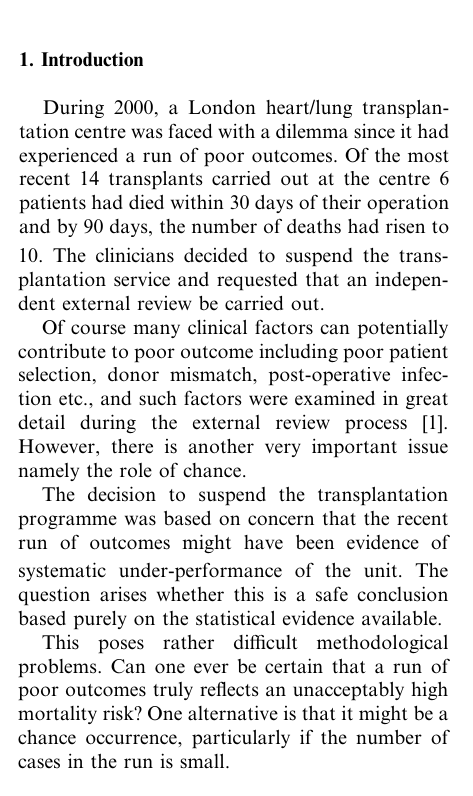
Key findings:
· The first graph shows the results of 5 deaths out of 14 operations. At 12% (comparable to 30-day mortality for heart transplant surgery), there’s a 50% chance that a run of 5 deaths out of 14 would occur within a sequence of 181 cases
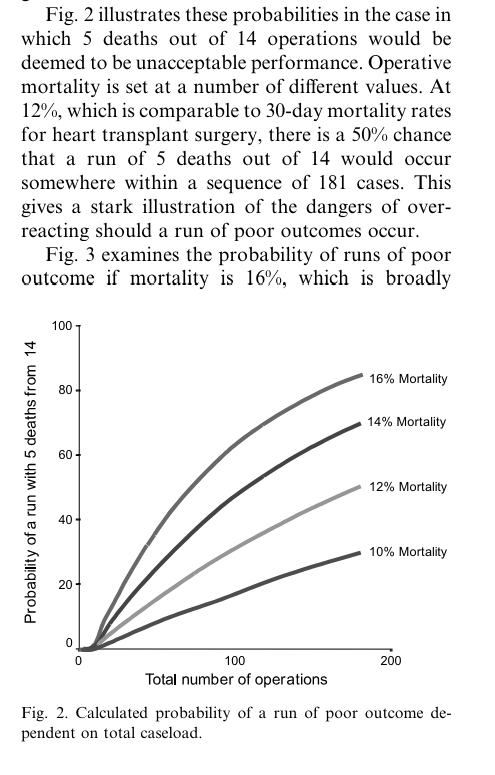
· This finding “gives a stark illustration of the dangers of overreacting should a run of poor outcomes occur”
· If mortality is 16% (comparable to 90-day mortality), then a run of 7 deaths out of 14 has a 15% probability of occurring from 181 operations; which they say “This is approximately the probability of throwing a six when playing dice––hardly unusual”
· Moreover, “the probability declines rapidly the larger the number of deaths and a sequence of 14 cases with 10 deaths is very unlikely to have occurred as a chance event”
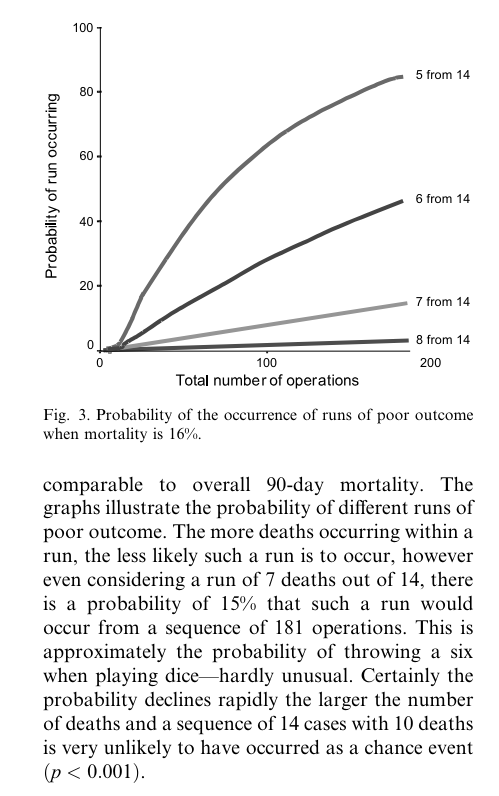
· They argue that “Clinical audit of surgical outcomes often involves examination of the number of poor outcomes from a relatively short sequence of the most recent operations performed. This is potentially misleading since, given a long sequence of operations over a number of years, it may be likely that a short term run of poor outcomes would occur by chance”
· For types of surgery like transplantation, with “relatively high mortality, it is natural to expect such runs to occur from time to time. This creates a dilemma for those who oversee quality standards in surgery. If a surgical unit, or indeed an individual surgeon, is experiencing a short term run of poor outcomes, should their operations be suspended until an independent review can be carried out?”
· In contrast, suspending surgery to investigate “may lead to an increase in the number of patients dying while on the waiting list”
Of course, nothing particularly new with this in the industrial sense – the quality and engineering folks have been calculating failure rates for many years…
Ref: Gallivan, S. (2003). How likely is it that a run of poor outcomes is unlikely?. European Journal of Operational Research, 150(1), 46-52.
Study link: https://doi.org/10.1016/S0377-2217(02)00780-4
My site with more reviews: https://safety177496371.wordpress.com

 SafetyInsights.org
One thought on “Chance of runs of workplace accidents: How likely is it that a run of poor outcomes is unlikely?”