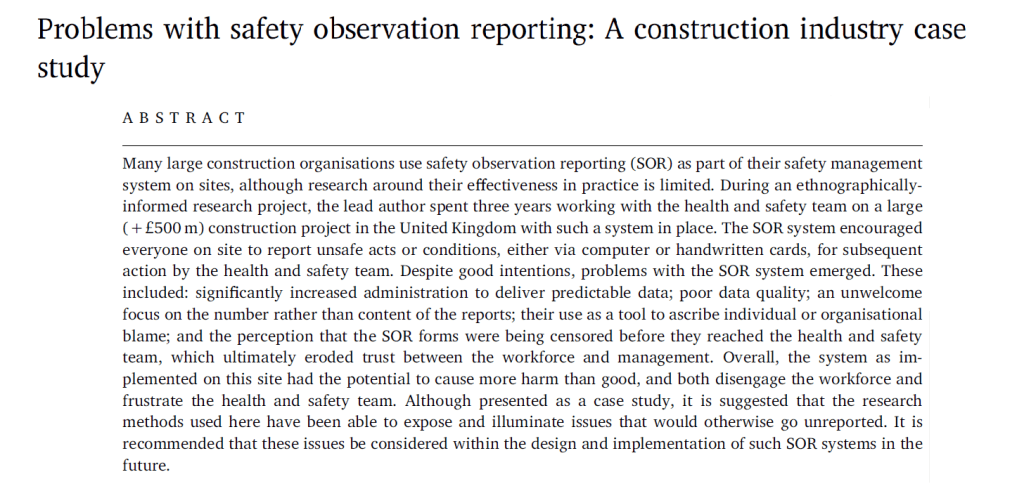
This 3-year ethnographic study had the lead researcher embedded within the safety team on a large UK construction project as part of a larger project. In this study, the use and limitations of the safety observation reporting (SOR) system was discussed (the system for reporting safety issues or observations via computer or handwritten cards).
N.B. I love ethnographies and the richness of data in this study is a perfect example why. The richness is also why I don’t summarise more ethnographies or qualitative studies (or S-II/resilience engineering research) – it just takes so much time.
First some existing issues with SOR were covered. These included:
· Problems with overreporting where set targets become the unit of management, where it’s noted “despite the obvious temptation for those responsible for delivery of these quotas to actively seek out (and even produce) any shortfall” (p37)
· Debates about whether the aim for SOR should be more or fewer near miss reports
· A culture of blame from reporting where disciplinary actions are focused in individuals rather than improvements from the organisation
· Admin burden from all the reporting and a process of filtering of the data
· Criticisms of how well the SOR represents reality, amplified by confusion about what could and should be reported where some types of hazardous conditions are underreported creating an “unconscious bias within the reporting system” (p37)
· On the above, a focus directed towards reporting and fixing what is easy observable and fixable and which also directs more focus towards lower hierarchy of control actions (eg solving the easy to fix problems rather than the important but harder to see problems).
Results:
1. SOR reporting may providing a lack of useful insights
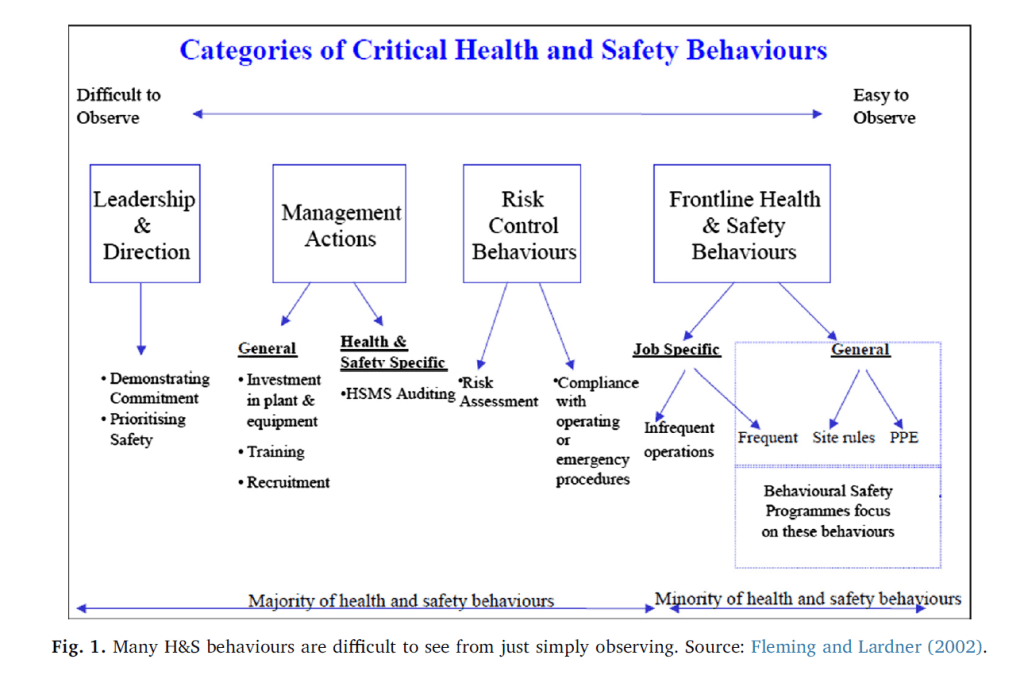
Found from the SOR data was a pronounced focus on the easily observable “frontline health and safety behaviours”, being things like access egress, housekeeping, PPE, work at height and traffic management.
They highlight the image below, indicating that SOR typically focuses on the easy to observe worker behavioural elements, and not so much the upstream elements:
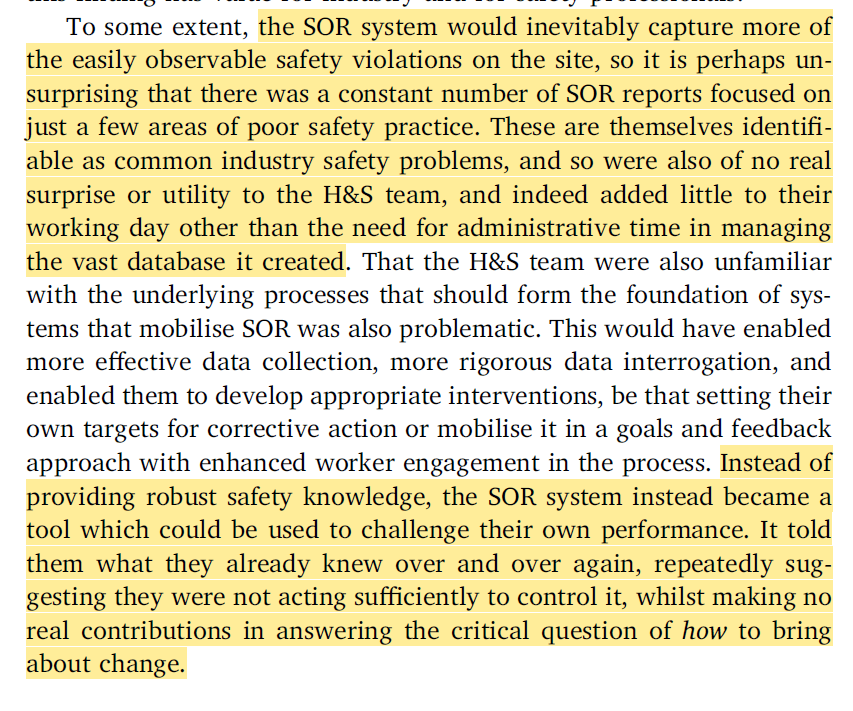
The H&S team indicated that SOR reports were continually the same known issues rehashed over and over. According to the report, H&S team saw the SOR as “not revealing anything new. It simply supported their own professional knowledge, and judgements gained from spending time on the site carrying out their own safety inspections” (p41); and also indicative of basic construction safety knowledge.
The validation of this SOR knowledge was said to have not been welcomed by the H&S team as their time in compiling and analysing the vast SOR dataset “for such little return” wasn’t seen as beneficial when they could reinvest that time in the field tackling the more pertinent site issues.
The SOR process was said to have become a full-time admin job where the “administrative burden of this process was seen as a bureaucratic addition to the wider safety management system, with little relevant contribution to make in practice” (p42). It was seen to lack any significant contribution to the “what next” question, or surface deeper leadership or management issues.
Also notably, the repetition of the SOR reports in those same categories was felt by the H&S to represent their lack of effort to resolving the issues highlighted in SOR. This led to perceptions of blame between the H&S team and project management and external auditors, where the way that unsafety was being measured and quantified within SOR was partially responsible – that is, a continual focus on issues which were already high on the H&S team’s agenda (traffic, heights, PPE etc.) was “more disheartening than helpful” (p42).
2. Hitting the targets
Problems with (formal or informal) target-setting were evident, where the volume of reporting and efforts in SOR was seen to demonstrate that team’s commitment to safety. Indeed, it was used as a symbolic representation to management that they were active with safety. Notable is the belief that “SORs are used as a league table for some Managers, there’s too much pressure on us to do them” (p42). This drive for numbers possibly further reinforced a focus on easily observable categories and the things most familiar to people working on sites.
As a further unintended consequence, some departments didn’t want to be seen to have a lower number of SOR reports compared to others and thus increased their volume & targets, leading to the metrics “gain[ing] more influence than actual practice, and on this site caused the H&S team to become more and more disillusioned with the value and utility of the data coming out of the SOR system” (p42).
Management engagement with the system didn’t have the intended purpose as this had more focus on reporting quotas leading to one person remarking that “numbers don’t mean safety” (p43).
Another interesting element was the symbolism of the SOR system. A belief was that by reporting something, the issue would be resolved once entered into the SOR system. As the authors discussed, the SOR reporting system provides a mechanism of displacing the issue from reality and into the formalised safety system, where a belief existed that the system will now “take care of [the issue]” (p43).
N.B. we also found a similar displacement effect in our study on the problems of safety auditing.
3. Naming, shaming and blaming
Despite best intentions of the SOR to create a communication channel for proactively raising issues, it was seen to be a mechanism for accusing and blaming people. 37% of the SOR reports focusing on unsafe acts identified a person either by name, company or rego of their vehicle.
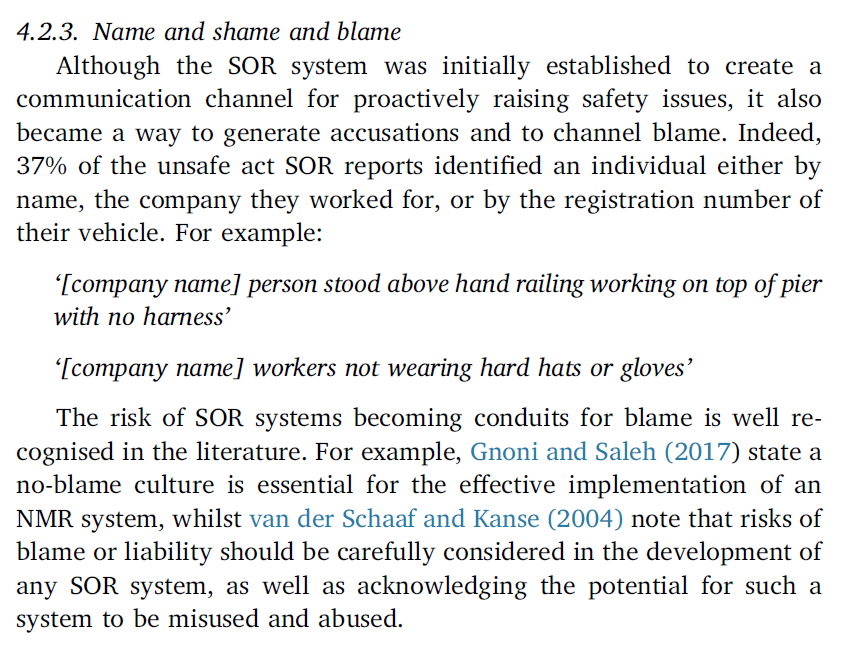
Authors note that SOR and other systems “becoming conduits for blame” is recognised across the literature” (p43). Interestingly, the use of SOR didn’t just stop at blame but rather had become a tool for individuals or companies “to ‘fire shots’ at each other’s safety practice, naming both individuals and organisations”, which ensured blame was appointed (p43). The H&S team was said to be frustrated by the backstabbing which was traceable through the SOR.
4. Trust in the system
Finally, there was a lack of trust and confidence in the system by site personnel – where people doubted the genuineness of management actually wanting open and honest reporting in the system. This resulted in workers worrying about submitting negative SOR cards to their managers or supervisors.
Fear of unemployment was one contributing factor and may have also contributed to the superficial SOR reports, which would protect their own management from implications of safety deficiencies; e.g. few reports on lack of providing safety equipment or time pressures, but rather reports on PPE and other easily observable things.
Another belief was that some believed that handwritten SOR cards were either filtered or just simply discarded by management; a process of vetting or censorship. This was seen to breakdown trust between workers and the H&S team to the validity and relevance of the SOR, but also breakdowns of trust between the workforce and their line management or supervisors.
Authors: David Oswald, Fred Sherratt, Simon Smith, 2018, Safety Science.
Study link: https://doi.org/10.1016/j.ssci.2018.04.004
Link to the LinkedIn article: https://www.linkedin.com/pulse/problems-safety-observation-reporting-construction-case-hutchinson/?published=t


 SafetyInsights.org