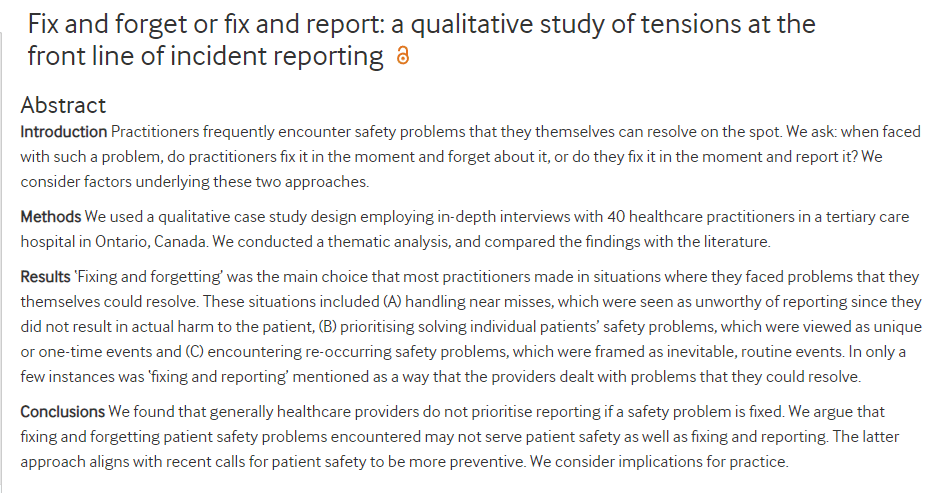
This upcoming study summary, with Tanya Hewitt as lead author, explored how frontline healthcare practitioners resolve issues by either ‘fixing on the spot and forgetting’ or’ fixing the problem and reporting it’ into a reporting system.
In-depth interviews with 40 healthcare practitioners in a tertiary care hospital was undertaken; extending Tucker & Edmondson’s work on first order and second order decision making.
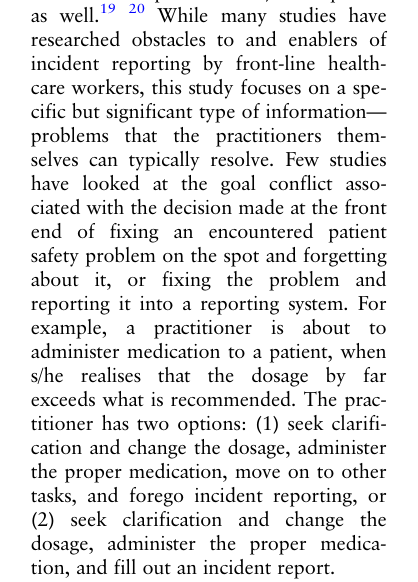
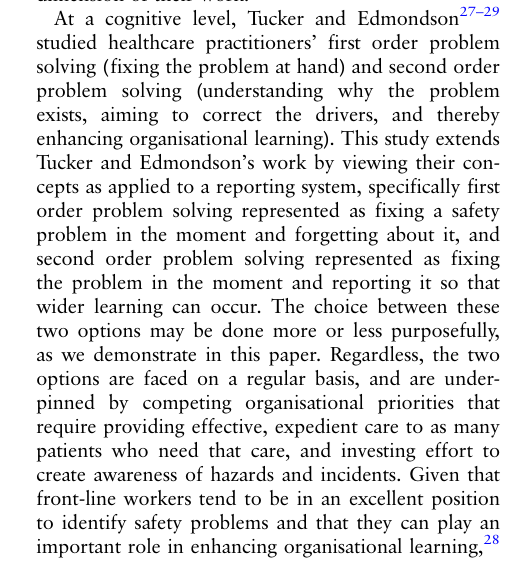
Key findings:
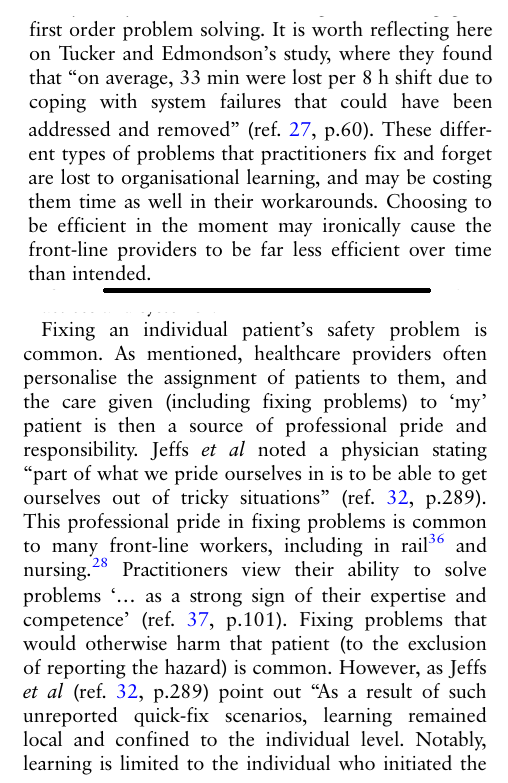
· ‘Fixing and forgetting’ (first order problem solving) was the main choice that most practitioners made when they faced a situation that they could resolve on the spot
· This included:
a) the handling of near misses, which they saw as “unworthy of reporting since they did not result in actual harm to the patient”
b) solved individual patient safety problems, which were saw as unique or one-off problems, inevitable or routine events
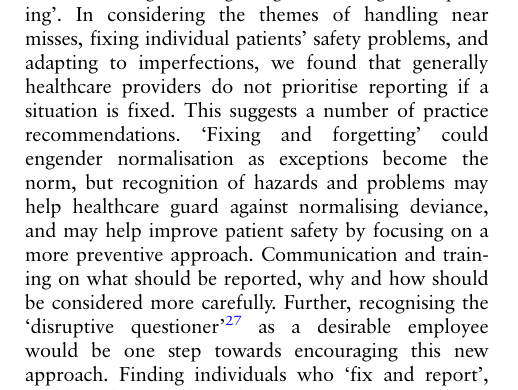
· Generally, healthcare providers in this sample don’t prioritise reporting if a safety problem is fixed, but that “fixing and forgetting patient safety problems encountered may not serve patient safety as well as fixing and reporting”
Three themes were evident on why practitioners decide to fix and forget or fix and report. These are:
1) Handling near misses – The main issue for reporting near misses is the fear that they’d create “overburdening paperwork”, and the “subtext of the patient not being harmed helped justify the decision to ‘fix and forget”. What constituted a near miss was seen to be poorly understood
2) Fixing individual patients’ safety problems – Practitioners prioritised caring for individual patients. Hence, if a problem occurred, the practitioner tended to treat the situation as a one-off
3) Adapting to imperfections – It’s said that “Fixes, or adapting to unfixed problems, can become routinised normal work, and may not be noticed any longer”. A sense of inevitability of issues as daily occurrences was evident; where practitioners need to deal with minor problems daily, as they attend to patients and other duties.
Ref: Hewitt, T. A., & Chreim, S. (2015). Fix and forget or fix and report: a qualitative study of tensions at the front line of incident reporting. BMJ Quality & Safety, 24(5), 303-310.
Study link: https://doi.org/10.1136/bmjqs-2014-003279
My site with more reviews: https://safety177496371.wordpress.com

 SafetyInsights.org
One thought on “Tensions between ‘fixing and forgetting’ or ‘fixing and reporting’ in workplace safety issues”