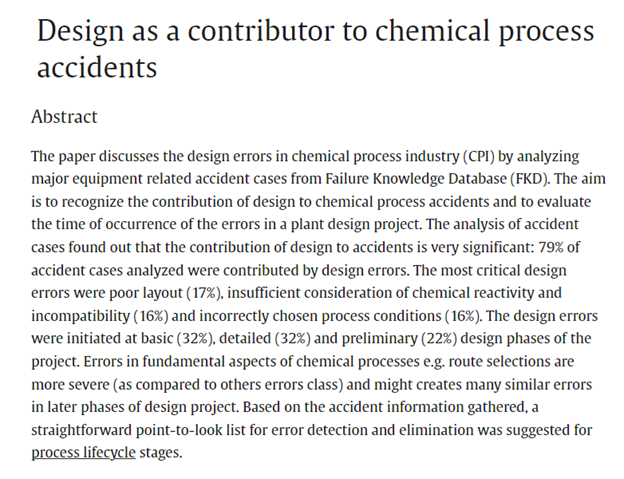
This paper studied design errors in the chemical process industry (CPI).
They analysed 284 major equipment-related accident cases from a database.
[Note. This is one of those ‘tabulation of error’ studies. But in this case, it’s focused on design-issues, rather than ‘human error’; I think there’s something to the key findings of an underappreciated role of design more than the specific percentages. We also need to be careful not to just shift blame from frontline to designers. Also remember that WYLFIWYF.]
Providing background:
· Research on design error in the CPI is said to be largely neglected
· It’s said that in the 1970s, “many designers refused to accept the term of ‘design error’”, whereas nowadays design quality control and review is well accepted
· Previous work from these authors found that design errors were common in accidents [** and likely properly functioning, non-accident systems, too]
· The design process is said to be “inherently error prone, since at some stage something is probably overlooked … [whereas] creative processes such as process development, lead to creative and novel errors”
· Design error is a feature of design where the design is unable to perform according to its specifications
· Not all design errors are safety related. Of those that are safety related, only a small percentage “reaches the stage where they cause an accident”
· Hence, for accident purposes, they propose that a more relevant definition is “a design error is deemed to have occurred, if the design or operating procedures are changed after an incident has occurred”
· This definition of design error includes both design and operating procedures changed after an accident, which interestingly captures a wider range of potential factors
· Another aspect of design errors are in the operator-technical interface. Prior work suggests this is a common contributing area to design errors, and means how clear and user-friendly the equipment or system is
Results
Key findings were that:
· Design errors were divided into 11 categories
· 79% (224 of 284) had at least one error
· 72% had multiple design errors, giving an average of 2.35 design errors per case
· ~59% of design changes involved changes in equipment or process, like minor structural modification, change in layout, replacement of construction material, safer heat transfer material or installing safety protection systems
· 41% were non-hardware related changes, including equipment setting, adjustment of automation limits, design documentation, and more
They state that “Design is seldom the only contributor to accidents”. A prior study found that design contributed to 25% of events. In this data, design contributes to 50-60% of accidents as a “main contributor”, and is present in 70-80% as a main or sub-contributor.
In this sample, all design related errors, including things like unsuitable equipment, excess corrosion, improper procedures were included as design.
They argue that “This is a matter of point of view”, since one company categorised corrosion to “bad weather”. Their response is that the design didn’t account for the environmental factors, nor equipment based on worst-case scenarios.
[Note: What we categorise contributors as is almost always a matter of view, rather than clear and unambiguous objective truths.]
The contributing design areas are shown below, with process layout, reactivity, and process condition topping the chart.

They further break-down the findings into greater granularity (pipes, connections, valves), but I’ve skipped this, and the “underlying causes” of the design errors, which I’ve also skipped.
Findings suggest that the majority (59%) of design errors occur in the process design phases, basic engineering (32%) and preliminary engineering (22%).
Design errors during construction and start-up were seen to be relatively low (5%), as with plant modifications in the operation phase (4%).
They propose that the differences seen in these phases is that more engineering decisions are made in these phases compared to downstream.
At the construction and start-up phase, most related to poor fabrication, construction and installation.
Based on other research, it’s suggested that design reviews throughout the process lifecycle may eliminate 80-95% of design errors. The remaining design errors “are present in most of the accidents …. This is because the existing methods have their limitations”.
They say that HAZO is the most common design review method, but it typically “does not deal with mechanical errors, rarely with dimensioning errors (Taylor, 2007a) and procedure errors”.
As seen below, the average frequency of design errors reaches a peak in preliminary design and gradually declines over project progression. Importantly, the number of design errors isn’t directly linked to the importance of them – as error rate may be high in some phases but the average importance of the decisions relatively low.

Wrapping up, they argue that nearly 80% of accident cases had at least one design error, and most had more than one.
These findings “shows that nearly 2/3 of design errors are done in basic and detailed engineering phases. However, the number of design errors done per one design aspect is largest in the preliminary design indicating that many errors are done in the fundamental process engineering decisions such as process conditions and chemical and reactions involved”.
Authors: Kidam, K., & Hurme, M. (2012). Design as a contributor to chemical process accidents. Journal of Loss Prevention in the Process Industries, 25(4), 655-666.
Study link: https://aaltodoc.aalto.fi/server/api/core/bitstreams/17cdd72b-0e32-4b7f-8c05-ed2bab7729c7/content
My site with more reviews: https://safety177496371.wordpress.com
LinkedIn post: https://www.linkedin.com/pulse/design-contributor-chemical-process-accidents-ben-hutchinson-o7rjc

 SafetyInsights.org
One thought on “Design as a contributor to chemical process accidents”