Do aesthetics and beautiful designs matter, or should the goal of workplace computerised systems be to “enhance efficiency, not to give pleasure”?
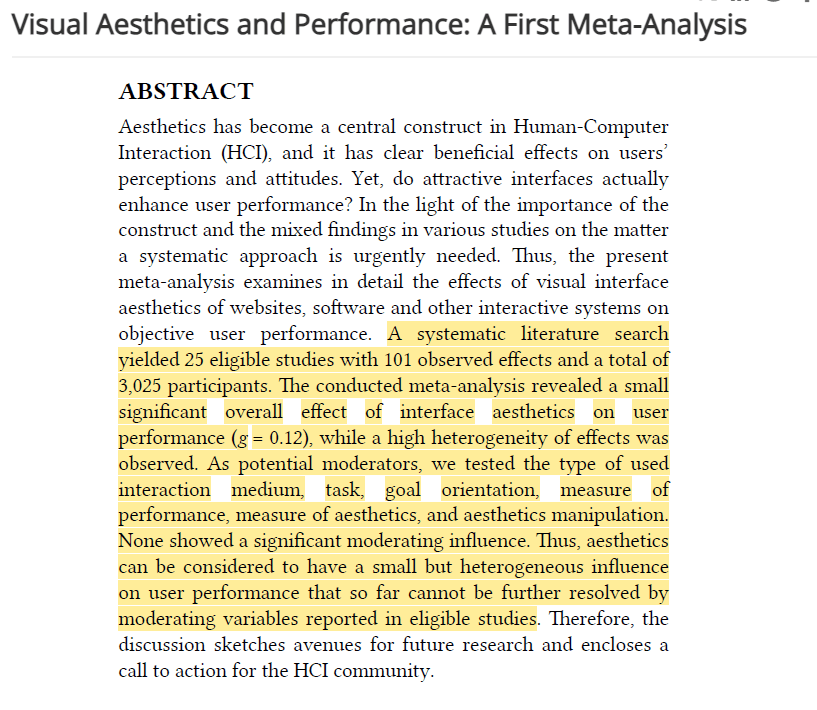
This 2019 meta-analysis on the relationship between visual aesthetics and performance may interest a small cadre of my HF/E peers and designers.
25 studies met inclusion.
They found that interface aesthetics:
· Had a small but significant effect on user performance (although a high heterogeneity was found across the sample)
· Despite the limitations and caveats, “considering the huge amount of interface users worldwide, even small positive effects can lead to vast consequences”
· The interface/user medium, task, goal orientation, performance measures, aesthetics measure and aesthetics manipulation had no significant effect on the effects of aesthetics on performance (but noting limitations)
· One study found that aesthetics only enhanced performance under conditions of poor useability, but when useability was held at a constant high level then attractive designs didn’t improve user performance
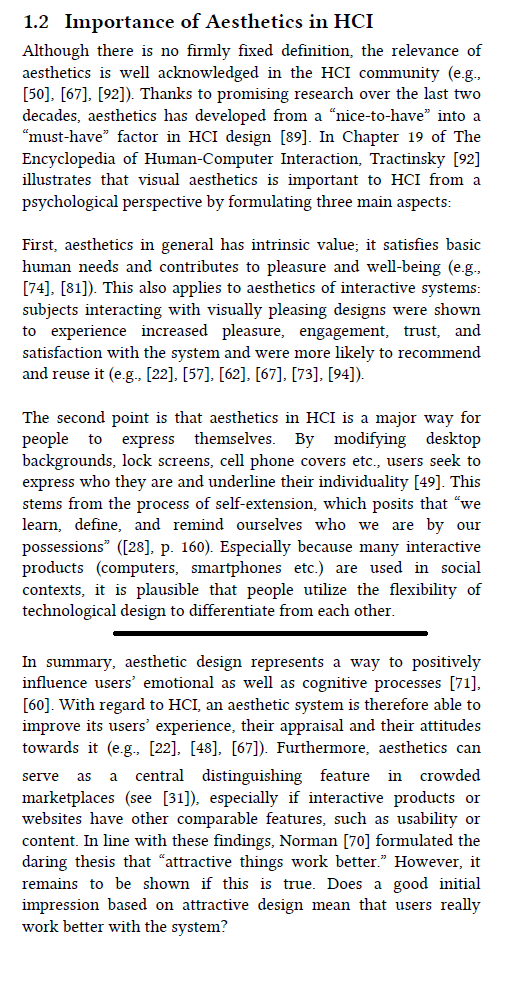
They argue for three main implications:
1) aesthetic designs generally don’t interface with work goals, nor harm user performance
2) attractive designs may mildly improve performance – but even minor improvements when applied at scale may have huge accumulated impacts (e.g. the millions of word or spreadsheet users)
3) the general positive impact of aesthetics on subjective outcomes should be kept in mind during design – e.g. higher user preference, satisfaction, trust and willingness to reuse and recommend
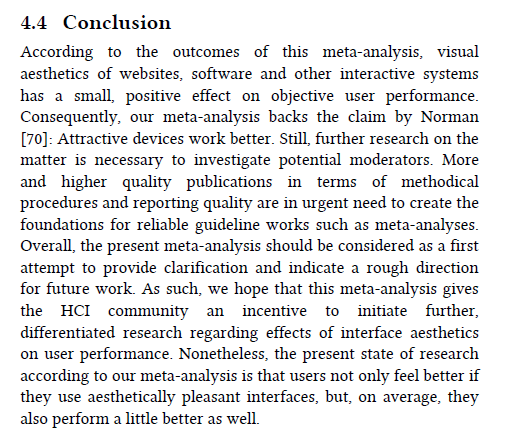
In concluding, they argue: “Attractive devices work better”.
Ref: Thielsch, M. T., Scharfen, J., Masoudi, E., & Reuter, M. (2019). Visual aesthetics and performance: A first meta-analysis. In Proceedings of Mensch und Computer 2019 (pp. 199-210).
Study link: https://www.uni-muenster.de/imperia/md/content/owms/2019_thielsch_et_al.pdf
My site with more reviews: https://safety177496371.wordpress.com

 SafetyInsights.org
One thought on “Visual Aesthetics and Performance: A First Meta-Analysis”