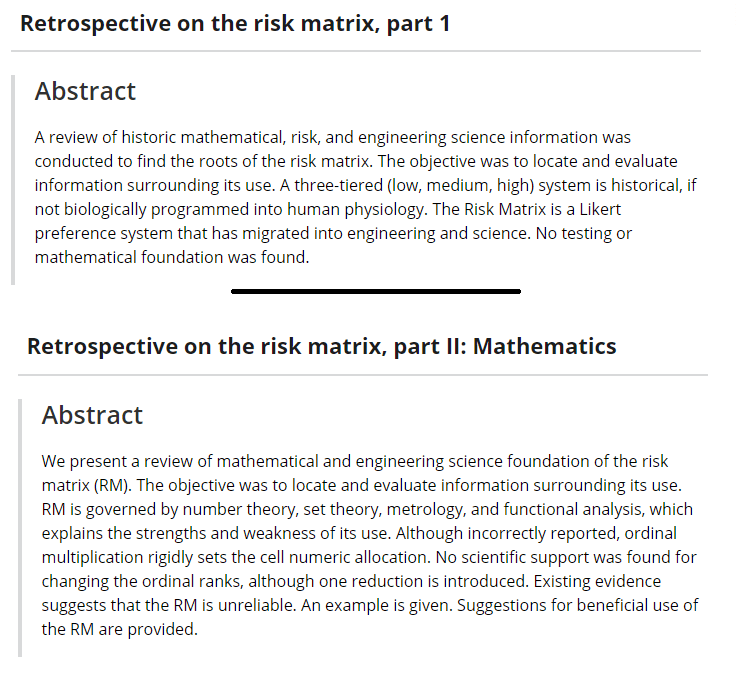
Here’s a couple of interesting papers, exploring the history, methods and applications of risk matrices “Retrospective on the risk matrix” parts I & II, primarily from an engineering perspective.
Unfortunately behind paywalls, but the pirates among you may be able to locate them (Or try ResearchGate/the author).
Not summarising them, but some key points across both papers:
· “The Risk Matrix is a Likert preference system that has migrated into engineering and science. No testing or mathematical foundation was found [by the author]”
· “Existing evidence suggests that the RM is unreliable”
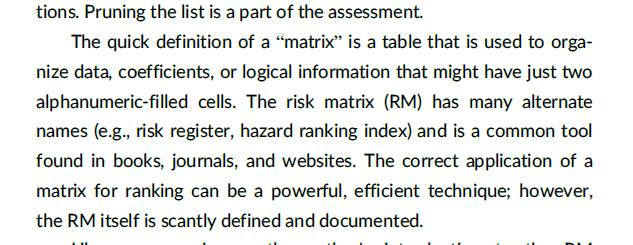
· RMs contain numerous issues; some argue that these issues can be addressed, whereas others argue that they cannot (e.g. mathematical and scaling issues)
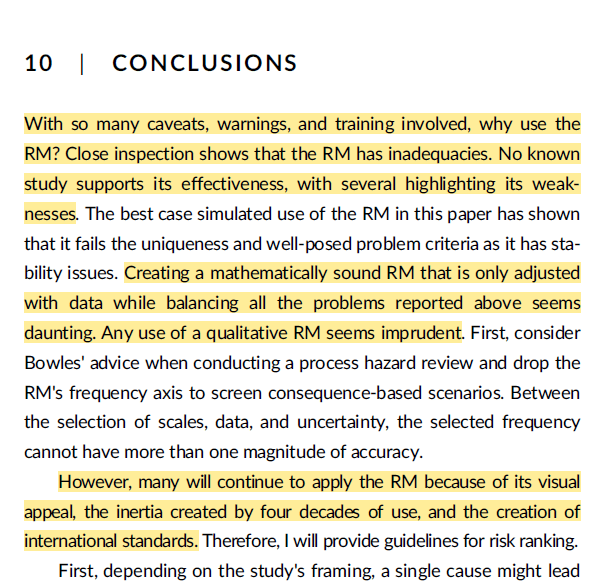
· The author questions why do we keep using RMs despite the known caveats, warnings and training involved? Particularly referring to the point that “No known study supports its effectiveness, with several highlighting its weaknesses”
· The author suggests that the continued use of RMs “will continue to apply the RM because of its visual appeal, the inertia created by four decades of use, and the creation of international standards”
Some other points of note:
· I’ve skipped the history (but it is interesting), but they note that the “From ancient cultures recognizing the risk-on/risk-off logical ranking, the concept of low/medium/high levels gradually emerged”
· Hence, matrices, with their pretty three-tiered structures (low, medium, high) emerged as much from human visual/sequencing preferences (to avoid uncertainty) as from anything else; or as the author says, “is historical, if not biologically programmed into human physiology”
· “The RM was not synthesized at an exact moment but evolved during an age of accelerating technology”
· “One key difference between military uses of rating systems (FMEAC) and the common RM is that the criticality codes and methods are fine-tuned as feedback data are accrued. The author found no back-verification of the RM rankings”
· “Perhaps perception-based is a better adjective than preference-based, but the ordinal and cell RM is an old paradigm that could be inappropriately substituted for data”
· “As more risk matrices proliferate with new names and in varied settings, the factual foundation has deteriorated and perhaps become confused with other problem-solving, weighted ranking methods”
· It’s argued that “Including the RM as a communication tool for what might otherwise be esoteric knowledge to operators or management is still an excellent application of the RM”
Refs:
1. Moseman JA. Retrospective on the risk matrix, part 1. Process Saf Prog. 2024;43(2):270‐277.
2. Moseman JA. Retrospective on the risk matrix, part II: Mathematics. Process Saf Prog. 2024;1‐14.
Study links:
https://doi.org/10.1002/prs.12540
https://doi.org/10.1002/prs.12614
My site with more reviews: https://safety177496371.wordpress.com

 SafetyInsights.org