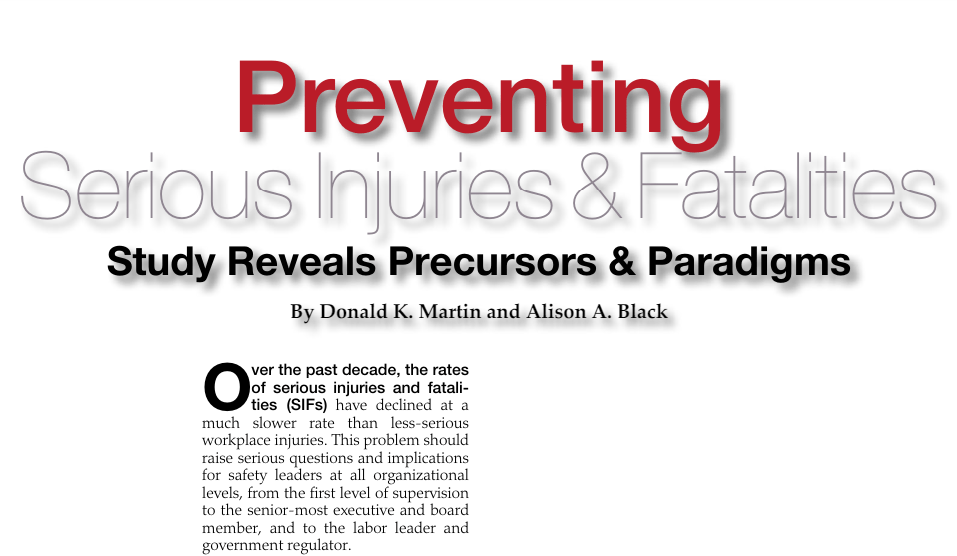
This 2015 paper explored the differences between SIFs and no-SIFs – finding the underlying factors to be “measurably different”.
Summary posted soon.
They drew on data from seven multinational organisations: monthly injury data (fatal and non-fatal), comprehensive narratives for all serious injuries over the past 2 years and a sample of non-SIFs.
Key findings:
· A Subset of Reported Incidents Will Have SIF Exposure Potential: When incident data was evaluated case-by-case, they found a percentage originally reported as nonserious contained the potential for a SIF
· Hence, the data “clearly indicated that not all incidents had the potential to be an SIF. This logically leads to a conclusion that reducing the frequency of less-severe incidents at the bottom of the triangle does not necessarily reduce the number at the top in a proportional way”
· Safety initiatives can be effective at lowering the number of injuries with low SIF potential, but largely ineffective for lowering high SIF potential
· Nonserious injuries with high exposure potential in this dataset ranged from 10 to 36%, and is “organization- and location-specific, and in all cases is a subset of all reported lower severity injuries”
· Their data indicated that “The causes and roots of SIFs and non-SIFs are measurably different”
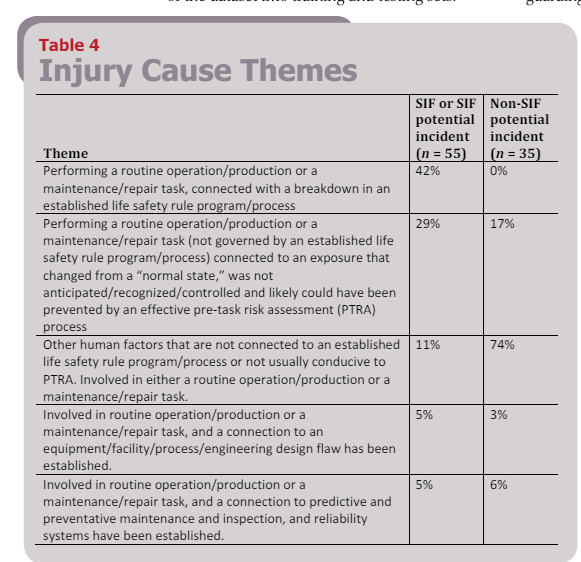
· 42% of SIFs related to breakdowns in processes of lifesaving policies and programs, whereas 0% of non-SIFs were related to lifesaving policies
· 29% of SIFs and 17% of non-SIFs were related to routine tasks, during “which exposure changed from a planned state, was unrecognized”
· 11% of SIFs and 74% of non-SIFs were related to people factors not connected to life-saving processes
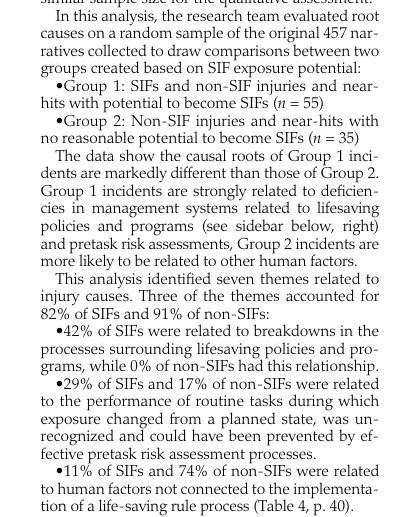
· It’s unlikely that a SIF is a one-off, considering that the precursors leading to it have been present all along
· Recordable injury logs are “misleading when it comes to SIF exposure”
· The SIF blind spot in organisations is significant
Authors: Martin, D. K., & Black, A. (2015). Preventing serious injuries and fatalities: Study reveals precursors and paradigms. Professional Safety, 60(09), 35-43.
My site with more reviews: https://safety177496371.wordpress.com

 SafetyInsights.org
One thought on “Fatal vs non-fatal injury types found to be “measurably different”; calls for a ‘new paradigm’ in managing SIFs”