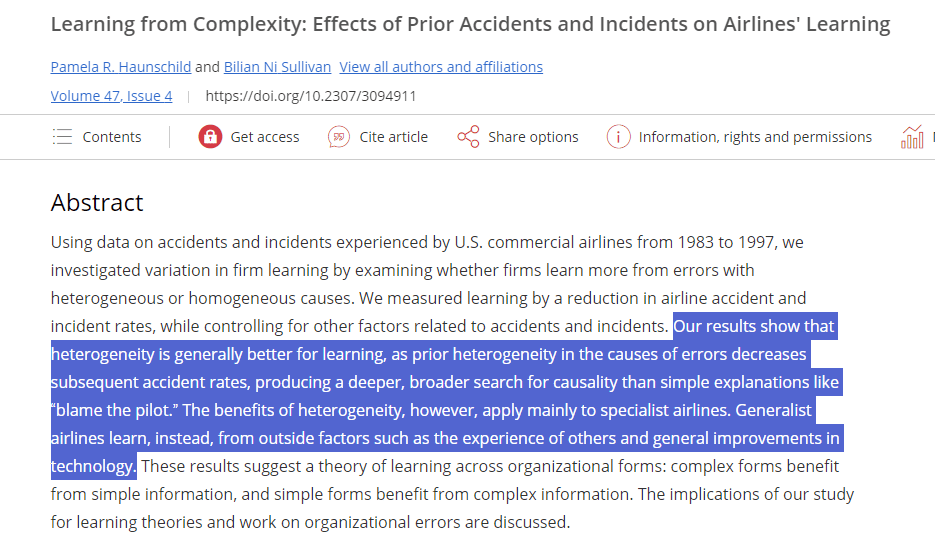
This was a really cool—albeit challenging—read. They explored variation in US commercial airline learning, namely whether airlines learn more from incidents with heterogeneous or homogeneous causes.
Caveat – this is from 2002 and the data 1983 – 1997.
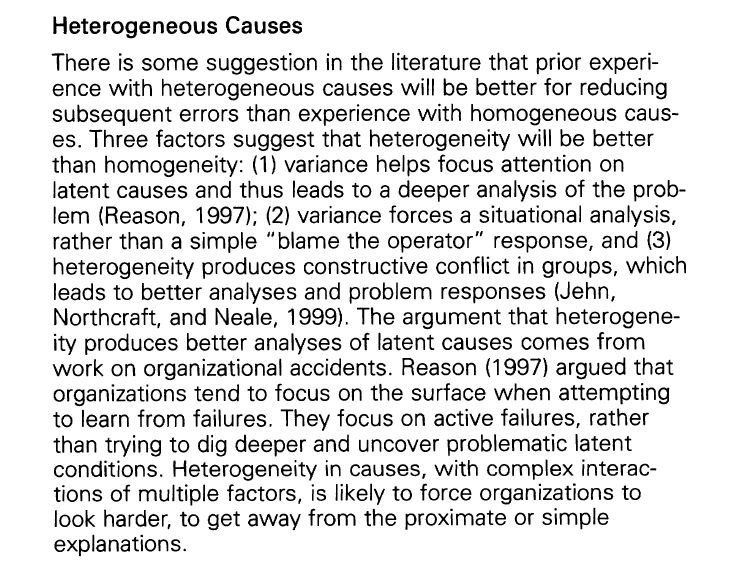
Some work indicated that exposure to heterogeneous experiences may be more effective for learning via:
1) variance helps focus attention on latent factors and leads to a deeper analysis
2) variance forces a situational analysis beyond “blame the operator”
3) heterogeneity “produces constructive conflict in groups”, leading to better analyses.
Key findings:
· Heterogeneity of causes is generally better for learning “as prior heterogeneity in the causes of errors decreases subsequent accident rates, producing a deeper, broader search for causality than simple explanations like “blame the pilot”
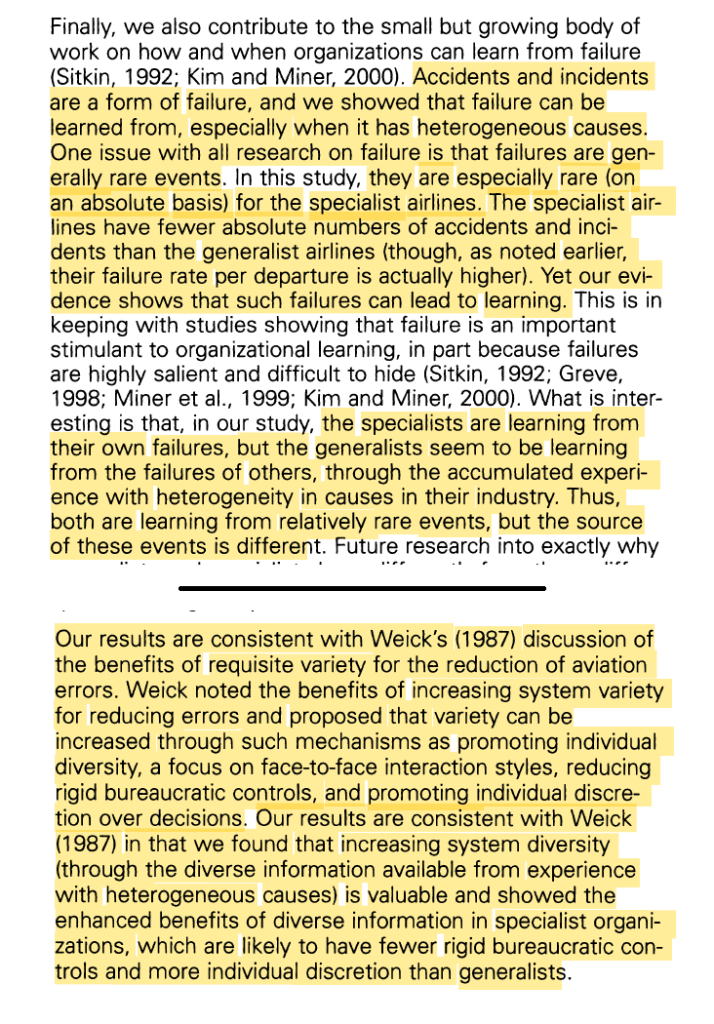
· They found “the specialists [airlines] are learning from their own failures, but the generalists seem to be learning from the failures of others, through the accumulated experience with heterogeneity in causes in their industry”
· They argue that their results are “consistent with Weick’s (1987) discussion of the benefits of requisite variety for the reduction of aviation errors”, where there is value in increasing system variety for reducing incidents
· “variety can be increased through such mechanisms as promoting individual diversity, a focus on face-to-face interaction styles, reducing rigid bureaucratic controls, and promoting individual discretion over decisions”
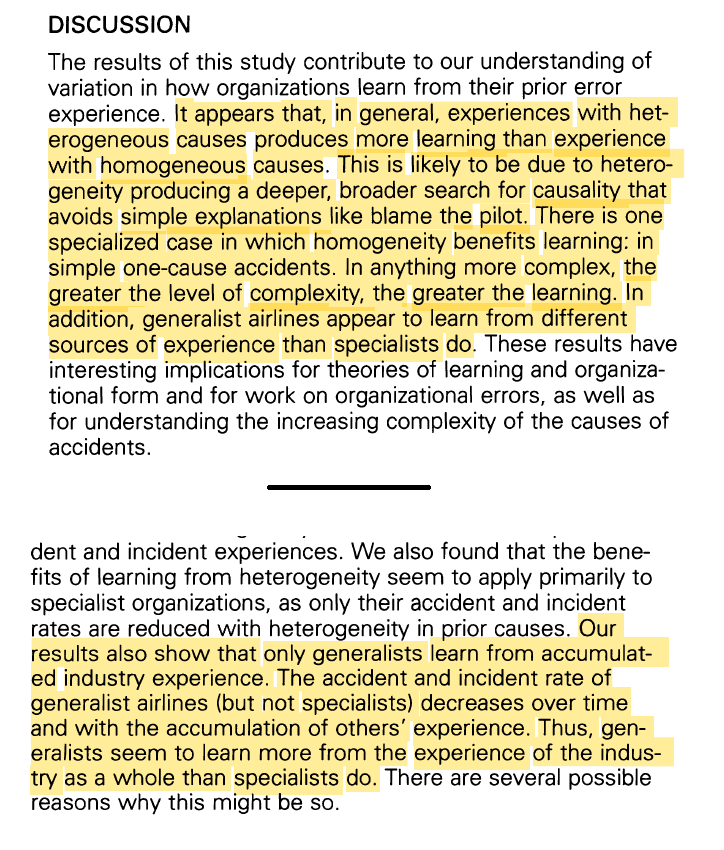
· Their results “found that increasing system diversity (through the diverse information available from experience with heterogeneous causes) is valuable and showed the enhanced benefits of diverse information”
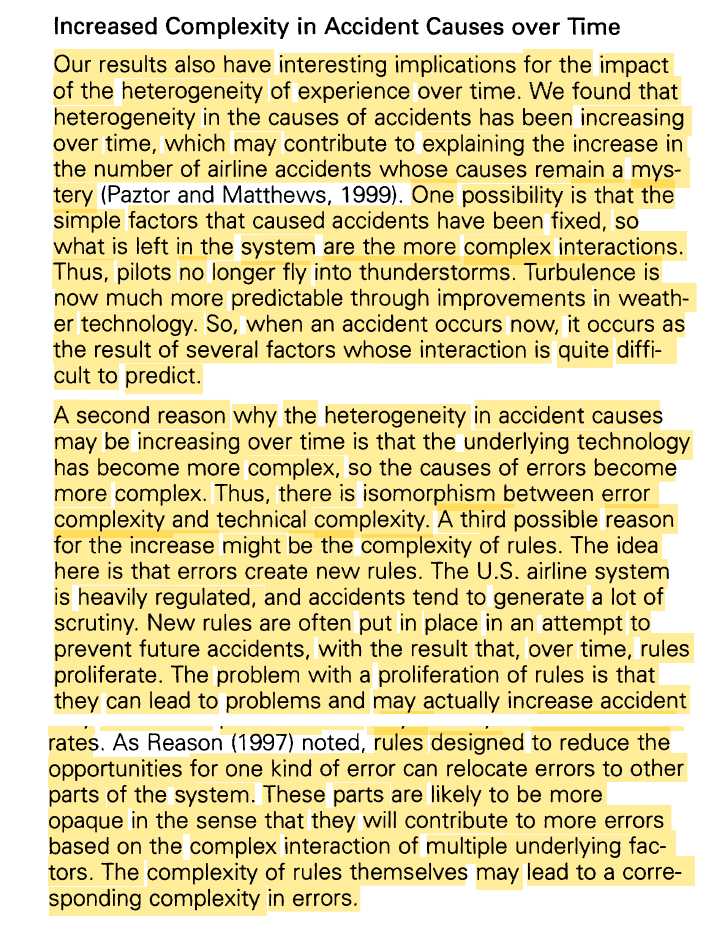
· They found that “heterogeneity in the causes of accidents has been increasing over time, which may contribute to explaining the increase in the number of airline accidents whose causes remain a mystery”
· That is, perhaps “the simple factors that caused accidents have been fixed, so what is left in the system are the more complex interactions” and “when an accident occurs now, it occurs as the result of several factors whose interaction is quite difficult to predict”
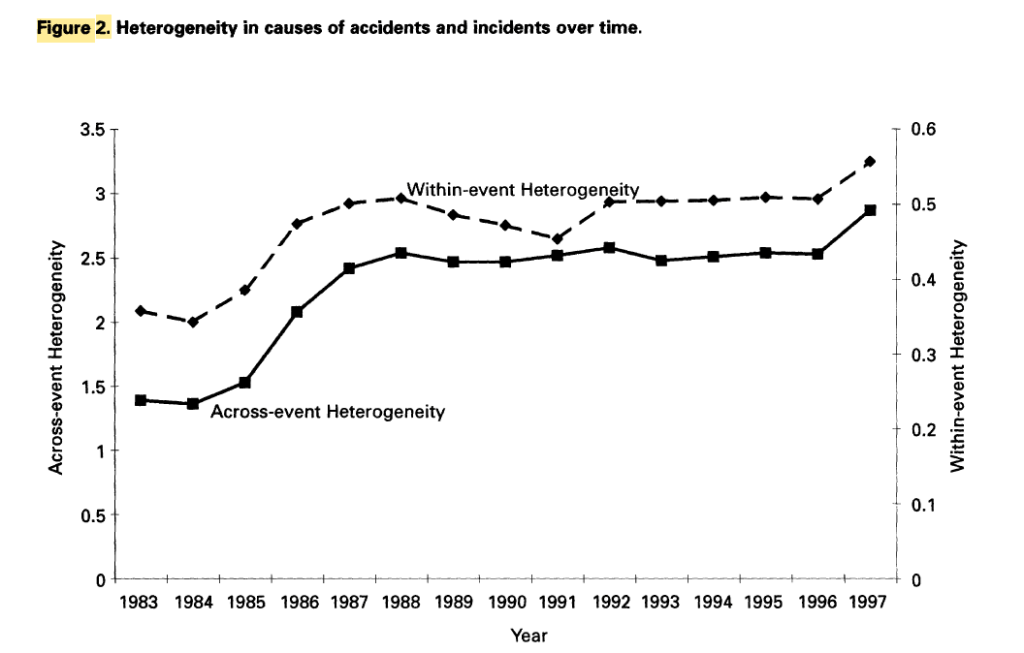
Reasons why heterogeneity in accident causes may be increasing are:
1) the underlying technology is becoming more complex, so the interactions are more complex
2) Another possible reason is due to complexity of rules. New rules may follow accidents to avoid recurrence “with the result that, over time, rules proliferate”.
A proliferation of rules “designed to reduce the opportunities for one kind of error can relocate errors to other parts of the system”
Further, “These parts are likely to be more opaque in the sense that they will contribute to more errors based on the complex interaction of multiple underlying factors. The complexity of rules themselves may lead to a corresponding complexity in errors”.
Study link: https://repositories.lib.utexas.edu/bitstreams/a8a3d935-830f-4c84-91c8-9578ef97b0ce/download
My site with more reviews: https://safety177496371.wordpress.com

 SafetyInsights.org
One thought on “Learning from Complexity: Effects of Prior Accidents and Incidents on Airlines’ Learning”