
A banger from Cristia Vesel exploring how language can hinder or facilitate organisational learning following events.
I put this summary off for a long time due to the challenge of summarising – virtually every line in the paper is something I want to repeat. Hence, I can’t do this justice – worth checking out the full paper.
People naturally want to know who or what was responsible for an action and particularly something undesirable. The assignment of action is called agency, where an agent is a person or thing that takes an active role or produces a specified effect.
Examples like Bob spilled the chemical, where Bob is the agent of the action. This simplistic sentence, however, doesn’t tell us whether Bob spilled the chemical intentionally, by accident, or was simply near the chemical when it spilled.
Despite this, “We likely assume that the agent of the action acted independently and made a free will choice to act”; these assumptions influence learning from events.
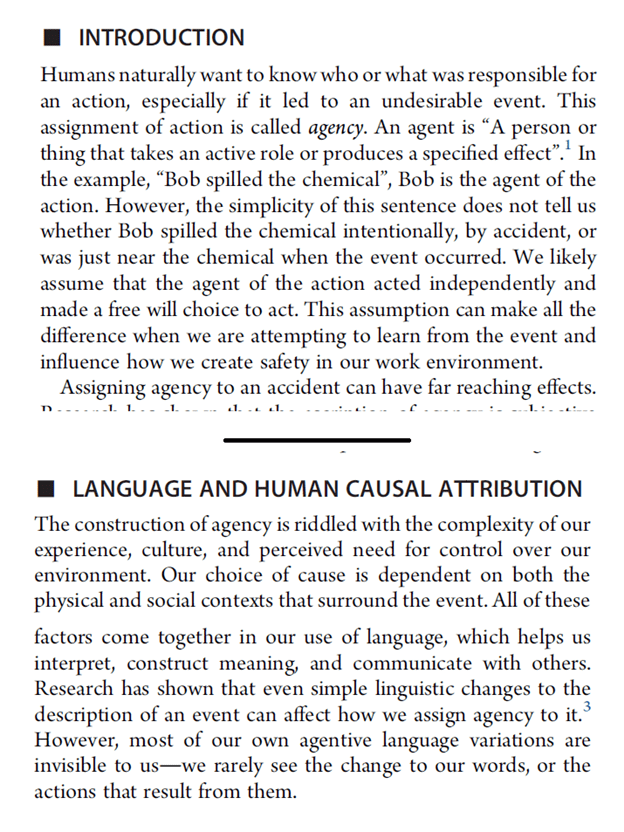
The assignment of agency is subjective and influenced by things like culture, experience and the language of the observer.
Notably, “Linguistic framing of events has been shown to directly affect the assignment of guilt, blame, and punishment of human actors”. The language of written accident reports play a role in identifying and agents and linking them to events.
Linguistic short cuts and biases are said to “reduce the understanding of context around an accident, which can artificially stop the learning process and lead to a false sense of improved safety”. Language is one of several influences on beliefs of causality, but it does have a strong effect.
Prior work has suggested that behaviour can be attributed to a person’s internal characteristics or disposition, e.g. personality, abilities, attitude, or to outside forces (e.g. cultural, social, norms, peer pressure, rules).
When observing others, a tendency is to “attribute that person’s behavior to internal causes (for example, the person’s disposition or mental state) and sometimes to external causes”. An example of this is the fundamental attribution error, where observers underestimate the external/situational influences on another’s behaviour and overestimate the individual’s traits or attitudes.
This effect “makes it easier to judge a person’s negative actions as coming from their own volition and disposition”.
Different cultures may also assign agency differently. Western societies are more likely to identify people other than ourselves as the person with agency, particularly for negative outcomes. When evaluating ourselves though, we typically focus on success and “distance ourselves from failure, which is referred to as self-serving attribution bias”.
English speakers have also been shown to have an agentive bias which could affect accident analysis. That is, English speakers are “more likely to use agentive descriptions for all events, as compared to some other language speakers”.
Being exposed to undesirable events can trigger a defensive attribution bias, where people defend themselves from the concern of being seen as the cause or victim of a mishap. Hence, “If we can categorize a serious accident in some way [as] the victim’s fault, it is reassuring”, because we “simply need to assure ourselves that we are a different kind of person from the victim, or that we would behave differently under similar circumstances”.
Research has highlighted that simple linguistic changes to an event’s description can effect the assignment of agency, but “most of our own agentive language variations are invisible to us”.
Language priming, like agentive language like “He crashed the car” or non-agentive “The car crashed”, has been studied in different ways. One example is how English speakers could better remember situations involving agentive language compared to non-agentive language. Quoting the paper, “Placing attention on individuals involved in accidents may improve memory for those individuals”.
Examination of >197k criminal trials in London from between 1684-1913 found that “the use of agentive language priming resulted in more guilty verdicts”.
THE LANGUAGE OF ACCIDENT INVESTIGATION
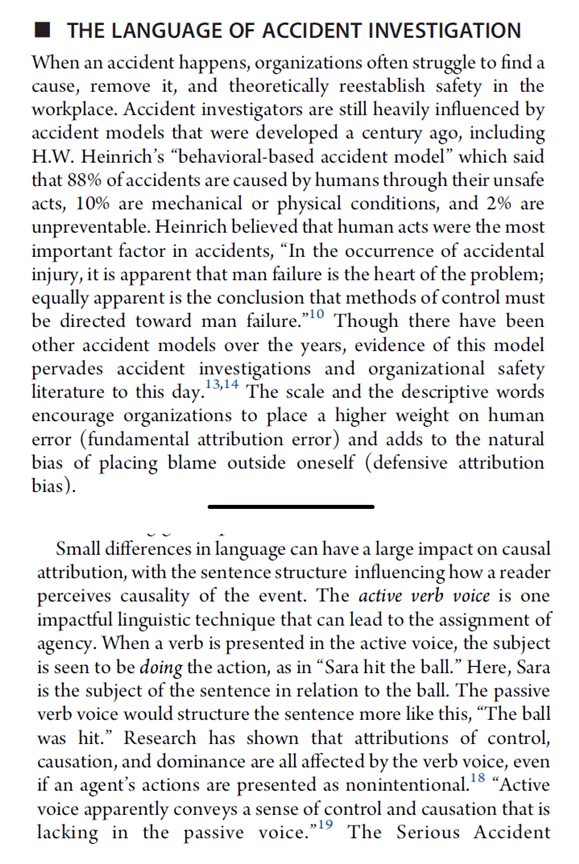
The need for linguistic shortcuts can lead investigations towards binary oppositions where “pairs of terms are seen as polar opposites”, like right/wrong, success/failure, good/bad; creating either/or situations can limit learning possibilities.
Success/failure linguistic separation is another binary commonality in safety, where the language “is rooted in theories surrounding simple or complicated machine systems”. These systems have a limited number of parts that can break and can function in bimodal manners (off/on, working/not working etc.).
Humans “are different and inherently complex, with dynamic and emergent cognition and a unique ability to learn”; hence, we can “really only say that a human “failed” or “succeeded” in hindsight, once the outcome of the action is known”. This machine agentive language is often used to describe human action.
Serious Accident Investigation Guide
They discuss the previous Serious Accident Investigation Guide in the US Forest Service. The first para “presupposes that the cause of accidents is human failure”. This guide repeated the word failure 91 times throughout and particularly regarding people.
This example, and others discussed in the paper, “reflect language priming for investigators. Language priming, or structural priming… as referred is a form of repetition”, and “When people talk and write, they tend to repeat the underlying basic structures that they recently produced”.
This guide is also said to distract from its own priming language by insisting that only ‘factual data’ should be used for evidence, and that interviews are about finding facts. Facts, according to the guide, implies reality, and that there’s “always an objective, knowable, and unbiased state of the world”.
However, “from the research on agency and language, it is unlikely that a single, objective story exists around an event… Memories, experiences, and language will differ when an event is retold, and written descriptions will be subject to linguistic bias and shortcuts”.
Active verb voice
Small differences in language and their large impact on causal attributions are then discussed. For instance, use of active verb voice, “Sara hit the ball”, directing agency to Sara being the one that hit the ball heightens attributions of control over passive voice (“the ball was hit”). This attribution effect may still remain even if the agent’s actions were presented as nonintentional.
HFACS
HFACS is also briefly discussed; HFACS divides human error into “a binary choice of two “unsafe acts”: error or violation”. Human agency is presupposed in both cases.
Moreover, error versus violation provides only two causal attribution frames for the investigator. These causal categories “are limited and incomplete, with no guidance for understanding the actions of the accused, the network of influences, or the context inherent in the event”.
Discussing the findings:
· investigators may search for human failure and place significant weight on human agency
· Blame can be further influenced by the fundamental attribution error, where dispositional/personality-based qualities of people are prioritised over other factors, e.g. cultural, environmental, social
· A defensive attribution bias can also become “a protection mechanism for investigators and organizational leaders, separating them from the presumed cause and theoretically restoring safety to the system”
· Systemic models of performance, instead, tend to treat these elements of agency and performance as the beginning of the inquiry, not the end
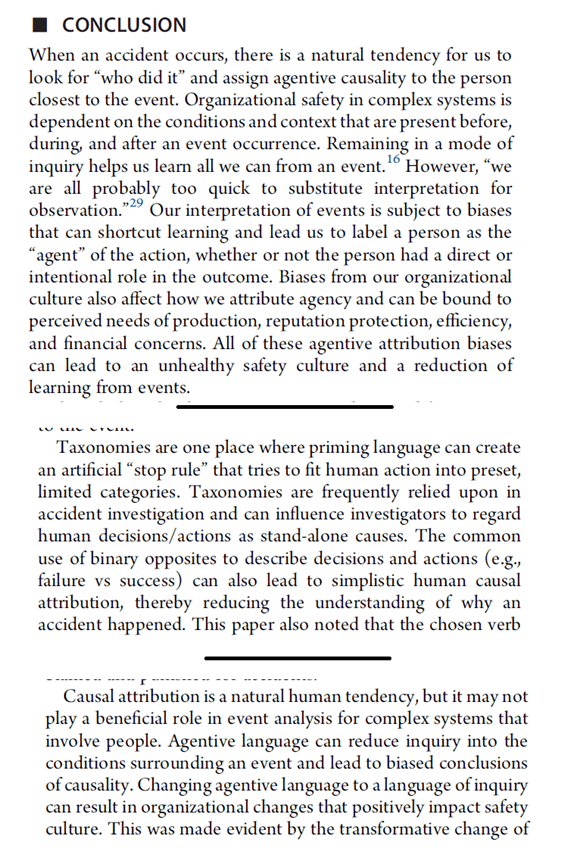
· It’s argued that changing the assumptions of accident genesis and analysis can have a profound impact on safety culture [** and presumably other facets like logics, belief systems etc.]
· And to change culture, “you have to change the assumptions that drive the culture.16 Language can be a major driver of this change by proactively replacing words that lead to agentive blame with descriptions that lead to a more robust and inclusive analysis of events”
· One type of refreshed learning practice undertaken by the Forestry Service is a Learning Review, which focuses on a “complex language-rich narrative, and a network of influences map that shows the context of the event and interrelations between elements”
Author: Vesel, C. (2020). Agentive language in accident investigation: Why language matters in learning from events. ACS Chemical Health & Safety, 27(1), 34-39.

Study link: https://doi.org/10.1021/acs.chas.0c00002
My site with more reviews: https://safety177496371.wordpress.com
LinkedIn post: https://www.linkedin.com/pulse/agentive-language-accident-investigation-why-matters-from-hutchinson-uqu0c

 SafetyInsights.org
2 thoughts on “Agentive Language in Accident Investigation: Why Language Matters in Learning from Events”