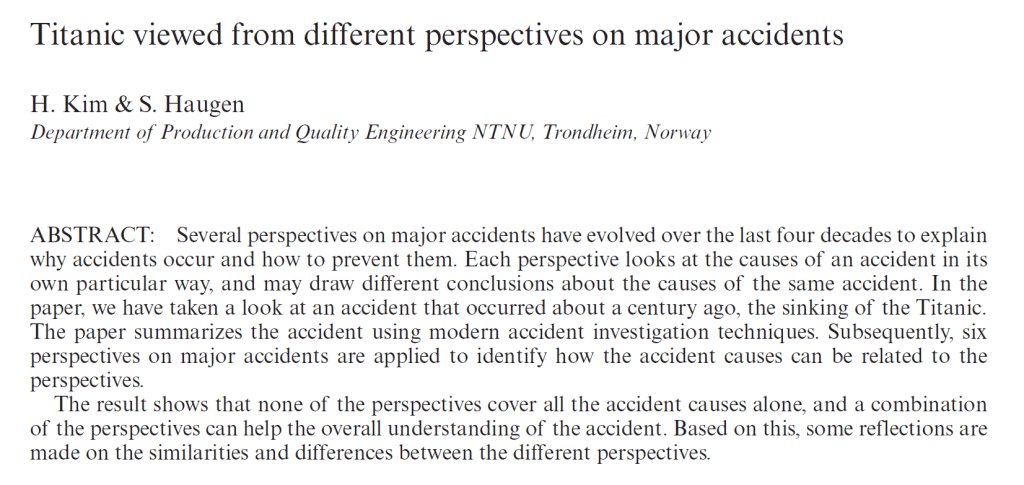
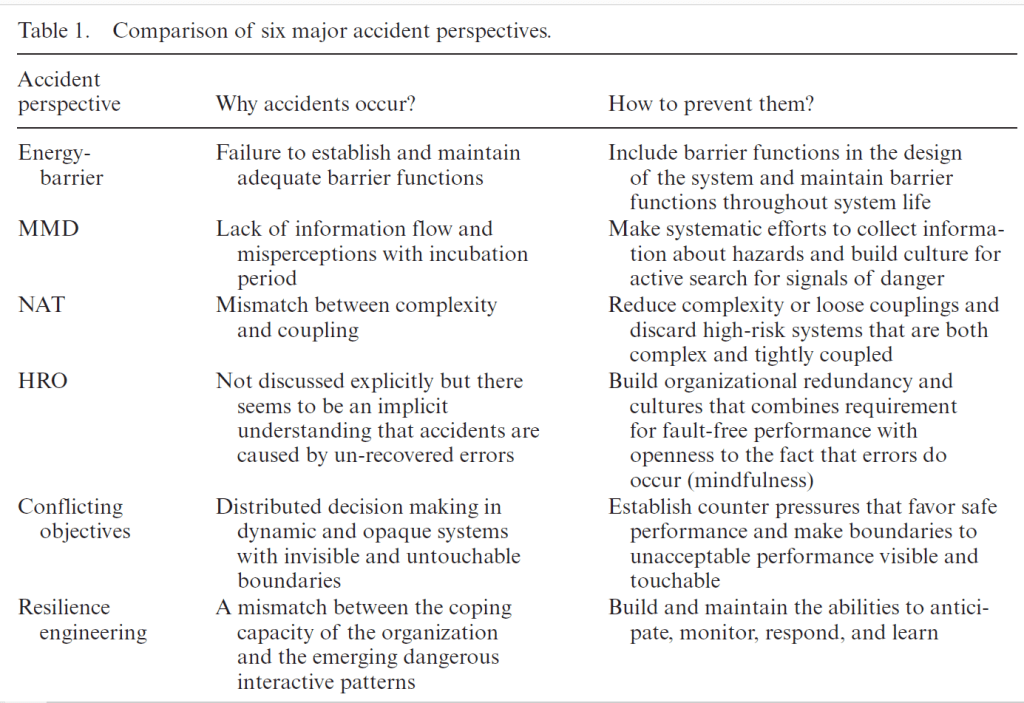
I found this read a little different from recent others – it compared several accident perspectives in explaining the Titanic sinking.
Note. I expect many will disagree with their classifications (as did I). Maybe don’t take the exact findings too literally, but it’s interesting to ponder the findings nevertheless – no less WYLFIWYF.
They used an MTO (Man, Technology, Organisation) analysis to canvass key (but not systematic) events, causes and conditions.
NB. There’s way too many individual findings to cover, so check out the paper if it interests you.
Some findings:
· Of the 23 factors they identified – none of the accident perspectives can alone explain the entire conditions and events “except for the energy-barrier model”
· Man-Made Disasters (MMD, from Turner), and Normal Accident Theory (NAT) “are applicable to only small part of the accident”
· HRO (High Reliability Theory) and RE (Resilience Engineering) are “related to nearly half of the accident causes only”
· Hence, “focusing on only one perspective may narrow our viewpoint and make us omit other important causes”
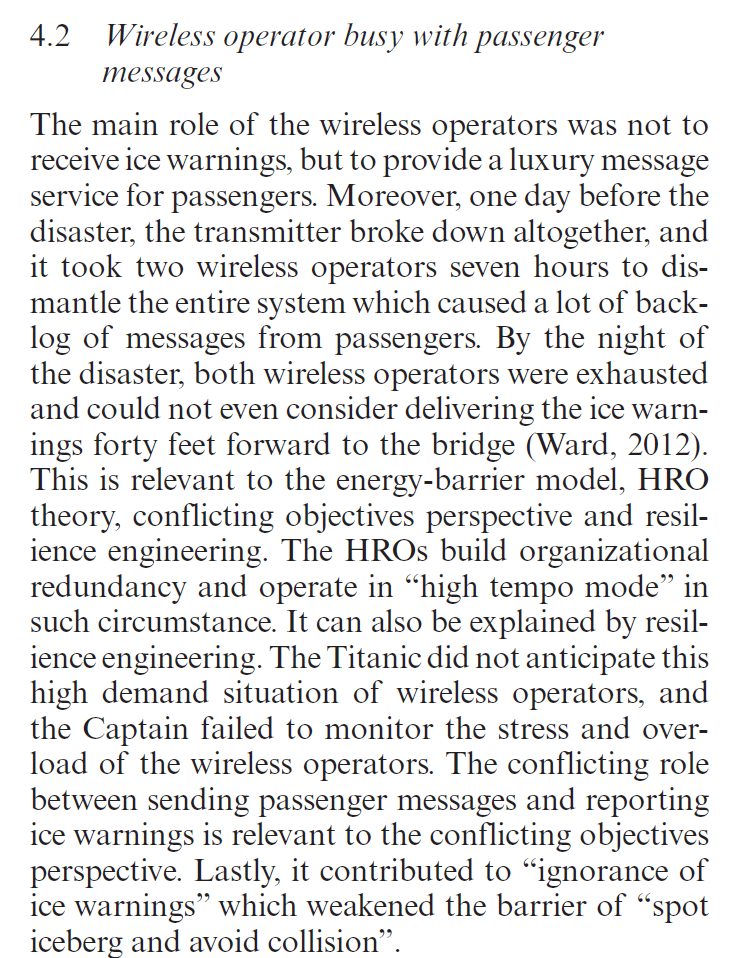
· As example, they argue that MMD elucidates a breakdown in communication, such that somebody in the rule making committee knew of the problem of the lifeboat requirements, and several crew knew something was wrong; but that only explains a small part of the Titanic accident
· Other factors like pressure of record breaking run, insufficient lookout, low quality rivets and more were also implicated
· NAT, HRO and RE were said to be largely relevant to operational factors, while the other perspectives are applicable to both operational and design matters [** I disagree with their summation here]
· Hence, “Too much attention to those perspectives may lead us to overlook design and “installation problems”
The authors suggest an integrated view is preferable, and the energy-barrier model may be suitable as the basis, where other perspectives supplement it “and explain why weakening or strengthening of barriers occurs”.
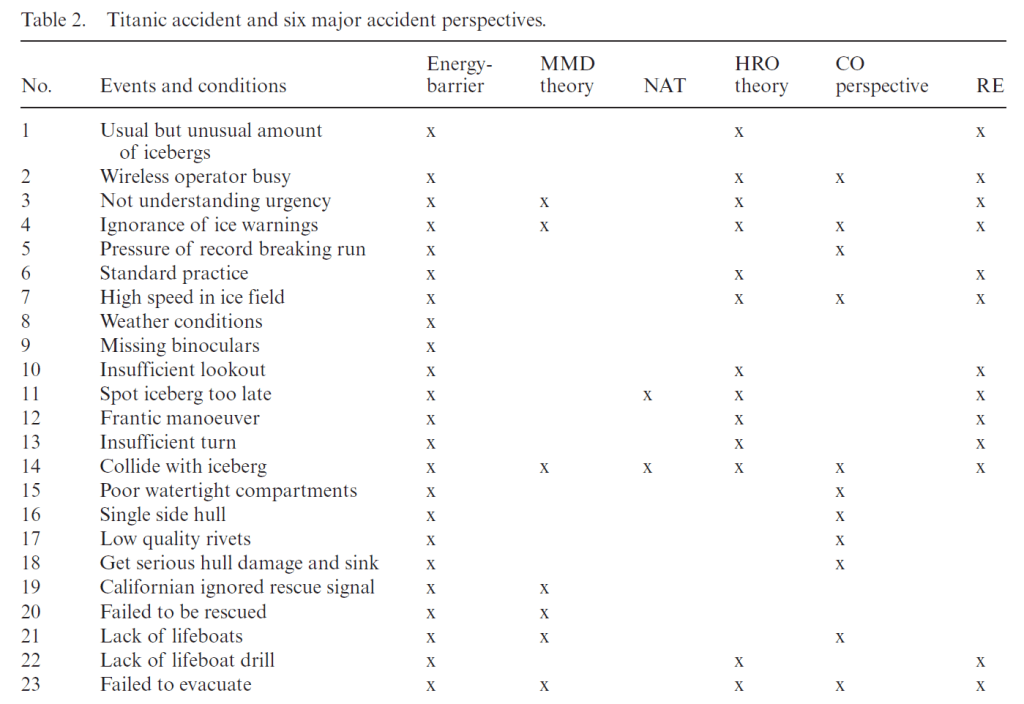
In any case, they say the “energy-barrier model is related to all causes of the disaster of the Titanic, but it cannot explain the reason why those causes had occurred”, where other perspectives, like MMD, can.
An important caveat is that the original analysis was undertaken with MTO, which is “basically founded on the energy-barrier model”. Different findings may have been observed if they used FRAM, STAMP etc.
And, the authors importantly argue that “All of the perspective are correct but the reason every perspective is describing it differently is because they view the accident from different viewpoints.”
Curiously, none of the perspectives identified an under-sized door as a flotation device 😉.
Ref: Kim, H., & Haugen, S. (2015). Titanic viewed from different perspectives on major accidents. Safety and reliability: Methodology and applications, 65-73.

My site with more reviews: https://safety177496371.wordpress.com

 SafetyInsights.org
2 thoughts on “Titanic viewed from different perspectives on major accidents”