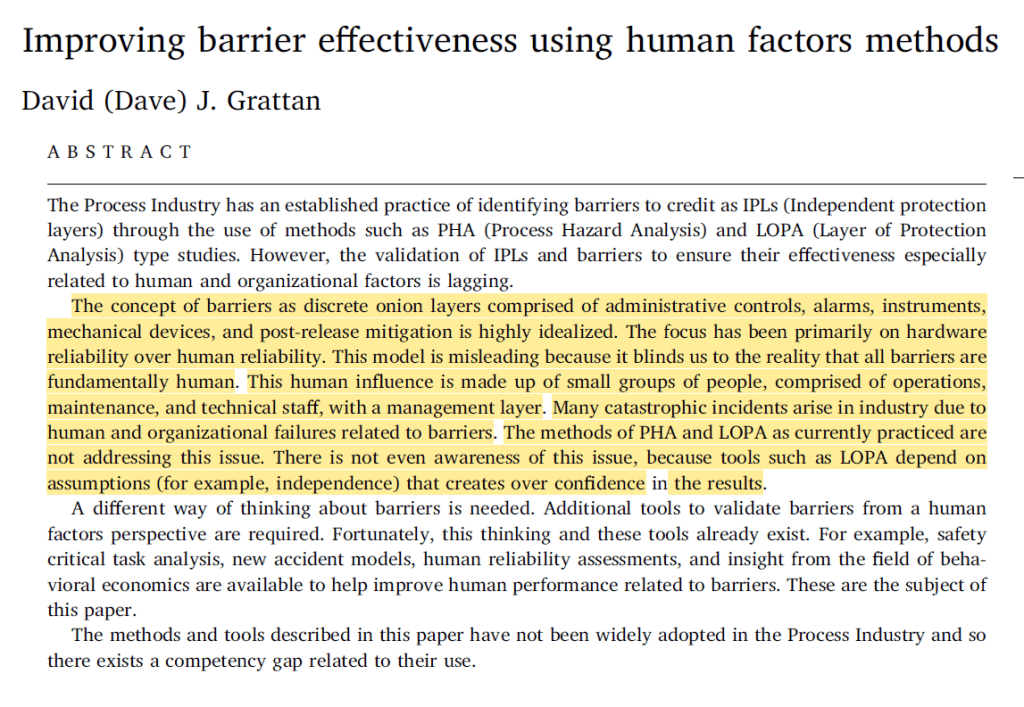
An interesting 2018 paper from Dave Grattan, discussing the importance of human factors in barrier effectiveness.
This paper covers A LOT – I’ll touch on a few points but suggest you check out the paper.
Points:
· Current approaches have emphasised “hardware reliability over human reliability”, which is “misleading because it blinds us to the reality that all barriers are fundamentally human”
· Methods like PHA and LOPA as “currently practiced are not addressing this issue. There is not even awareness of this issue, because tools such as LOPA depend on assumptions (for example, independence) that creates over confidence in the results”
· An example of a misinterpreted alarm is given, where it seems tempting to blame the operator over understanding the factors behind the misinterpretation
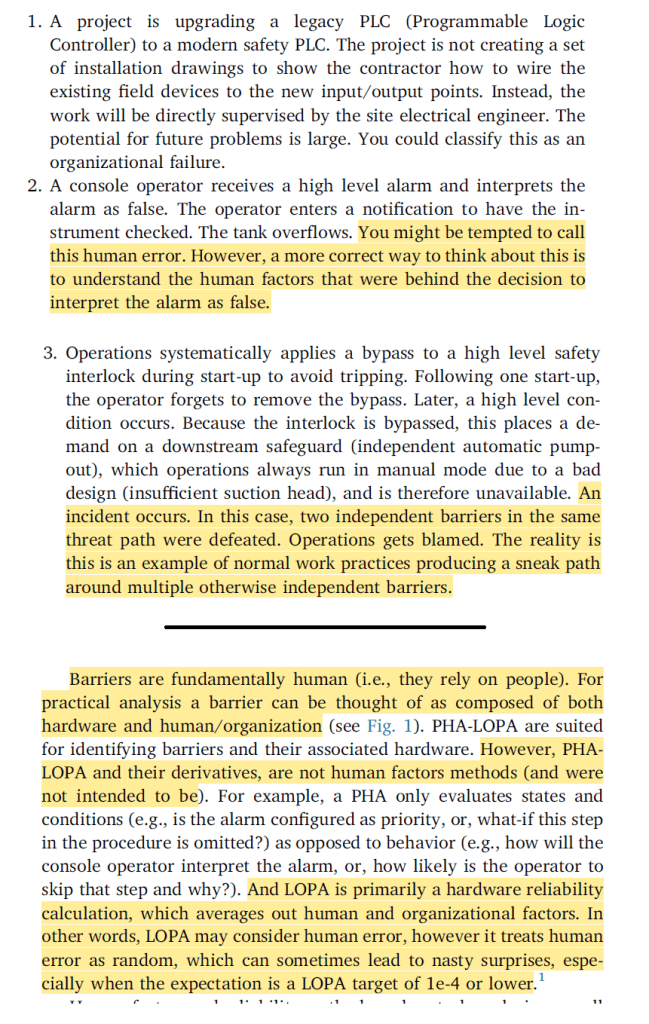
· “Barriers are fundamentally human (i.e., they rely on people)”
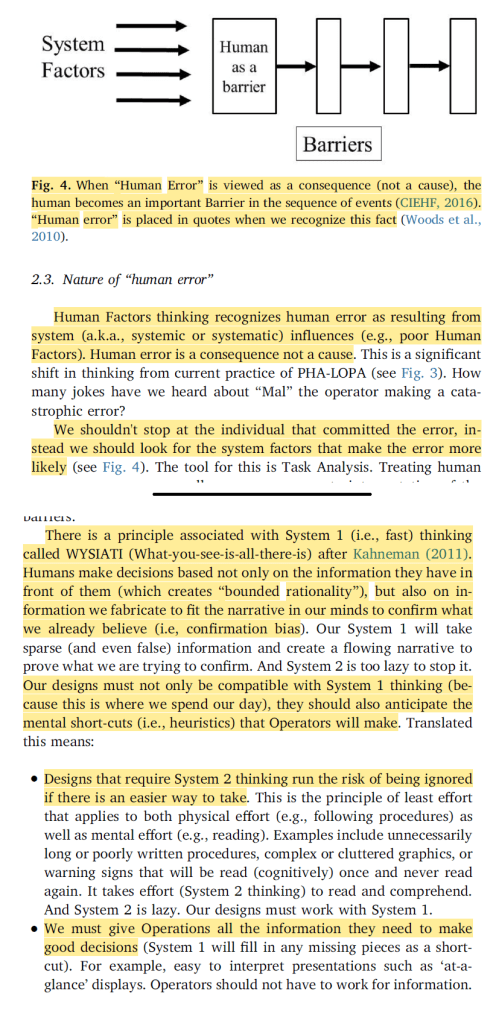
· Human Factors recognises “human error as resulting from system (a.k.a., systemic or systematic) influences” and it’s “a consequence not a cause”
· Cognitive processing is discussed, and the important role how “designs must not only be compatible with System 1 thinking … they should also anticipate the mental short-cuts (i.e., heuristics) that Operators will make”
· And regarding design, “We must give Operations all the information they need to make good decisions”
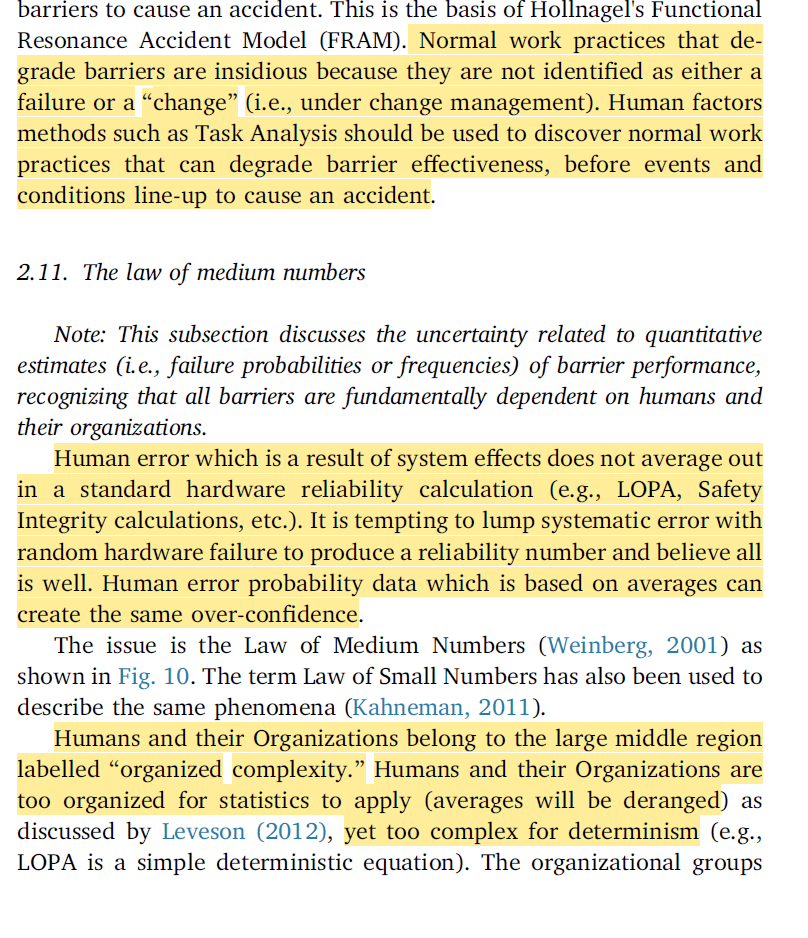
· The author emphasises the critical role of understanding normal work, e.g. “Normal work practices that degrade barriers are insidious because they are not identified as either a failure or a “change”
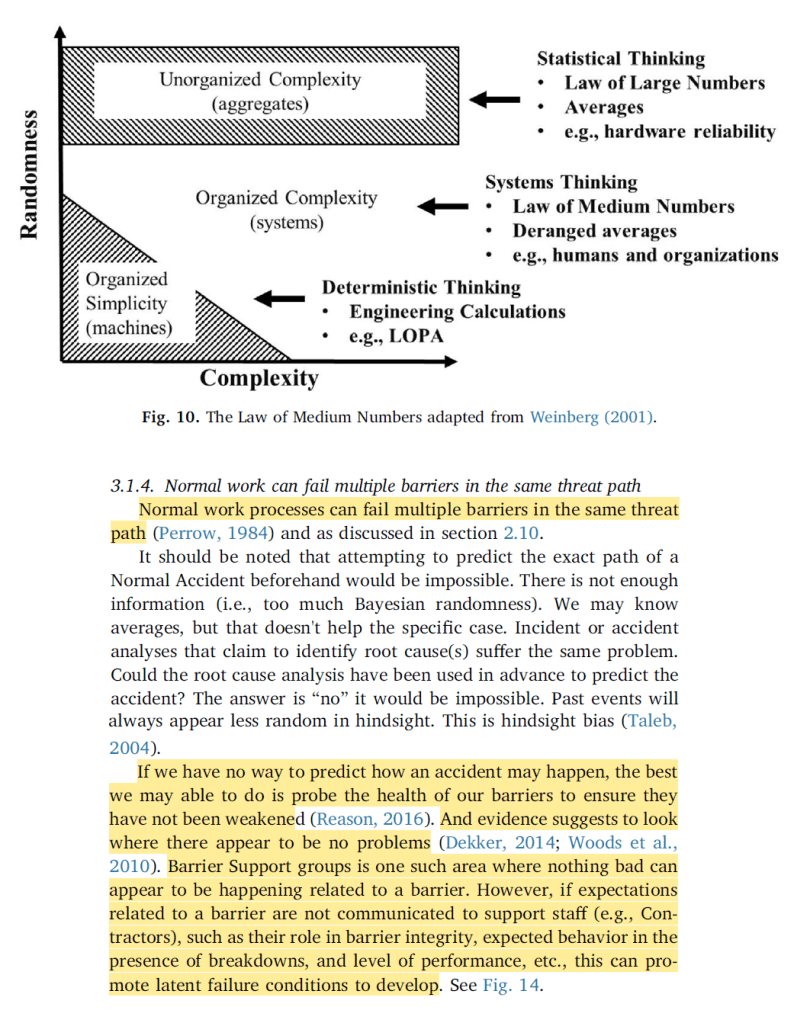
· While much thinking is devoted to deterministic approaches or laws of large numbers (in statistics), instead “Humans and their Organizations belong to the large middle region labelled “organized complexity.” Humans and their Organizations are too organized for statistics to apply (averages will be deranged)”
· Hence, the law of medium numbers may be more applicable to understanding human work in organisations
· Some statements regarding medium numbers are provided:
1) expect extreme outcomes on occasion,
2) don’t put too much trust in hardware reliability calculations,
3) it’s better to focus on human factors matters than massaging reliability calculations
· “Normal work processes can fail multiple barriers in the same threat path”
· Given the challenge in predicting how the next accident may happen, a better approach may be to “probe the health of our barriers to ensure they have not been weakened”
· Here, “evidence suggests to look where there appear to be no problems (Dekker, 2014; Woods et al., 2010)”, that is, normal work
· Normal work factors (workarounds, re-designs, ad hoc fixes, resource constraints) can “combine with other environmental factors to defeat otherwise independent barriers to cause an accident”
Ref: Grattan, D. D. J. (2018). Journal of loss prevention in the process industries, 55, 400-410.
Journal version: https://doi.org/10.1016/j.jlp.2018.07.016
My site with more reviews: https://safety177496371.wordpress.com

 SafetyInsights.org
One thought on “Improving barrier effectiveness using human factors methods”