
This paper from Edmondson and Besieux discusses proposed a framework to distinguish between productive and unproductive forms of voice and silence.
Summary next week.
Frequently conversations at work at said to be “unsatisfying, unproductive, or both”, like meetings with little input.
Speaking up isn’t always productive – like complaining endlessly or expecting someone else to fix the problems they raise.
Most people “intuitively understand that all voice is not productive – and that some silence is indeed golden”.

Psychological safety here is critical.
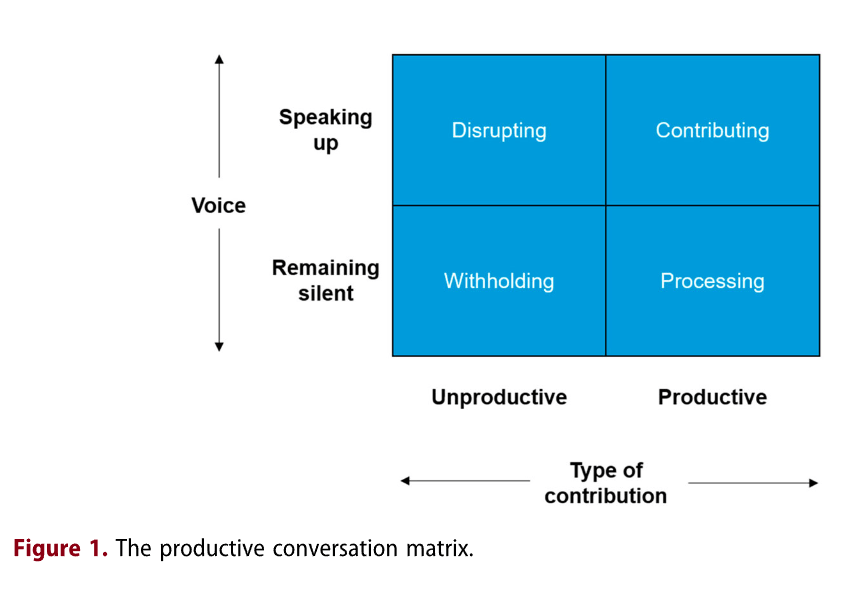
They developed a productive conversation matrix, proposing four archetypes of participation modes in a conversation:
· speaking up
· remaining silent
· productive contributions
· unproductive contributions.
What they’ve referred to as withholding, disrupting, contributing and processing.
Diminish Withholding
They provide an example of a major strategic decision failure where multiple people, for different reasons, decided to hold back on crucial info. Some examples was a belief that the leader was ‘always right’, because nobody else disagreed or complained, or a belief that the leader wouldn’t listen to concerns.
Minimize Disrupting
Next they discuss the role of disruption. Instead of a failure to speak up, disruption involves speaking that impede progress towards goals. Disruption includes “thoughtless utterances, where the speaker could have, but did not, consider the impact on others of what they were saying, and how they were saying it”.
Unproductive Voice and Leaders
They discuss how “harmful disruptive voice can be”. That is, “When disagreement is punished, or belittled, it quickly becomes rare”.
Further, the failure of speakers to understand the negative impact that angry or belittling outbursts can have on people.
Promote Contributing
In contrast to unproductive voice, productive voice is about speaking up with relevant points, to actively contributing to a conversation. Contributing isn’t just about ideas, info etc. but even verbalising agreement, supporting someone’s action, building on a concept, asking a question and more.

Encourage Processing
This step is about allowing people the opportunity to reflect on what they’ve heard. Processing means “active listening with a primary aim of understanding what is being said”.
This is a productive form of silence, and helps avoid people talking past each other. Productive silence, then, “is vital to the construction of conversations that move forward in meaningful ways”.

They conclude that “Workplace conversations that truly work – that advance understanding, learning, and task progress – have never been a more important source of organizational effectiveness”.

Authors: Amy C. Edmondson & Tijs Besieux (2021) Reflections: Voice and Silence in Workplace Conversations, Journal of Change Management, 21:3, 269-286, DOI
Study link: https://doi.org/10.1080/14697017.2021.1928910
My site with more reviews: https://safety177496371.wordpress.com

 SafetyInsights.org
One thought on “Productive vs unproductive conversations – matrix from Amy Edmondson”