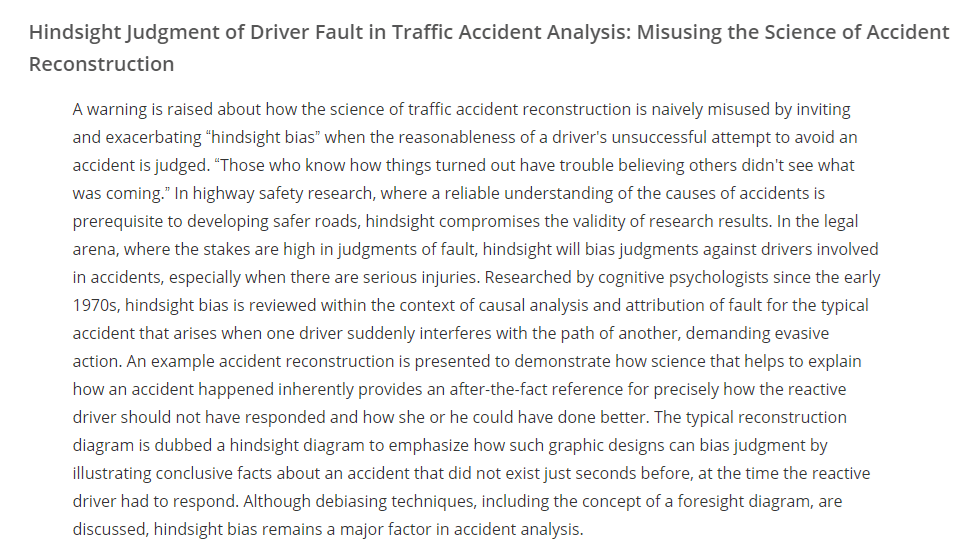
This was cool – it explored the role of hindsight in shaping traffic accident judgements.
It also constructed a hindsight / foresight diagram comparing what the ‘culpable’ driver knew prior to the accident compared to what was learnt after.
It’s said:
· “hindsight bias refers to the tendency for after accident observers to believe falsely that the once future accident was more foreseeable than was actually the case for those involved””
· It’s also been referred to as creeping determinism, and ‘magical thinking’
· Hindsight knowledge leads to people to judge drivers “harshly, as irresponsible and therefore unreasonable”; claims are made by how the driver (who didn’t avoid a crash) failed to “drive defensively, not anticipating the conflict, inattentiveness”

· “People are inclined to believe that the wisdom they gain from knowing precisely what happened sharpens their ability to look back and pass judgment on the driver’s actions. But the view we get when looking back at how things turned out can be dangerously misleading”
· step-by-step crash analysis tends of after-the-fact evidence “tends to dilute the surprise, uncertain, threatening, and emergent nature of the situation that existed before the collision”
· This occurs with the benefit of knowledge that the accident occurred and to “undo mentally the accident several times and imagine how the drivers could have done better”
· Hindsight processes are so natural “most are not conscious of how their knowledge of how an accident happened can bias their judgment of the performance of those involved”
· “This outcome knowledge poisons the ability of after accident observers to recreate the view of the situation before the accident”
· “Hindsight bias remains the primary obstacle to accident investigation”

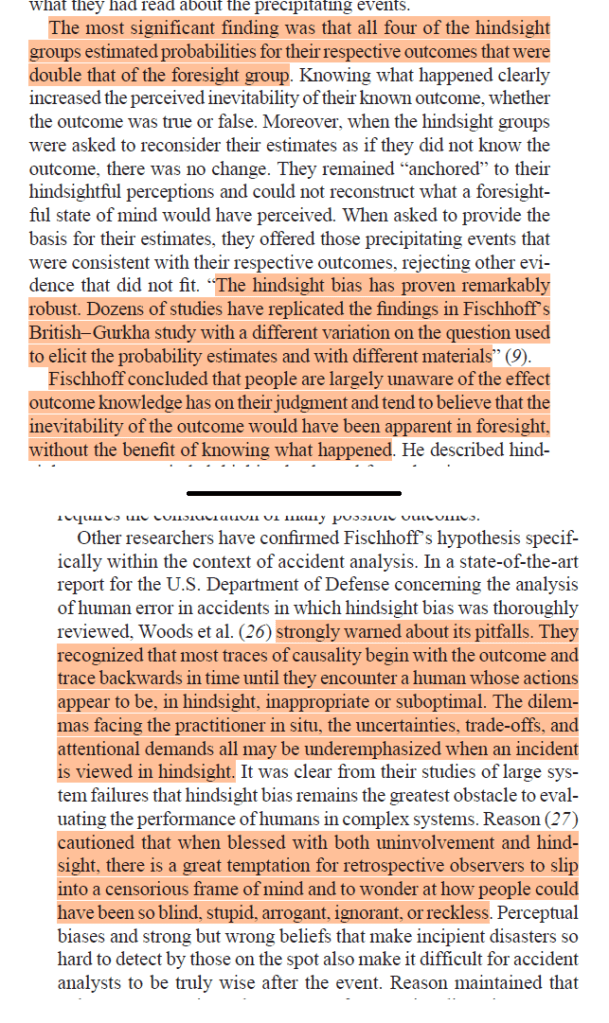
· “overwhelming consensus is that the hindsight bias is a robust phenomenon that is not easily eliminated or even moderated (8)”
· Hindsight bias “is caused by a deeply ingrained cognitive process, as well as significant motivational forces”
· “Hindsight bias is subtle in its nefariousness. It is hard to recognize and hard to “feel” it happening. Since it is natural for people to use outcome knowledge when looking at the past, people may react with puzzlement to concerns about this bias and falsely believe that they are immune to its influence”
· They discuss a model of an accident from both the hindsight perspective (after the fact knowledge), and knowledge known to one of the drivers at the time – foresight
· It’s highlighted how the driver didn’t know a considerable portion of the cues, nor could have
· Hence, “most of the events [in the foresight map] had not yet occurred and could not be reliably predicted [by the driver]”
Ref: Dilich, M., Kopernik, D., & Goebelbecker, J. (2006). Transportation research record, 1980(1), 1-7.
My site with more reviews: https://safety177496371.wordpress.com

 SafetyInsights.org
One thought on “Hindsight Judgment of Driver Fault in Traffic Accident Analysis: Misusing the Science of Accident Reconstruction”