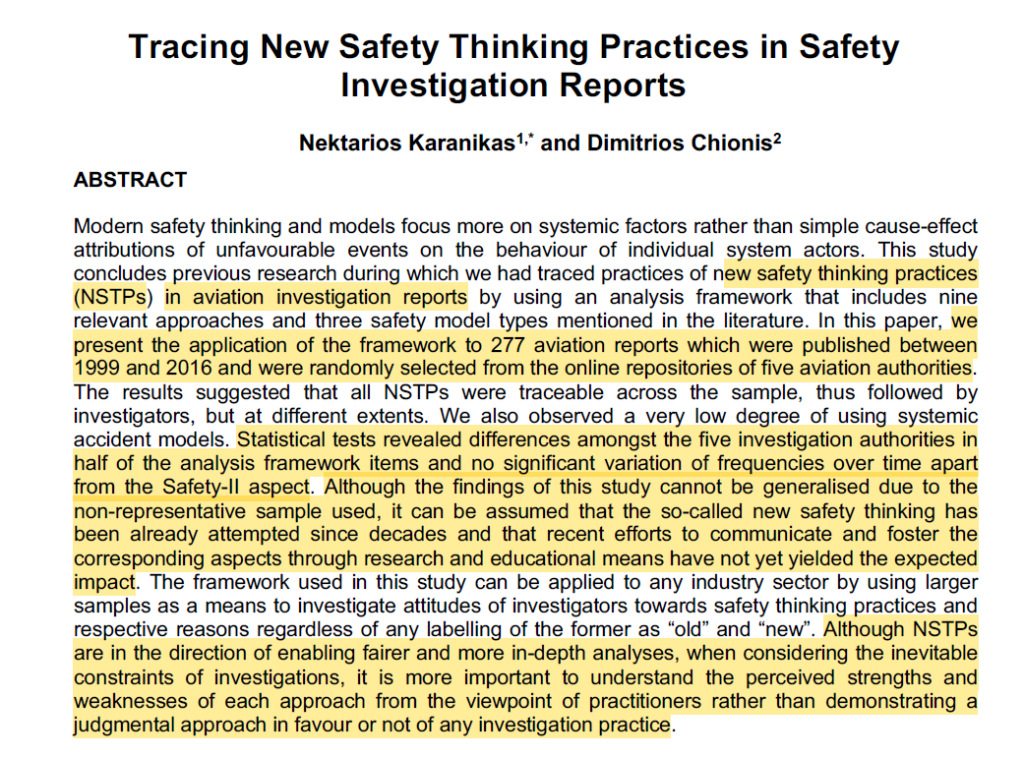
This 2019 paper from Nektarios Karanikas and colleague explored the adoption (or not) of New Safety Thinking Practices (NSTPs) in aviation investigation reports from five aviation authorities.
Not a summary but you can read the whole report.
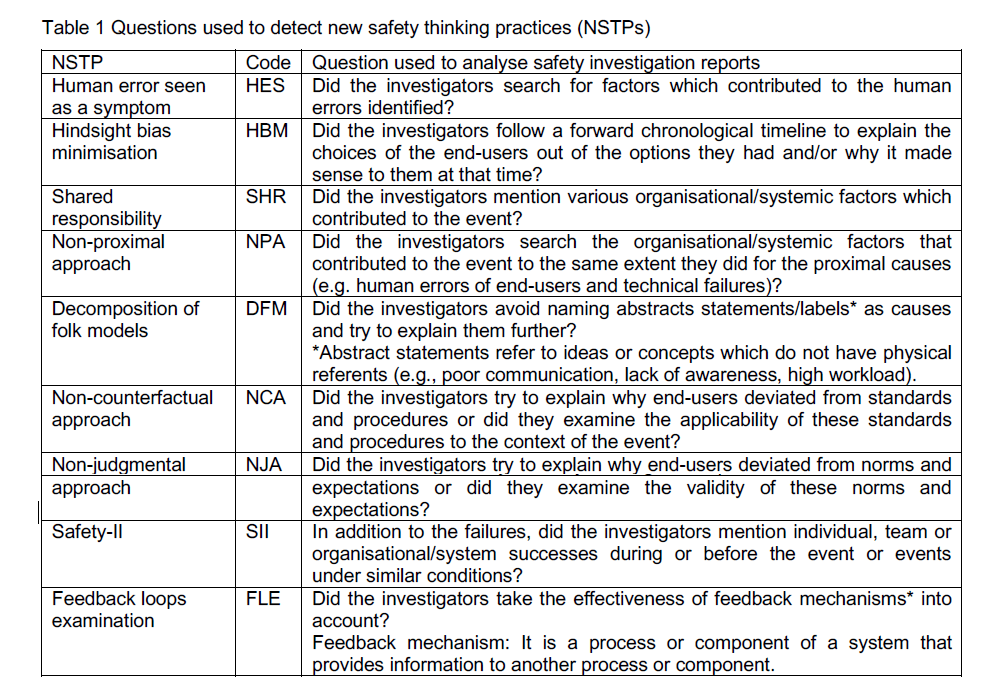
Some extracts:
· All elements of the studied NTSPs were visible across the sample, but to different extents
· They “observed a very low degree of using systemic accident models”
· Half of the framework items were found to change little over the timeframe, whereas the Safety-II aspect did change
· They warn that while the findings can’t be generalised outside of the sample, “it can be assumed that the so-called new safety thinking has been already attempted since decades”
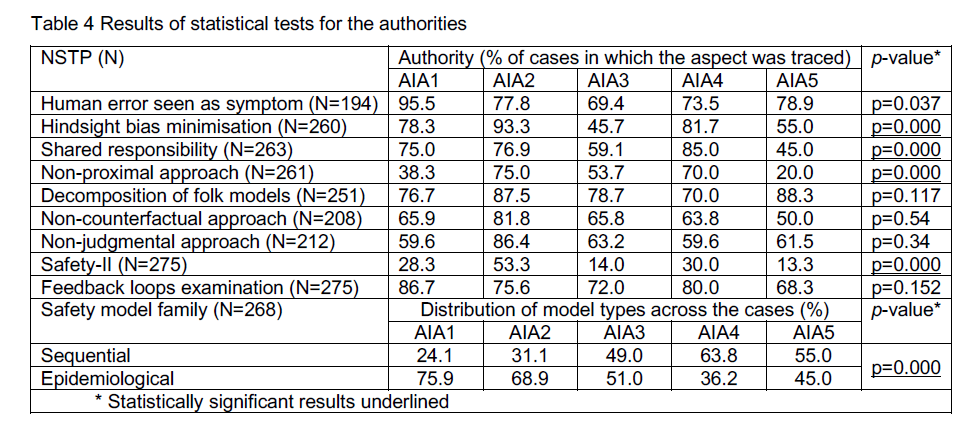
· “it seems that investigation teams had sufficiently embraced the concept that the detection of human error cannot constitute the end point of investigations”
· “detection of this aspect in almost 80% of the sample can be attributed to the fact that the “human error seen as a symptom” perspective has been advocated long before recent literature was published”
· Investigator “efforts to look behind human error might stem naturally from a reflection on unpleasant situations they confronted and, possibly, their will to protect others from the unfair treatment”
· “Nonetheless, almost one fifth of the reports had stopped at the attribution of human error as the final cause of events; this result suggests that there might be plenty of occasions where investigations focus on the performance of the end-users alone and, apart from laying the ground for a blaming culture”
· Decomposition of folk models and feedback loop examination were observed in >75% of reports, which the authors believe is influenced by the number of engineers in the field
· Engineer familiarity with systems engineering “have led them to (1) avoid the labelling of constructs as event causes because they search for measurable and observable causal factors, and, (2) examine whether systems provided to the end-users with adequate information about the state and outcomes of processes”
· “hindsight bias minimisation” was observed in ~72% of reports; seen as a “highly positive sign”
· Attempts to minimise non-judgemental language and counterfactuals was observed in ~66% of reports
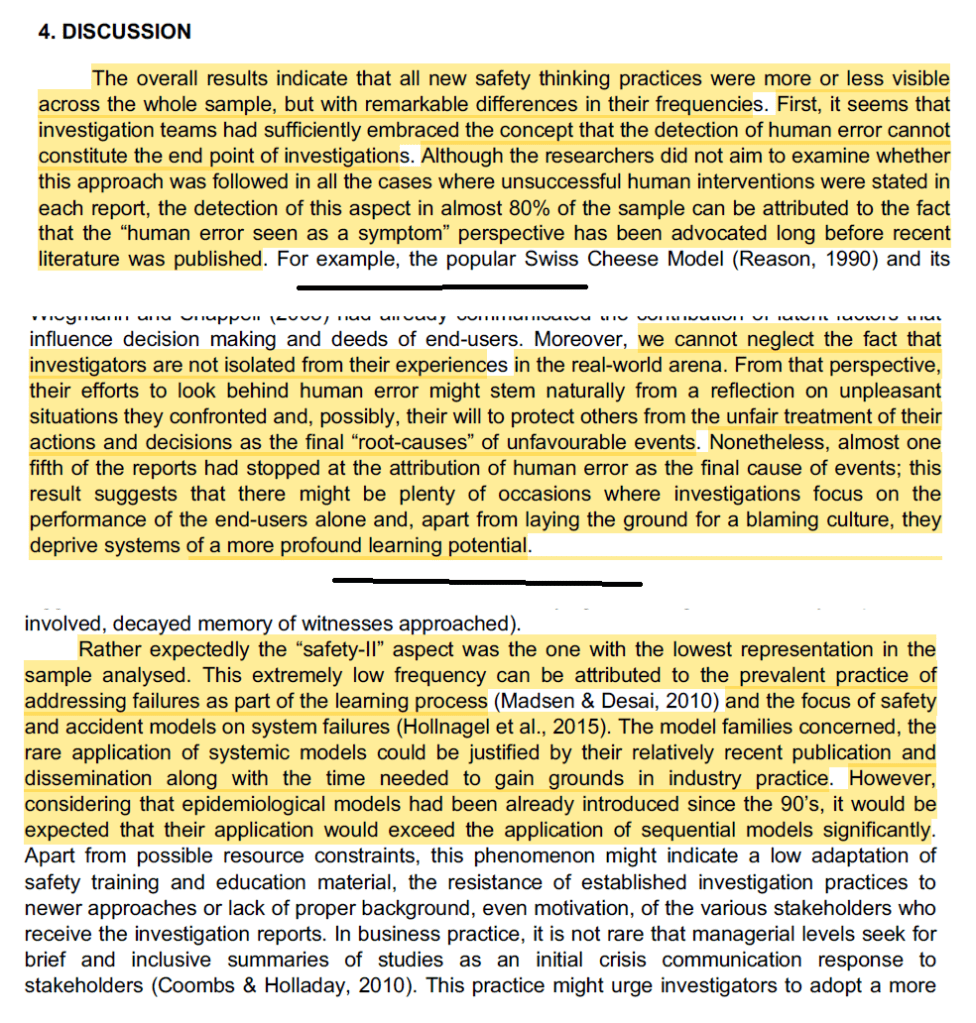
· “Rather expectedly the “safety-II” aspect was the one with the lowest representation in the sample analysed”; but did significantly increase over the time period
Finally, they argue that while “NSTPs offer the opportunity for fairer and more in-depth analyses … [investigations are still] subject to boundaries, even these are not always explicitly recognised and reported”.
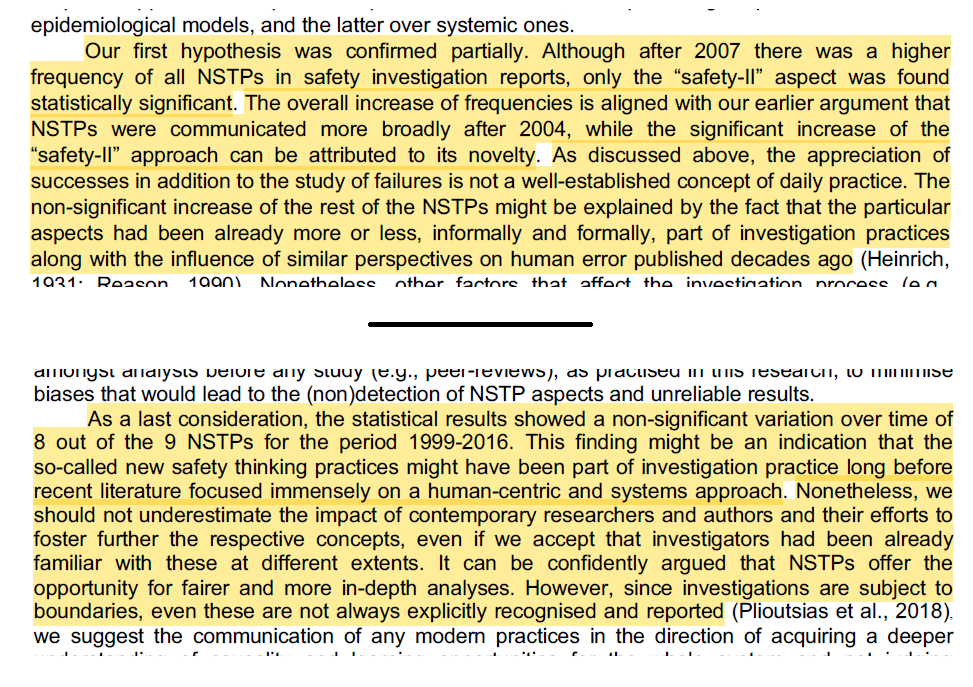
Ref: Karanikas, N., & Chionis, D. (2019, February). Tracing new safety thinking practices in safety investigation reports. In 3rd International Cross-industry Safety Conference (p. 01001). EDP Sciences.
My site with more reviews: https://safety177496371.wordpress.com

 SafetyInsights.org
2 thoughts on “Tracing New Safety Thinking Practices in Safety Investigation Reports”