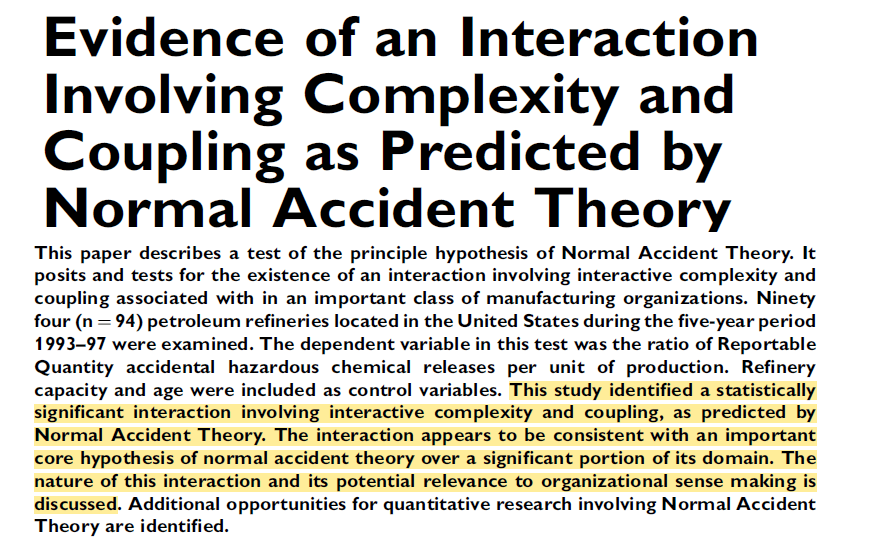
This was cool – they evaluated the relationship between reportable quantity accidental HAZCHEM releases as a function of refinery interactive complexity and coupling, as per Perrow’s Normal Accident Theory (NAT).
94 US refineries were included.
Background:
· According to NAT, “technical system risk is determined by the interaction of two characteristics associated with the organization and its technology: interactive complexity and coupling”
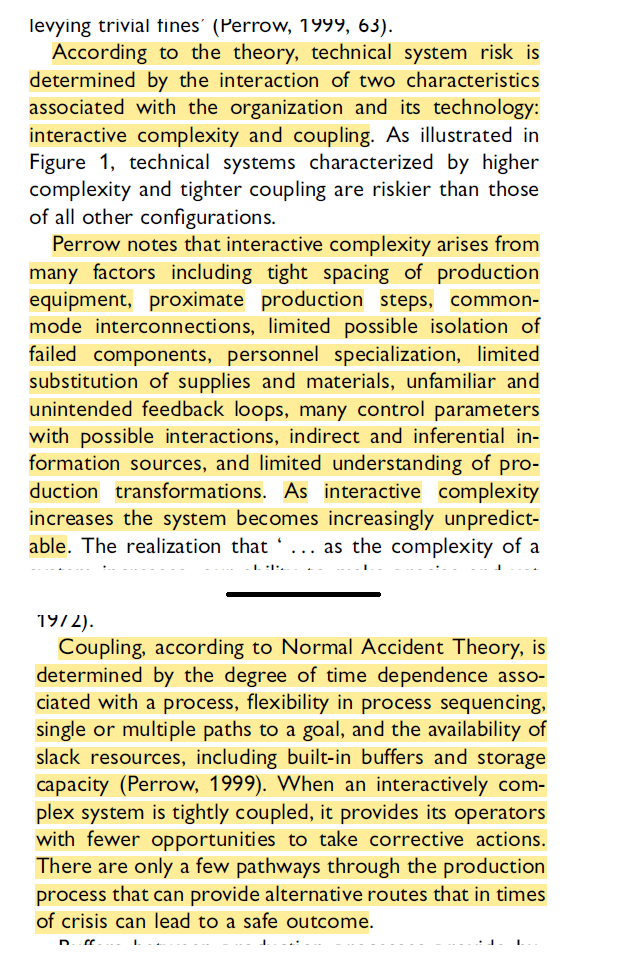
· “interactive complexity arises from many factors including tight spacing of production equipment, proximate production steps, common-mode interconnections, limited possible isolation of failed components, personnel specialization, limited substitution of supplies and materials” and more
· “As interactive complexity increases the system becomes increasingly unpredictable”
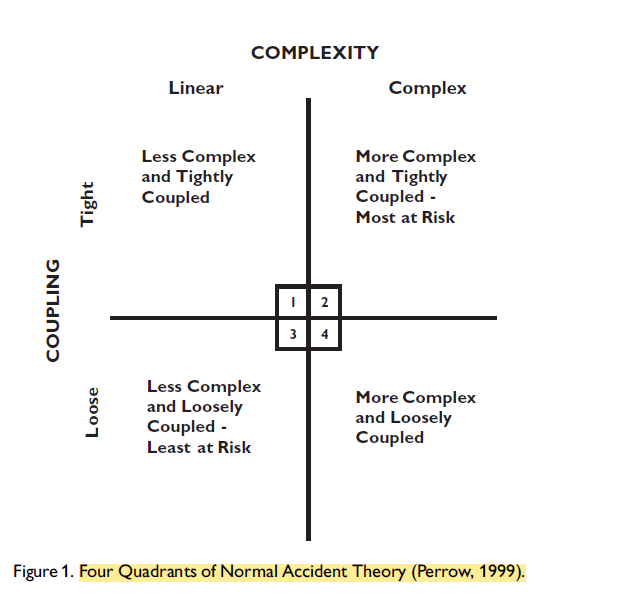
· Coupling is “determined by the degree of time dependence associated with a process, flexibility in process sequencing, single or multiple paths to a goal, and the availability of slack resources, including built-in buffers and storage capacity”
· “When an interactively complex system is tightly coupled, it provides its operators with fewer opportunities to take corrective actions”
Key findings:
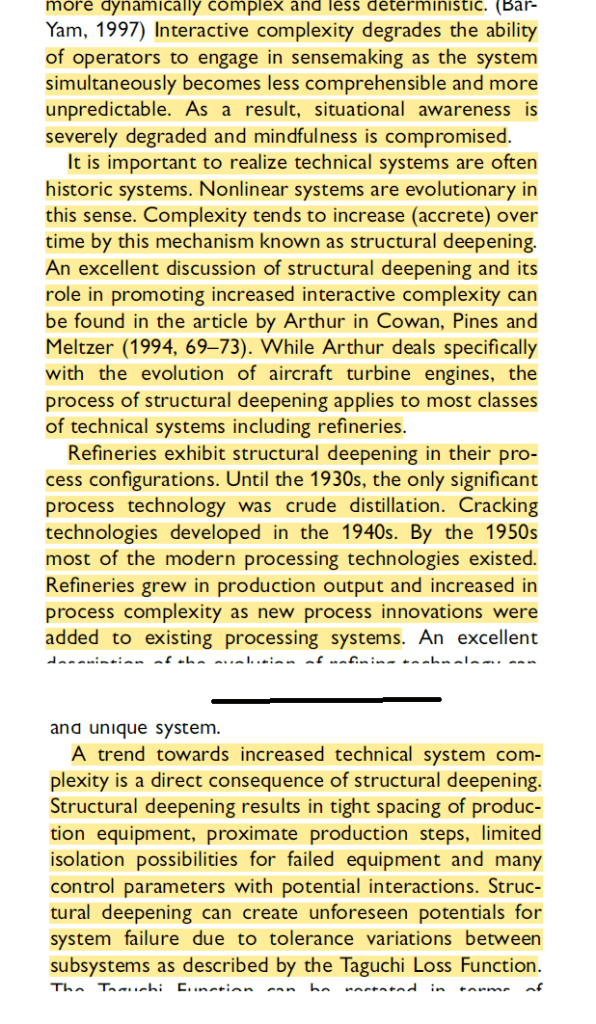
· They “identified a statistically significant interaction involving interactive complexity and coupling, as predicted by Normal Accident Theory”
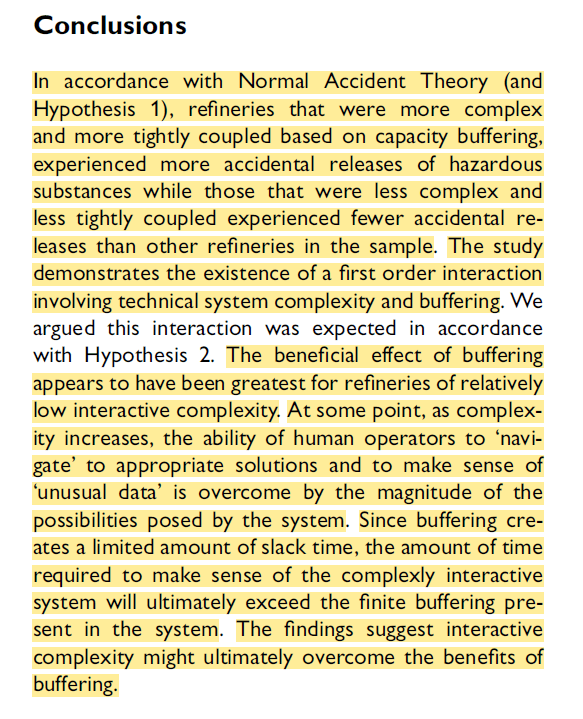
· “environmental reliability as described by the rate of accidental hazardous substance releases is significantly lower for refineries characterized by higher interactive complexity and tighter coupling associated with buffering capacity”
· “a beneficial effect associated with looser coupling was observed for refineries characterized by buffering ratio between 0.7 and 1.2 and a moderate level of interactive complexity”
· The beneficial effect of looser coupling was observed for moderately interactively complex refineries, and no beneficial effect found for higher levels of interactive complexity
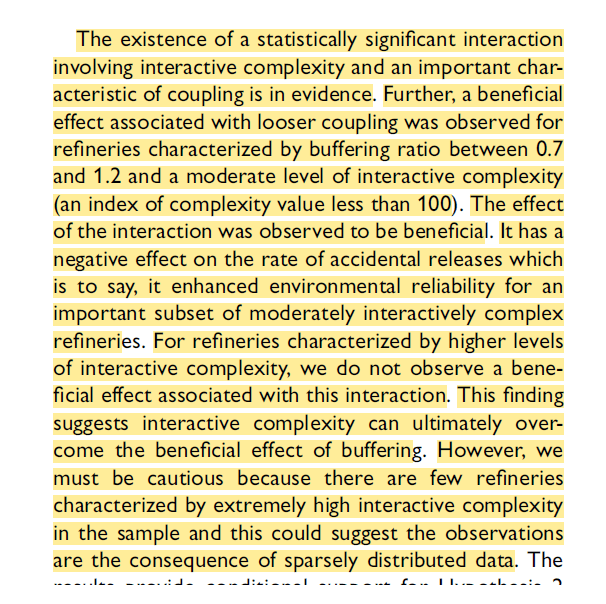
· Hence “At some point, as complexity increases, the ability of human operators to ‘navigate’ to appropriate solutions and to make sense of ‘unusual data’ is overcome by the magnitude of the possibilities posed by the system”
· This “suggests interactive complexity can ultimately overcome the beneficial effect of buffering”
· However, the sample was limited by refineries with extremely high interactive complexity
· Buffering capacity were beneficial for looser coupling, yet “Strong organizational pressure exists to … minimize buffering capacity in refinery systems”
· Buffering creates “a limited amount of slack time, the amount of time required to make sense of the complexly interactive system will ultimately exceed the finite buffering present in the system”
Ref: Wolf, F., & Sampson, P. (2007). Journal of Contingencies and Crisis Management, 15(3), 123-133.
My site with more reviews: https://safety177496371.wordpress.com

 SafetyInsights.org
One thought on “Evidence of an Interaction Involving Complexity and Coupling as Predicted By Normal Accident Theory”