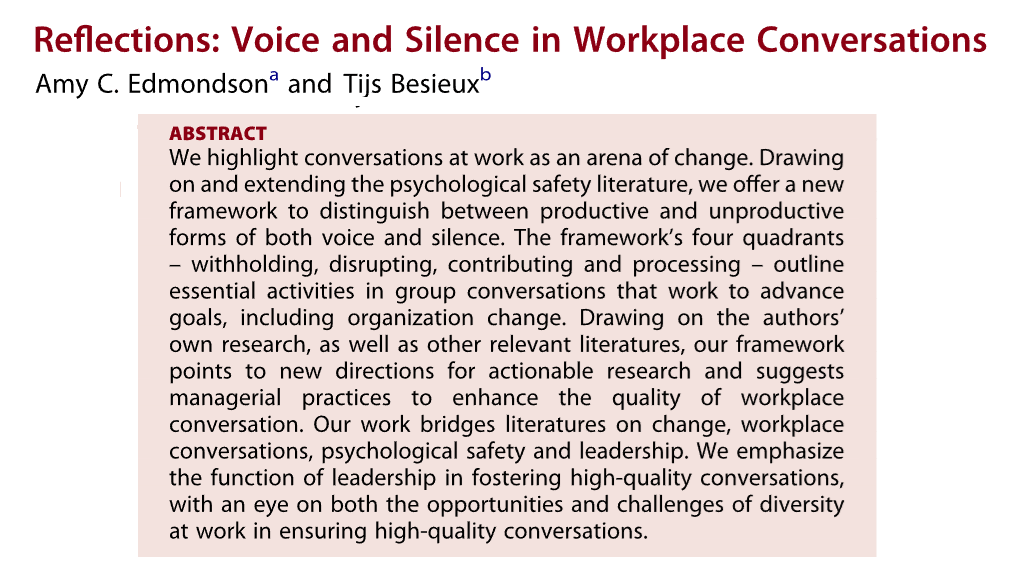
A fascinating read from Edmondson and Besieux, who discuss the role of conversations in driving change at work, and proposing a framework to distinguish between productive and unproductive forms of voice and silence.
Note – I’ve skipped heaps, and especially their examples/scenarios, and also many of their suggestions on how to implement improvements. Check out the full paper.
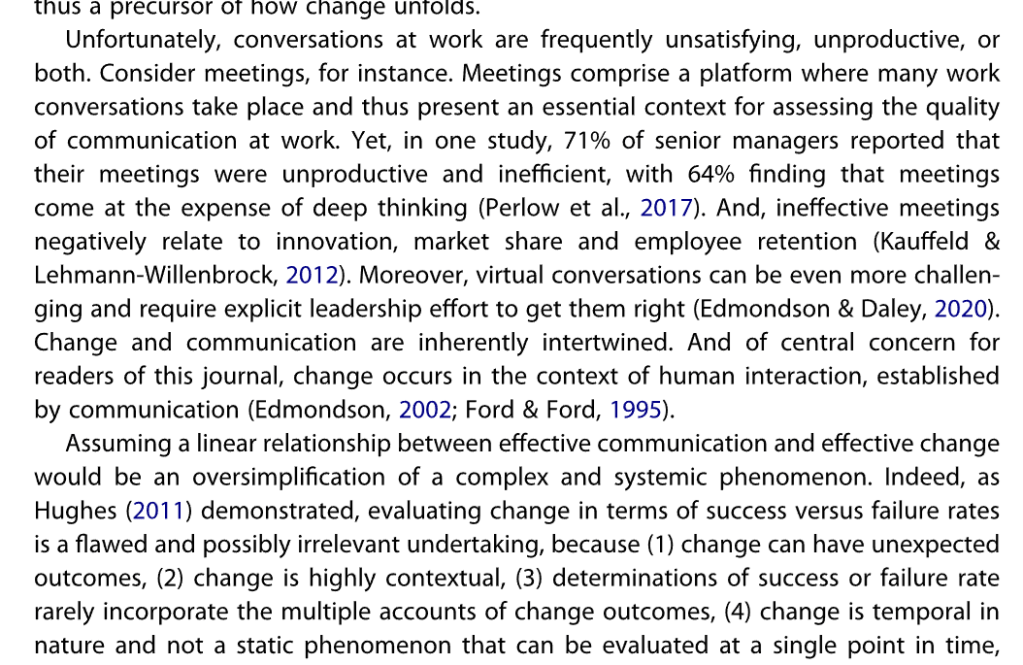
Frequently conversations at work at said to be “unsatisfying, unproductive, or both”. Meetings for instance allow a platform for many work conversations to take place; yet one study found 71% of senior managers reported that their meetings were unproductive and inefficient, and 64% reporting that “meetings come at the expense of deep thinking”.
They provide an example of how junior associates failed to offer their ideas and honest assessments during a meeting with senior executives. That people hold back, particularly junior workers, isn’t surprising to most – especially when those voiced opinions may be underdeveloped or seen as critical of superiors.
Psychological Safety (PS) has been recognised as a work climate factor that influences speaking up; being, in part, a “belief that speaking up with ideas, questions, concerns, or mistakes is expected and feasible, and is best summarized as a sense of permission for candour”.
Nevertheless, some executives worry in private that “creating psychological safety will result in too much cross-talk or unleash endless chatter, gobbling up valuable time, slowing progress, or creating confusion”.
In other ways, some people might speak up in unproductive ways, like complaining endlessly or expecting someone else to fix the problems they raise. Most people “intuitively understand that all voice is not productive – and that some silence is indeed golden”, making it difficult to know which is which, and how to balance solicitation of input with maintenance of efficiency. Efficiency usually wins in this balancing act.
Nevertheless, they authors don’t see this as a balancing act but rather “as a matter of discernment, focus and skill in leading effective discussions”. They offer a framework to help elucidate useful distinctions about when voice and silence are productive and unproductive.
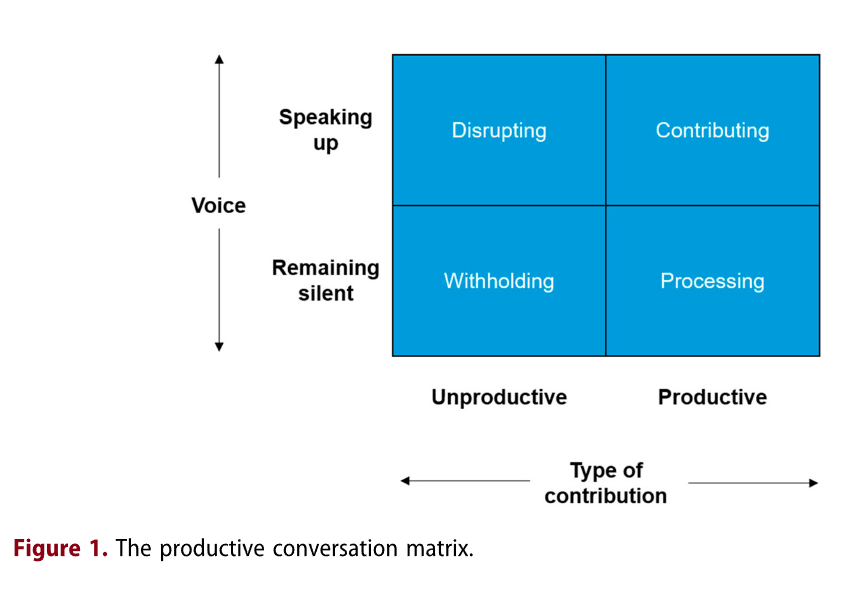
The Productive Conversation Matrix
When PS is low and employees refrain in meetings, quality of conversation and results are diminished. Further, diversity of thought may be impacted, brilliant ideas missed, the benefits lost from thoughtful debate, and at worst, silences on crucial info or issues aren’t shared, allowing a major failure. But a free-reign meeting without any rules, management and principles is also problematic.
Hence, they propose four archetypes of participation modes in a conversation, based on two dimensions: speaking up or remaining silent, and productive or unproductive contributions. What they’ve referred to as withholding, disrupting, contributing and processing.
Diminish Withholding
They provide an example of a major strategic decision failure where multiple people, for different reasons, decided to hold back on crucial info. Some examples was a belief that the leader was ‘always right’, because nobody else disagreed or complained, or a belief that the leader wouldn’t listen to concerns. In any case “Ineffective conversation resulted in ineffective change”.
Drivers of Withholding
Withholding is argued to occur when people refrain from sharing on-topic info. For these people, although they’re aware they have a relevant point, “they feel it might be risky, inappropriate, or unwelcome, and thus hold back”. Holding-back by somebody is said to be, by definition, hard to observe but overtime may become apparent.
They gave an example about a leader asking if anybody had a ‘brilliant idea to share’. One junior offered an idea that was quickly rejected by the leader. Resultingly, no other juniors voiced their opinions – “unproductive silence (withholding) ensued”. No changes were made to their strategy, and the leaders believed that their subordinates lacked insight or were unengaged.
Withholding comes about for several reason:
1) at a personal level – the risk of receiving demeaning comments, and this becomes more salient when race or gender are at play [** and I wonder power differentials?]
2) Institutionally – it can be intimidating to point about potentially serious business risks in leaders’ ideas and “particularly if it’s been presented with enthusiasm or bias in its favour by someone in a position of power”
Reducing Withholding Through Psychological Safety
They provide some suggestions on reducing withholding via PS. While much has been written about creating PS, “many leaders still fail to recognize the importance of their own behaviour in ensuring productive voice in the workplace”.
Leaders may fail to adopt a “healthy stance of humility and curiosity congruent with the uncertainty and challenges that lie ahead”.
Humility is exhibited when making explicit statements about the need for others’ input, whereas curiosity is found in “artful questions that invite and engage others in thinking deeply about the issues at hand”.
These prompts can help frame voice as essential to the quality of decisions and “ creates an explicit rationale for why others’ ideas are being requested, which lowers reluctance to jump in with a dissenting view”.
They argue that “It is hard to overstate the value of an explicit invitation”.
Minimize Disrupting
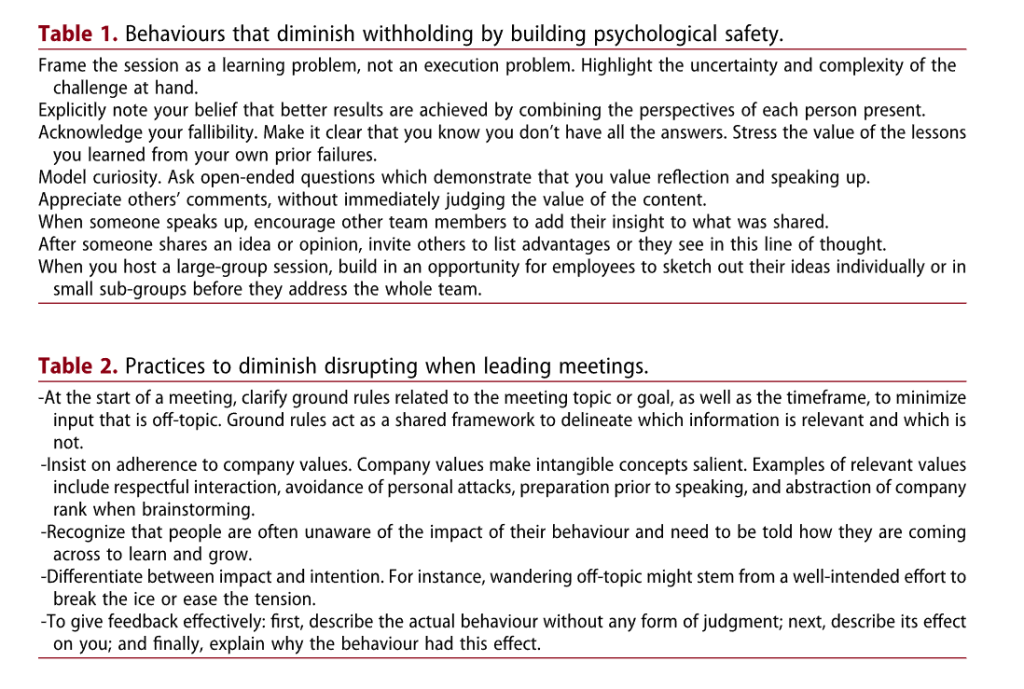
Next they discuss the role of disruption. Instead of a failure to speak up, disruption involves speaking that impede progress towards goals. Disruption includes “thoughtless utterances, where the speaker could have, but did not, consider the impact on others of what they were saying, and how they were saying it”.
Unproductive Voice and Leaders
They discuss how “harmful disruptive voice can be”. That is, “When disagreement is punished, or belittled, it quickly becomes rare”.
Further, the failure of speakers to understand the negative impact that angry or belittling outbursts can have on their target, and on others who observe or even just hear about the outburst. They provide an example demonstrating how harmful it can be, and highlights “the special responsibility leaders hold for ensuring that they communicate in ways that foster learning, progress and positive change”.
Another example they provide is how a leader framed a meeting by being an opportunity to “harvest the very best ideas” and they need everybody to “bring your A-game to the table!”.
The authors ask why this well-intended approach didn’t work? For one, it “inadvertently set up an evaluative context (grades) rather a problem solving or learning context”. That is – this framing raised the bar so that people would filter their responses to ensure that their ideas deserved an A-grade; people erred on the side of caution.
They also discuss how meetings and conversations can become fragmented, or off-topic, with small talk. While small talk is normal, and can help break the ice or diffuse anxiety, it also takes up valuable time that others can’t use to provide their input.
Interestingly, the authors argue that small talk, jokes and departures from topics may also “inadvertently signal that divisive topics are indeed off-limits”.
When Truth Hides Behind Closed Doors
This type of unproductive voice is in the form of candid and relevant voice about problems, but occurring only behind closed doors. This is reflected in people speaking up about real issues in a way that lets them blow off steam, but makes no difference to the core issues. Hence, they speak up but only with peers.
They discuss an example from Boeing whistleblowers, and how some issues were discussed behind closed doors. It’s argued that while it’s “harmless to grumble now and then about the boss, the boring meeting, or an unwelcome policy from senior management, discussions of crucial issues that take place in side conversations, rather than in formal meetings, where concerns can be addressed thoughtfully with people in a position to instigate a change of course”.
Hence, these grumbles and closed-door conversations can “cause more harm than good”.
Promote Contributing
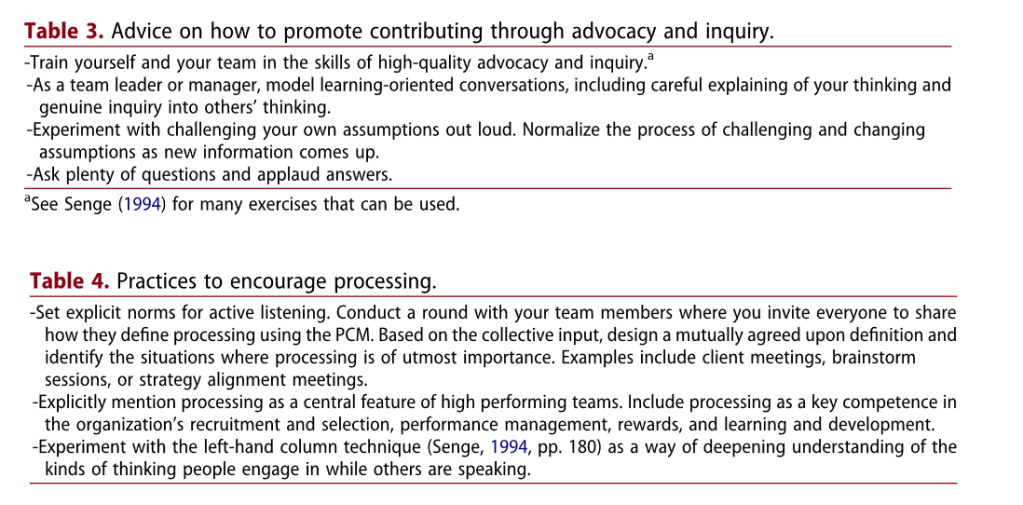
In contrast to unproductive voice, productive voice is about speaking up with relevant points, to actively contributing to a conversation. Contributing isn’t just about ideas, info etc. but even verbalising agreement, supporting someone’s action, building on a concept, asking a question and more.
Hence, “Contributing is thus more than the reverse of withholding. It actively nurtures a climate of psychological safety and moves the conversation forward”.
Asking questions are suggested as actively promoting of contribution, since questions help “a group dig more deeply into a topic or redirect a discussion”.
They argue for a healthy mix of advocacy and inquiry for higher-quality discussions. Like a leader asking a junior to run them through their suggestion and how it would look/work. A way to shutdown the conversation, even when well-intentioned, could be to say that somebody’s idea is great and let’s run with it.
Here, moving straight to the action stage shuts down opportunities for dissent and constructive debate, especially from the most junior people. Another way is Devil’s Advocate.
Leaders have opportunities to model and explicitly train teams in the skills of productive dialogue. Advocacy for instance, is more than just somebody voicing their opinion but is a process of thinking aloud to aid thinking.
Inquiry is another way to promote higher-quality conversations by asking open-ended questions.
They also mention a potential technique is to “reframe withholding as an act of disloyalty” that is, “engrain speaking up in the very DNA of the organization” by imbibing the principle that this culture values speaking up, not silence.
Encourage Processing
This step is about allowing people the opportunity to reflect on what they’ve heard. Processing means “active listening with a primary aim of understanding what is being said”. This isn’t sitting back while others do the work, but “exercising the mental capacity to remain engaged in the discussion while silent”.
This is a productive form of silence, and helps avoid people talking past each other. Productive silence, then, “) is vital to the construction of conversations that move forward in meaningful ways”.
Some types of communication can destroy productive silence, like off-topic content, jokes, and other content that’s unimportant or tangential. Teams can set explicit norms for active listening to allow productive silence.
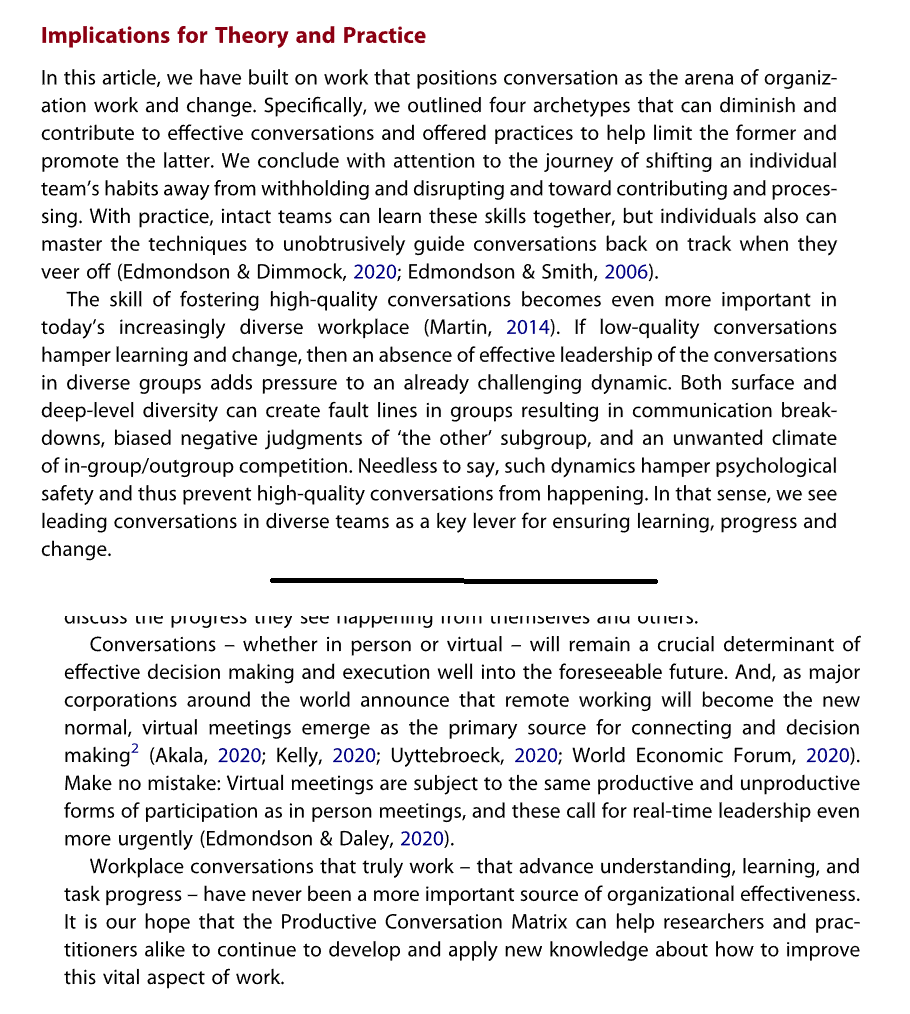
Developing high-quality conversations may be more difficult in modern diverse environments. They say that “Both surface and deep-level diversity can create fault lines in groups resulting in communication breakdowns, biased negative judgments of ‘the other’ subgroup, and an unwanted climate of in-group/outgroup competition”; which can hamper PS.
Finally they discuss ways to apply their framework, and to move forward with improvements in quality conversations. This includes assessing current levels of withholding, disrupting, contributing and processing within your teams.
This could be achieved via an external member observe the meeting as a fly on the wall, using surveys, or through skilled interviews. I’ve skipped most of this, so recommend you check out the paper.
Finally, they conclude that “Workplace conversations that truly work – that advance understanding, learning, and task progress – have never been a more important source of organizational effectiveness”.
Authors: Amy C. Edmondson & Tijs Besieux (2021) Reflections: Voice and Silence in Workplace Conversations, Journal of Change Management, 21:3, 269-286

Study link: https://doi.org/10.1080/14697017.2021.1928910
My site with more reviews: https://safety177496371.wordpress.com
LinkedIn post: https://www.linkedin.com/pulse/re%25EF%25AC%2582ections-voice-silence-workplace-conversations-ben-hutchinson-k7bic

 SafetyInsights.org
3 thoughts on “Reflections: Voice and Silence in Workplace Conversations”