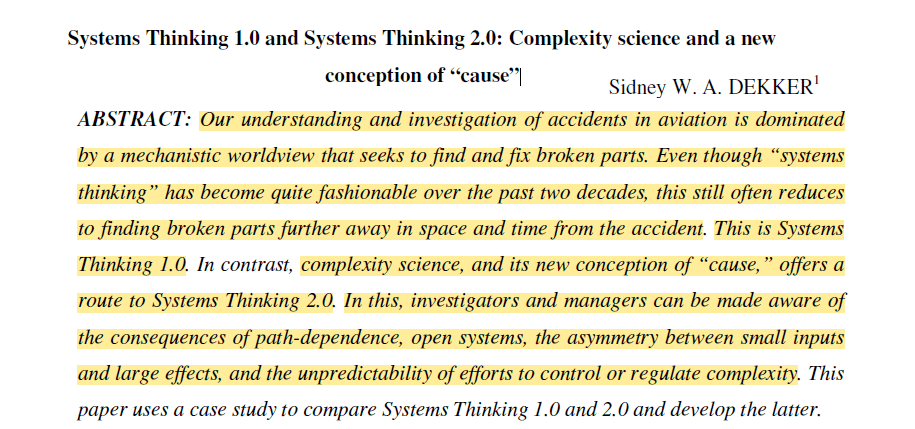
This 2011 paper from Sid Dekker may interest people. I only just ran across this.
It contrasts two different perspectives on systems thinking:
Systems thinking 1.0 (ST-1): A more mechanistic view of systems, encouraging reductionist and mechanistic worldviews – and “finding more broken parts further away in time and space from the accident”
Systems thinking 2.0 (ST-2): Drawing on complexity science, this perspective recognises non-linear relationships, emergent behaviour, path-dependence and more; hence, accidents “emerge from the multiple of relationships” rather than just linear sequences or broken parts
Not a summary, but the full paper is available via link.
Some extracts:
• ST-2 “is about accidents that are more than the sum of the broken parts. This entirely reinvents the notion of cause. Rather than being “caused” by broken parts in a linear sense (like the breach of successive layers of broken defenses), accidents emerge from the multitude of relationships”
• “Emergence is a conception of “cause” that is entirely different from Newtonian or mechanistic ideas. It is critical feature of complexity”
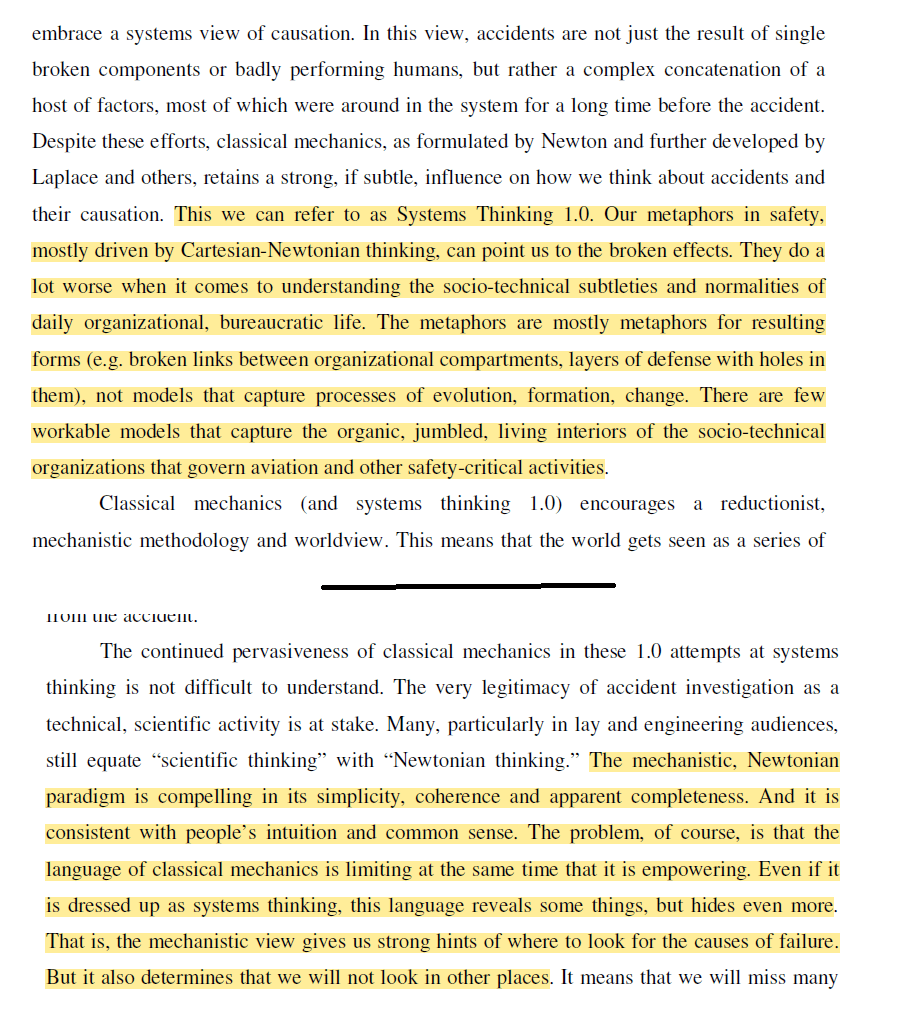
• ST-1 “encourages a reductionist, mechanistic methodology and worldview. This means that the world gets seen as a series of machines with parts that interact and that can break”
• “Even organizations get pictured as a collection of parts (e.g. layers of defense, stacked linearly). … Finding out why an accident happens is often still a matter of finding out which parts were broken”
• The perseverance of ST-1 logics aren’t hard to understand “The very legitimacy of accident investigation as a technical, scientific activity is at stake…The mechanistic, Newtonian paradigm is compelling in its simplicity, coherence and apparent completeness”
• “The problem, of course, is that the language of classical mechanics is limiting at the same time that it is empowering”
• “Even if it is dressed up as systems thinking, this language reveals some things, but hides even more”
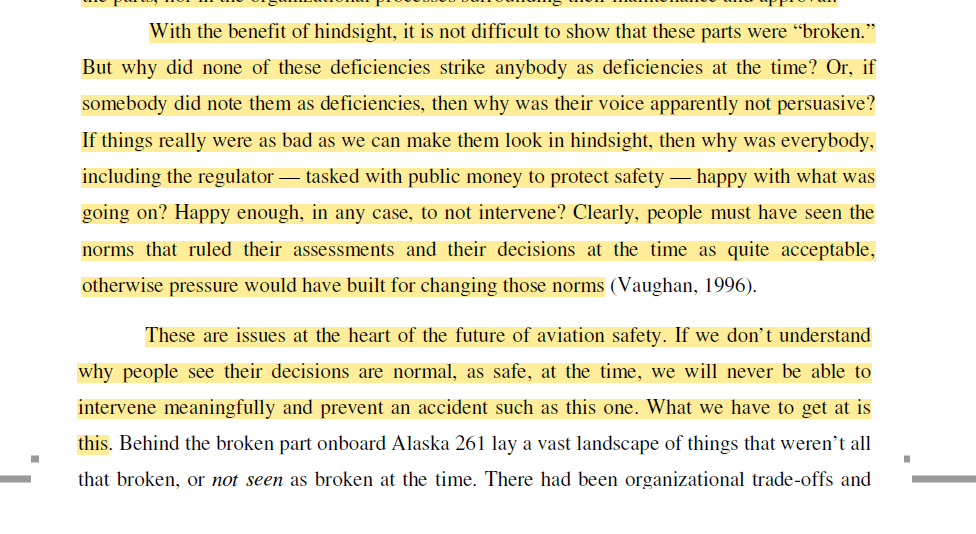
• Dekker discusses questions beyond the figurative ‘broken parts’, like why didn’t anybody pick up the apparent deficiencies? If they did, why wasn’t their voice persuasive? Etc
• “Clearly, people must have seen the norms that ruled their assessments and their decisions at the time as quite acceptable, otherwise pressure would have built for changing those norms”
• And “If we don’t understand why people see their decisions are normal, as safe, at the time, we will never be able to intervene meaningfully and prevent an accident such as this one”
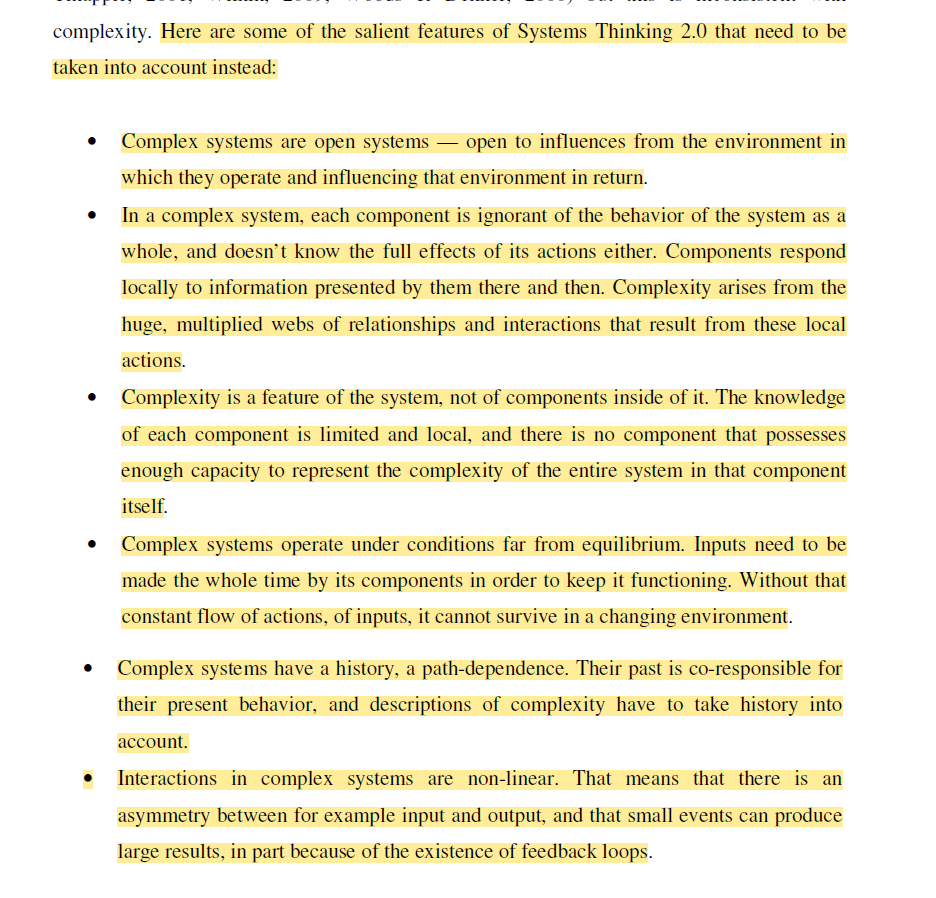
• Dekker discusses some salient features of ST-II logics (see attached image), involving being open systems, components being ignorant of the system behaviour, performance is a feature of the whole and not the parts, these systems operate far from equilibrium, they have a path-dependence, and are non-linear
• Adapting to resource pressures and the like “is normal: Scarcity and competition are part and parcel even of doing inspection work”
• Feedback imbalances exist, like it’s easy to measure early arrival or cost benefits, but “How much is or was borrowed from safety in order to achieve that goal, however, is much more difficult to quantify and compare”
• “The brewing of an accident, however, hides somewhere in the conflicts that get sorted out in these trade-offs”
• And, “This tension can lead to a slow, steady disengagement of practice from earlier established norms or design constraints (Leveson, 2011), and a redefinition of what is “normal” or “safe” or “acceptable”
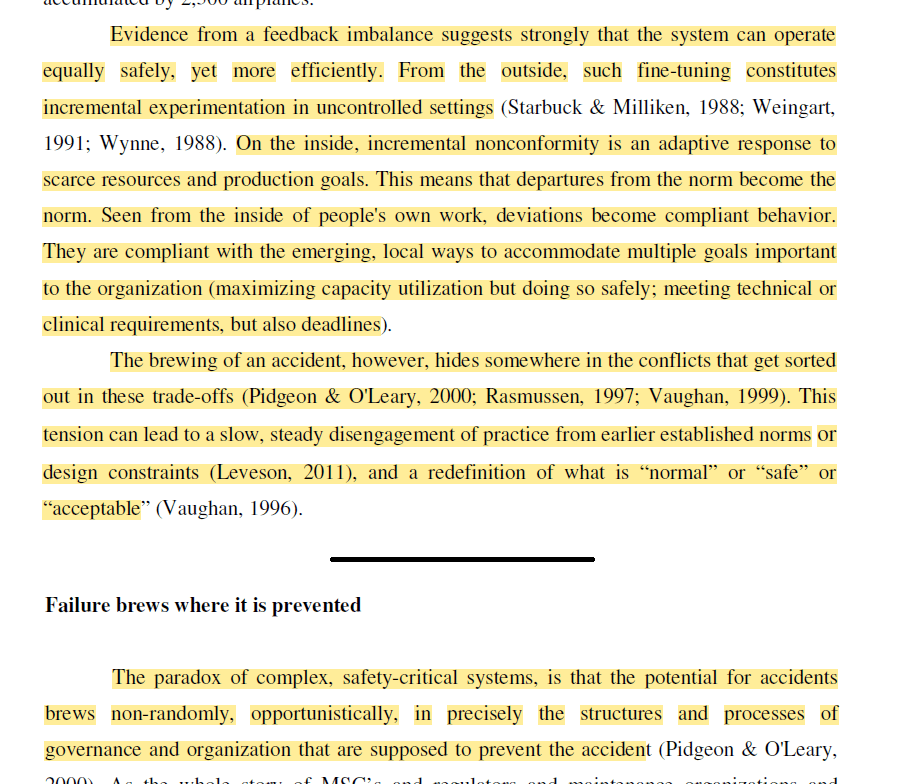
• “The paradox of complex, safety-critical systems, is that the potential for accidents brews non-randomly, opportunistically, in precisely the structures and processes of governance and organization that are supposed to prevent the accident”
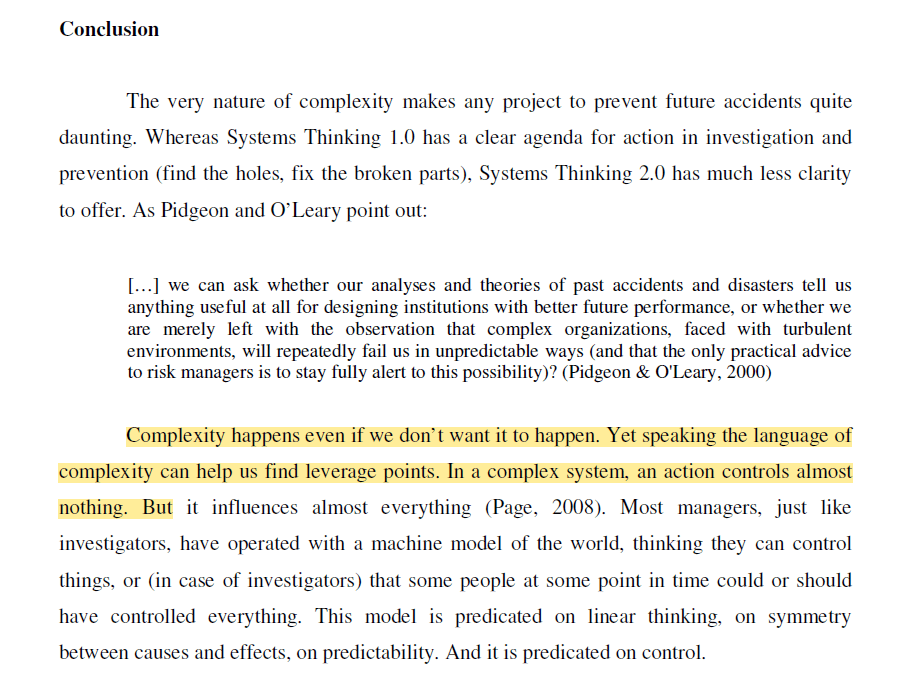
• “Complexity happens even if we don’t want it to happen. Yet speaking the language of complexity can help us find leverage points”
• Dekker discusses the role of diversity in system performance, noting that “Systems that don’t exhibit diversity will be driven to pure exploitation of what they already know. Little else will be explored and nothing new will be learned; existing knowledge will be used to drive through decisions”
Ref: Dekker, S. (2011). Systems Thinking 1.0 and Systems Thinking 2.0: Complexity science and a new conception of “cause”. Aviation in Focus-Journal of Aeronautical Sciences, 2(2), 21-39.
Study link: https://revistaseletronicas.pucrs.br/index.php/aviation/article/download/9589/7304
My site with more reviews: https://safety177496371.wordpress.com

 SafetyInsights.org
One thought on “Systems Thinking 1.0 and Systems Thinking 2.0: Complexity science and a new conception of “cause””