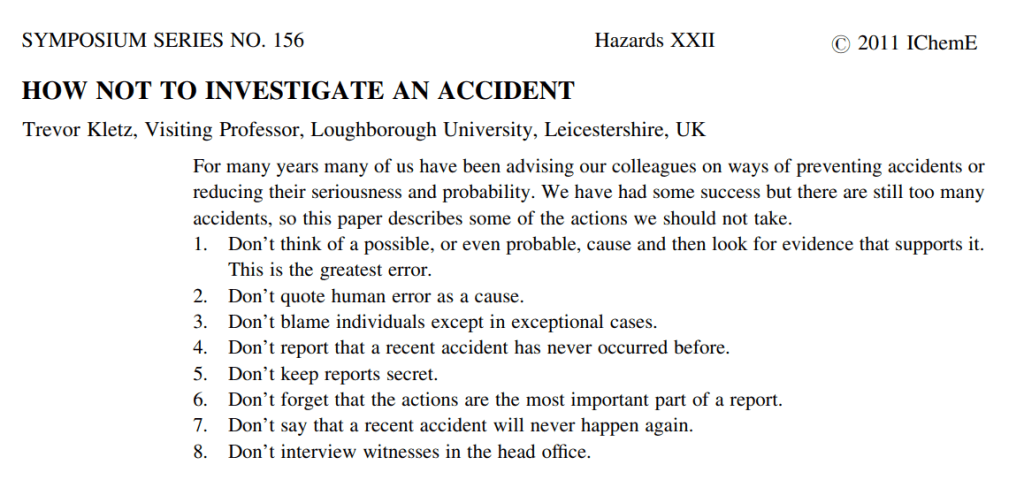
This is an interesting little 2011 paper from the late, great Trevor Kletz.
He discusses “how not to investigate an accident” via a few principles.
Some extracts:
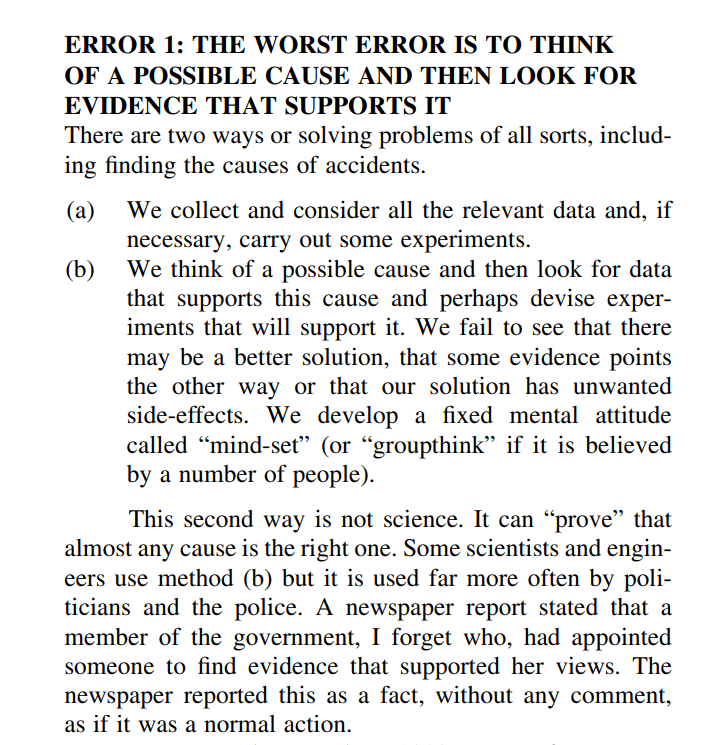
- The worst error is to think of a possible cause and then look for evidence that supports it:
- Kletz discusses the backwards logic of identifying a ‘cause’ and then tracing through the confirming, rather than disconfirming, evidence.
- Quoting the paper “Miller (1978) writes: “If a theory is persuasive enough … scientists will accommodate inconsistent or anomalous findings by decorating the accepted theory with hastily improvised modifications.”
- And “Mind-sets are not always absurd. They can be plausible but incorrect” [*** Weick also said something similar about people often seeking plausibility over accuracy]
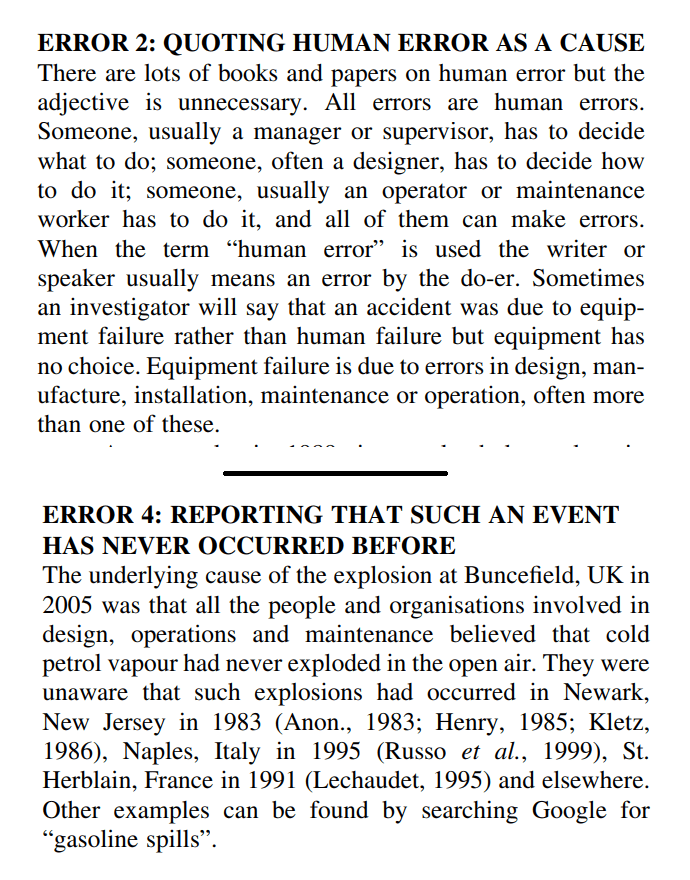
- Quoting human error as a cause:
- Kletz discusses the weak logics about ‘human error’, since ultimately, it’s a person who has to decide (or even just act without conscious decisions) what to do at some point, knowing what they know; including managers, designers, workers
- “There are lots of books and papers on human error but the adjective is unnecessary. All errors are human errors”
- He discusses medical equipment-related accidents, but “do not blame the designer … [since] Why did he or she produce such a poor design? What was lacking in his or her training and the company standards? Was a safety engineer involved? Was the design Hazoped? Why did the operating team not notice the hazards and change the fittings? Reports rarely look for these underlying causes”
- He believes that “System and organisational errors are euphemisms for management errors as only managers can change systems. Accident investigators do not like to blame their bosses, so they blame systems or institutions rather than those who designed or tolerated the systems” [*** I don’t completely agree that institutional behaviour is just a product of managers, since there is non-designed emergent behaviour distributed across organisations]
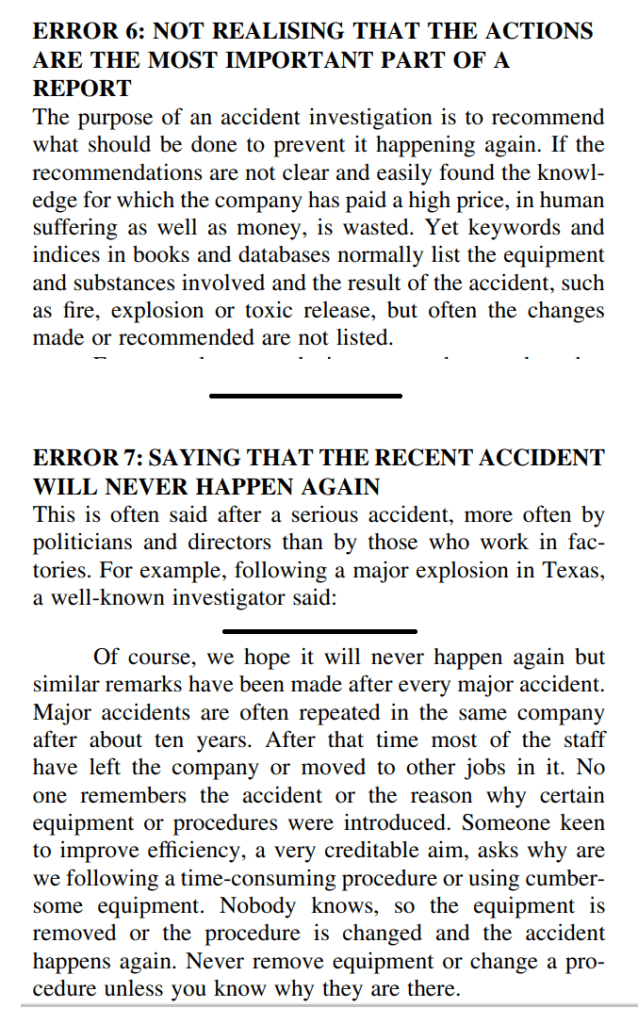
- Error 6: not realising that the actions are the most important part of a report
- “The purpose of an accident investigation is to recommend what should be done to prevent it happening again. If the recommendations are not clear and easily found the knowledge for which the company has paid a high price, in human suffering as well as money, is wasted”
- He notes that many keywords and indices in books and accident databases “normally list the equipment and substances involved and the result of the accident, such as fire, explosion or toxic release, but often the changes made or recommended are not listed”
- He also relates the story of a conference paper he read where “the writer, after the heading, “Actions”, wrote, “No need for any as the plant is damaged beyond repair and will not be replaced”. It did not occur to him at the time that other plants and people might benefit from the lessons that could be learned”
- This example reminds me a bit of ‘distancing by differencing’ – where we find perceived differences between events in order to justify why it doesn’t relate to us
- Error 7: saying that the recent accident will never happen again
- “Major accidents are often repeated in the same company after about ten years. After that time most of the staff have left the company or moved to other jobs in it”
- Further, “No one remembers the accident or the reason why certain equipment or procedures were introduced. Someone keen to improve efficiency, a very creditable aim, asks why are we following a time-consuming procedure or using cumbersome equipment”
- Kletz warns to “Never remove equipment or change a procedure unless you know why they are there”
Ref: Kletz, T. (2011). How not to investigate an accident. Loss Prevention Bulletin, 219, 8-12.

Study link: https://www.icheme.org/media/9290/xxii-paper-80.pdf
My site with more reviews: https://safety177496371.wordpress.com

 SafetyInsights.org
3 thoughts on “How not to investigate an accident”