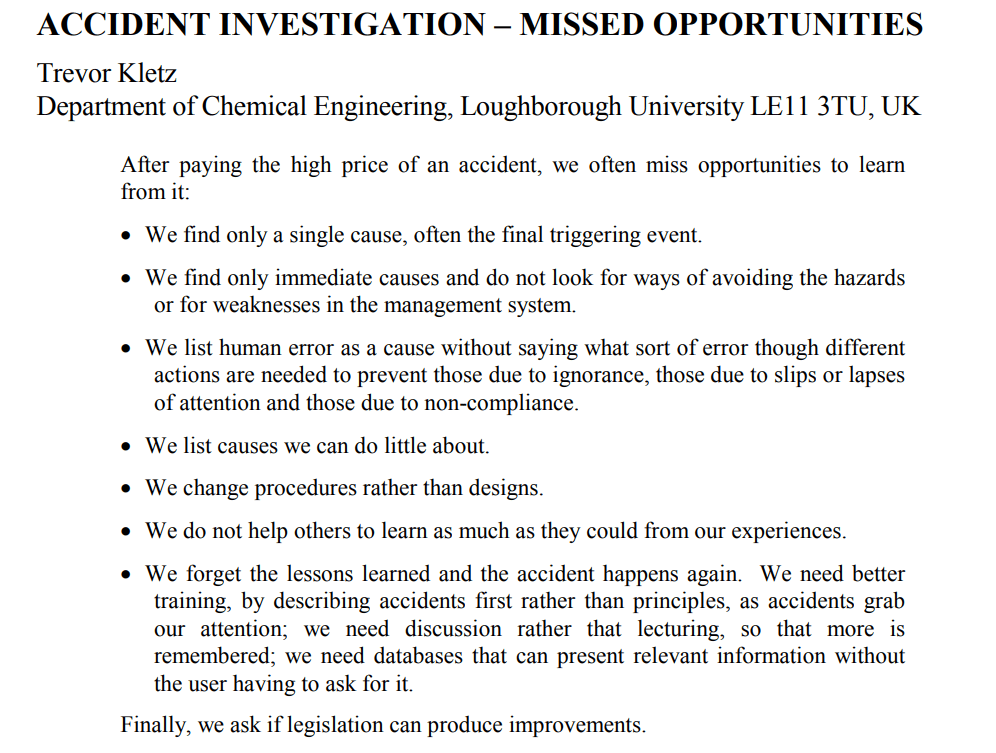
Another banger from Trevor Kletz on a similar theme to the last. He discusses the “missed opportunities” from accidents and investigations.
Only covering a few items, so check out the full paper.
1. We find only a single cause, often the final triggering event
- “Often, accident reports identify only a single cause … The single cause identified is usually this last link in the chain of events that led to the accident, such as an operator closing the wrong valve”
2. We find only immediate causes and do not look for ways of avoiding the hazards or for weaknesses in the management system
- “Even when we find more than one cause, we often find only immediate causes. We should look beyond them for ways of avoiding the hazards, such as inherently safer design, and for weaknesses in the management system”
- “For example, could less hazardous raw materials have been used? Could more safety features have been included in the design”
- He argues that many commentators on the Bhopal disaster missed the most important lessons: “the material that leaked and killed over 2000 people was not a product or raw material but an intermediate. It was convenient to store it but not essential to do so”
- Further, “afterwards many companies did reduce their stocks of hazardous intermediates, often using them as they were made and replacing 50 or more tonnes in a tank by a few kilograms”
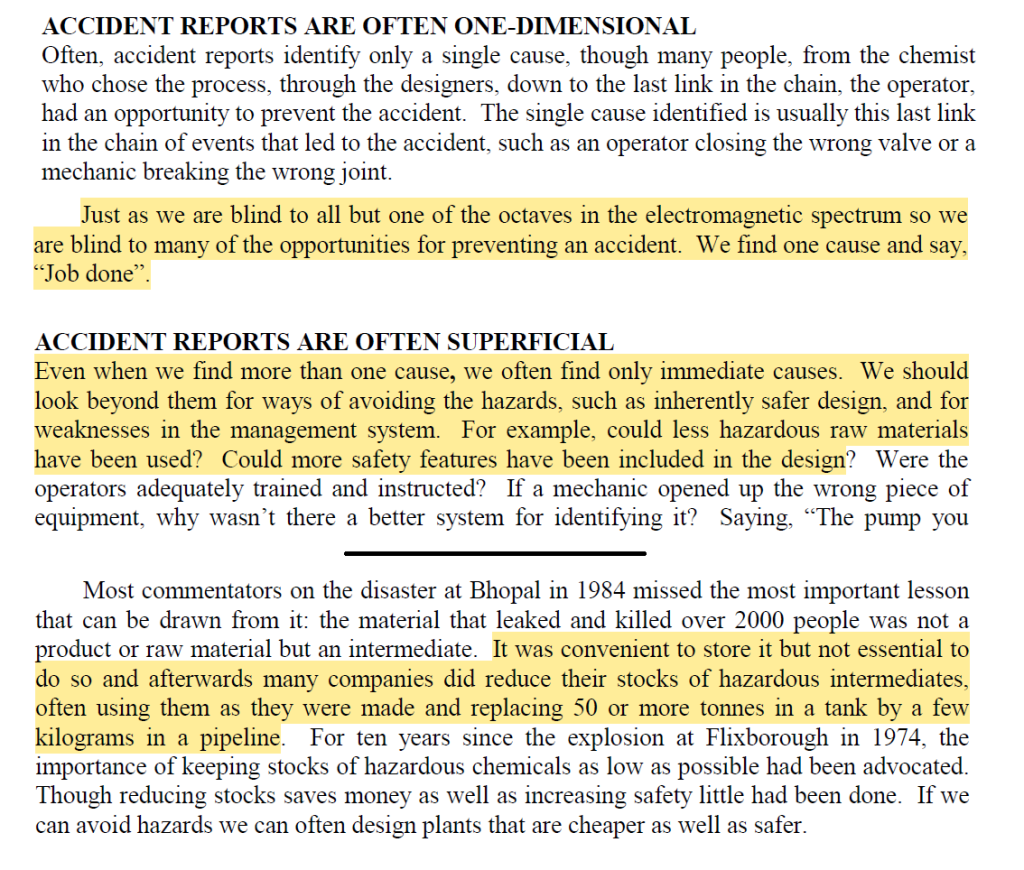
3. We list human error as a cause without saying what sort of error though different actions are needed to prevent those due to ignorance, those due to slips or lapses of attention and those due to non-compliance
4. We list causes we can do little about
- An example is given with how ignition is often listed as “the cause” of explosions, but “ it is impossible on the industrial scale to eliminate all sources of ignition with 100% certainty”
- He notes that the collection and storage of hazardous materials are easier to control than all ignition sources.
- Further, “Instead of listing causes we should list the actions needed to prevent a recurrence. This forces to people to ask themselves if and how the so-called cause can be prevented in future”.
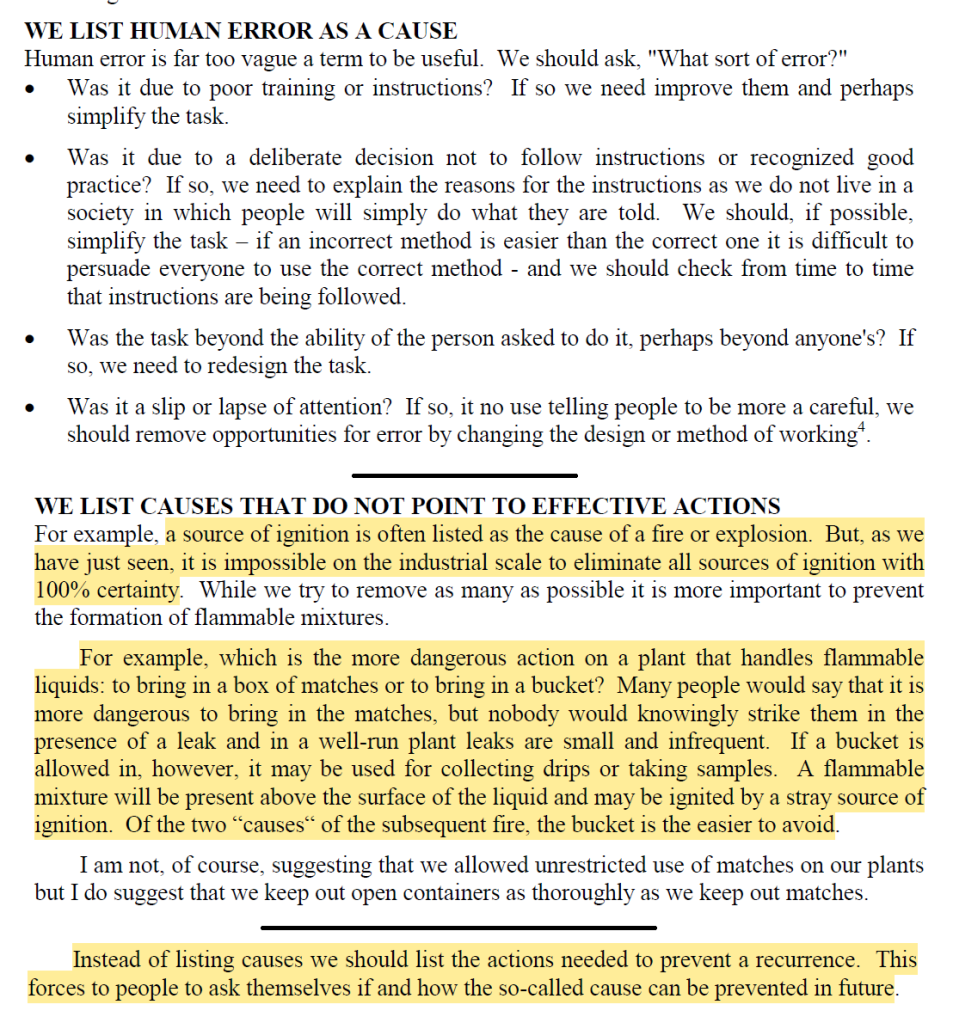
4. We change procedures rather than designs
- The first recommendation should be removing the hazard – inherent safety
- However, “In some companies, however, the default action is to consider a change in procedures first, sometimes because it is cheaper”
5. We do not help others to learn as much as they could from our experiences
He identifies three logics of why we should learn from the collective industrial experience:
- Moral – we have a duty to share and learn
- Pragmatic – if we share ours, other companies will share theirs
- Economic – “we would like our competitors to spend as much as we do on safety”
- Industrial – the industry is one and reputation matters
6. Safety databases should be active and fuzzy
- Kletz laments the then current state of accident databases as ‘passive’. That is, the user is active and “The user has to ask the database if there is any information on [hazards]”
- “The user has to suspect that there may be a hazard or he or she will not look”
- Instead, the database should be active – it offers information – and fuzzy in that it’s not hindered by specific search terms
- While this wasn’t practically available when Kletz wrote this paper, it is now with machine learning approaches
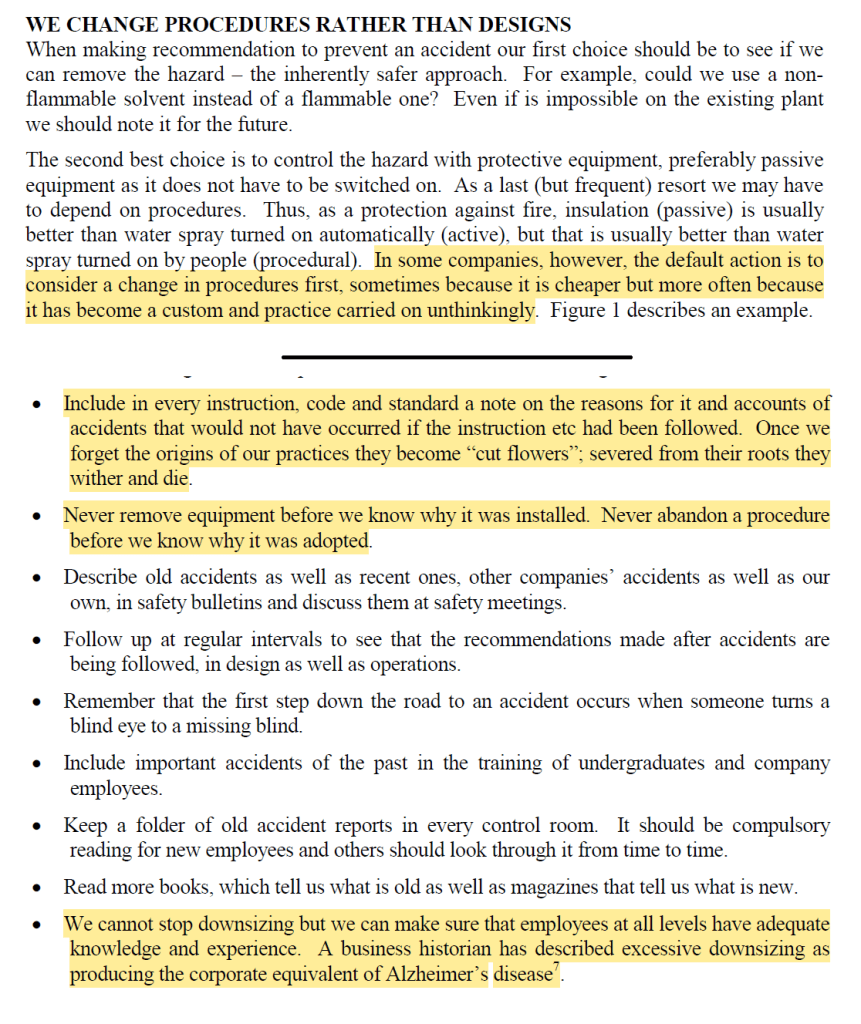
Ref: Kletz, T. (2002). Accident investigation—Missed opportunities. In Components of System Safety: Proceedings of the Tenth Safety-critical Systems Symposium, Southampton, UK 2002 (pp. 3-15). Springer London.
Study link: https://www.icheme.org/media/10146/xvi-paper-01.pdf
My site with more reviews: https://safety177496371.wordpress.com

 SafetyInsights.org
2 thoughts on “Accident Investigations – Missed Opportunities”