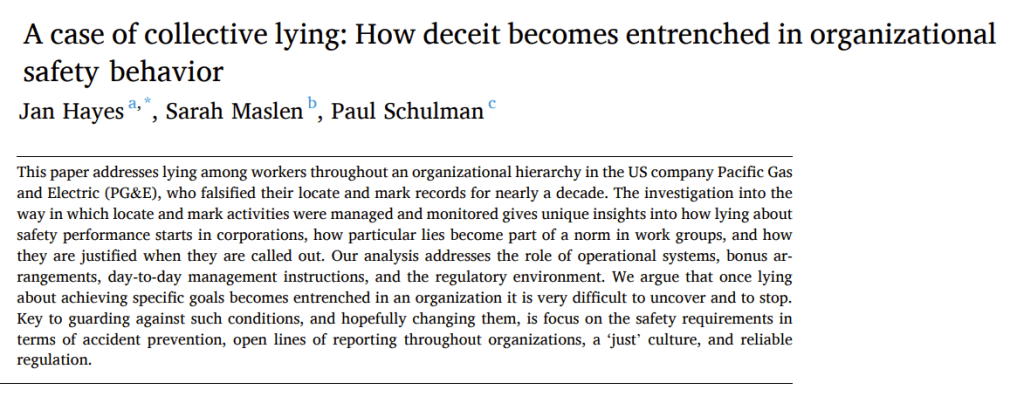
This new study from Hayes, Maslen and Schulman explored how lying about safety performance starts, how some lies become part of work group norms, and how lies are justified.
Context was the investigation of PG&E following the San Bruno pipeline explosion.
Not a summary – but the paper is open access.
Some points:
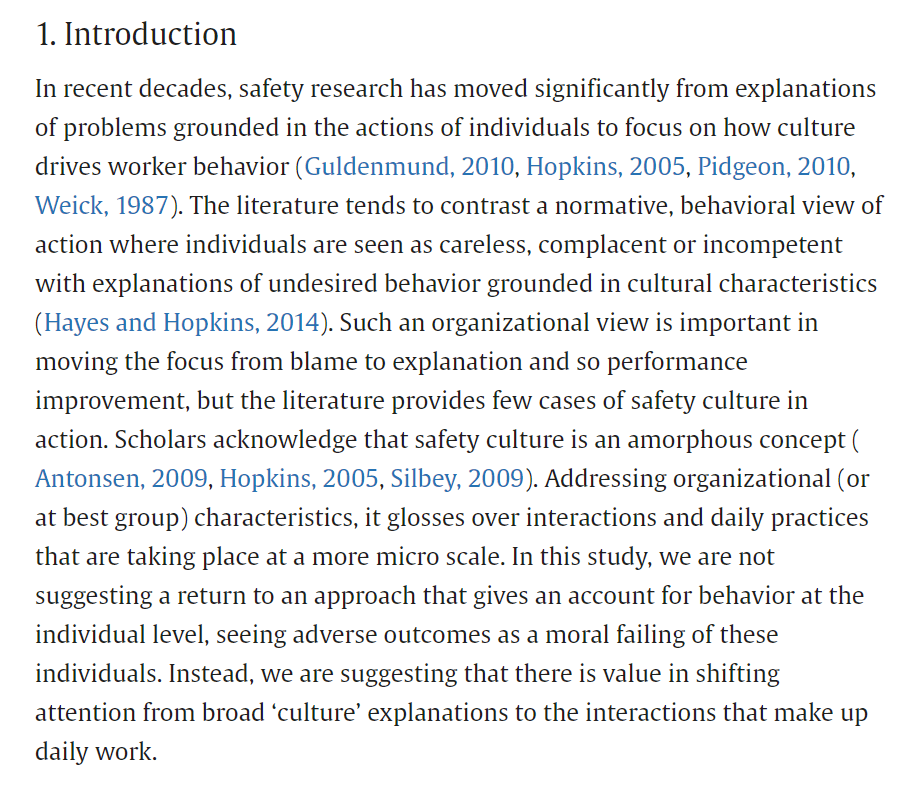
· Different lies exist, from principled (to protector people or moral codes), defensive (protecting individuals or coping with conflict), malice (intentionally harming others or gain advantage), material (for personal gain)
· “individual workers can be motivated to lie in various ways although this work also emphasizes that telling lies is a state, not a trait, of any given individual
· Moral distress can be avoided via the use of mechanisms, eg moral justification (giving behaviour a moral purpose), advantageous comparison (everybody does it), displacement of responsibility (others made me do it), diffusion of responsibility (it was all of us), distorting the consequences (it’s not so bad), dehumanisation of those impacted, attribution of blame (we were provoked)
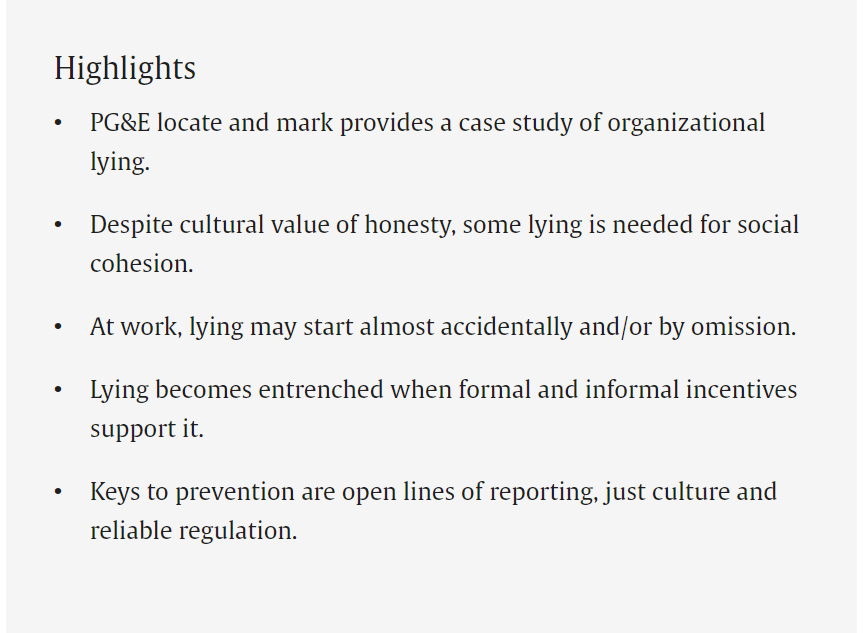
· “Despite cultural value of honesty, some lying is needed for social cohesion”
· Lying “becomes entrenched when formal and informal incentives support it”
· “Despite a common focus on honesty in discussions of corporate ethics, lying is a common behavior that greases the wheels of everyday social interactions”
· “The PG&E case shows that incentive schemes have a major role to play here. The design of reward systems must address the question of the undesirable consequences that may result”
· Incentive schemes “must ensure that the desired behaviors are actively encouraged rather than just providing an incentive to hide undesired behaviors and or outcomes”
· And “The case graphically illustrates the long term impact of a poorly designed scheme”
· And “Simply removing disincentives will not necessarily change behaviors if other structural issues reinforce the status quo”

· Managers must be “prepared for bad news to emerge if they want change to happen. Hopkins (2019) would call for a structural solution to this issue insisting on the benefits of an organizational design that provides a pathway for safety information to flow to the top of the organization”
· Dekker and others “would see the answer in a ‘just’ organizational culture. The presence of a ‘just’ culture, and free flows of information, are not limited to the organization itself, but include the regulatory environment”
· “this case also illustrates how lying may result from a mismatch between public expectations and organizational capacity. This was perhaps a factor in PG&E’s false reporting to the regulator”
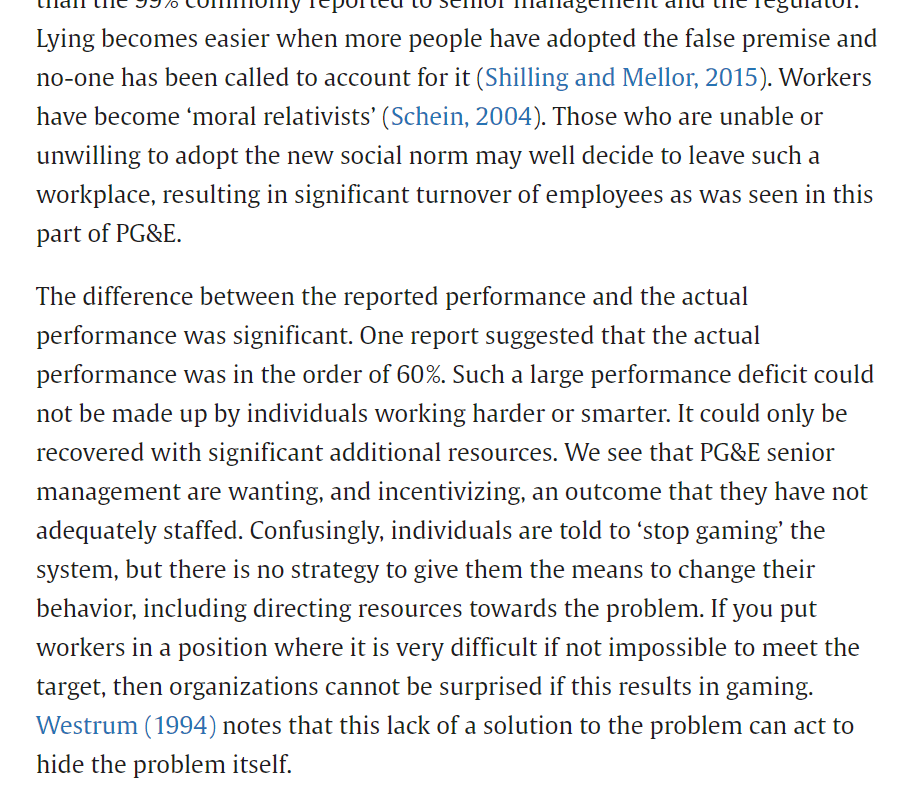
Ref: Hayes, J., Maslen, S., & Schulman, P. (2024). A case of collective lying: How deceit becomes entrenched in organizational safety behavior. Safety Science, 176, 106554.
Study link: https://doi.org/10.1016/j.ssci.2024.106554
My site with more reviews: https://safety177496371.wordpress.com

 SafetyInsights.org