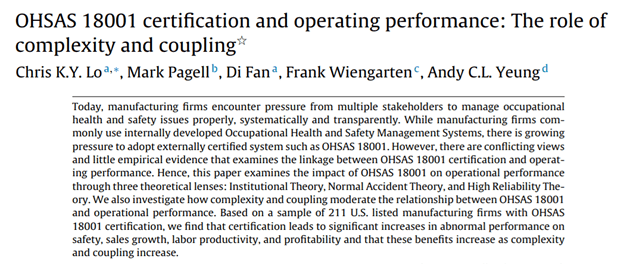
This study explored the links between OHSAS 18001 certification and operating performance, using Normal Accident Theory (NAT), High Reliability Theory (HRT), and Institutional Theory to frame the findings.
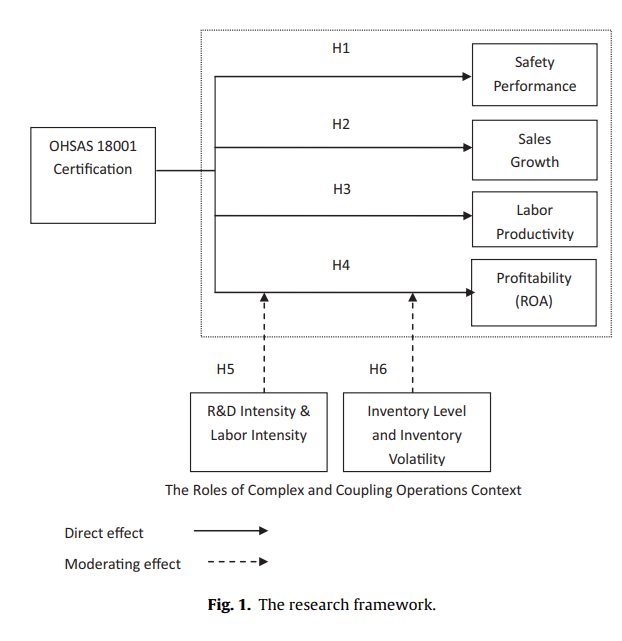
They also investigated how complexity and coupling moderate the relationship between 18001 and operational performance.
211 US listed firms with certification were included.
Provided background:
· “Most safety incidents occur in operational settings, therefore poor safety performance is indicative of poorly managed operations; safety is an operational priority”
· They explore four dimensions of operational performance that 18001 could impact: safety, sales, labour productivity, profitability
· Sales is important because certification is driven by customer demand and could therefore influence sales; labour productivity acts as a good proxy for operating effectiveness and improvements in safety are likely related to labour productivity; profitability, measured as ROA, is relevant because ROA is an efficiency metric of profits, reflecting operational effectiveness
· They suggest that 18001 may help “a firm signal legitimacy to major customers … Previous research showed that ISO 9001 and 14001 were both adopted partially for legitimating reasons”
· “OHSAS 18001 is interpreted as a signal of a firm’s commitment to health and safety management. Given the increasing demand for organizations to at least appear to meet expectations about health and safety, such pressure could be a powerful driver toward certification”
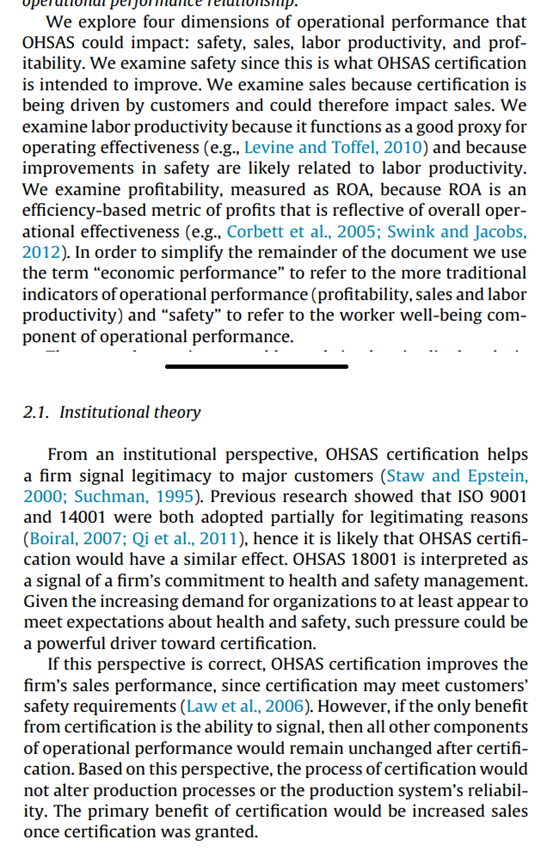
· Hence, “OHSAS certification [may improve] the firm’s sales performance, since certification may meet customers’ safety requirements (Law et al., 2006)”
· However, if “the only benefit from certification is the ability to signal, then all other components of operational performance would remain unchanged after certification … [hence] the process of certification would not alter production processes or the production system’s reliability”
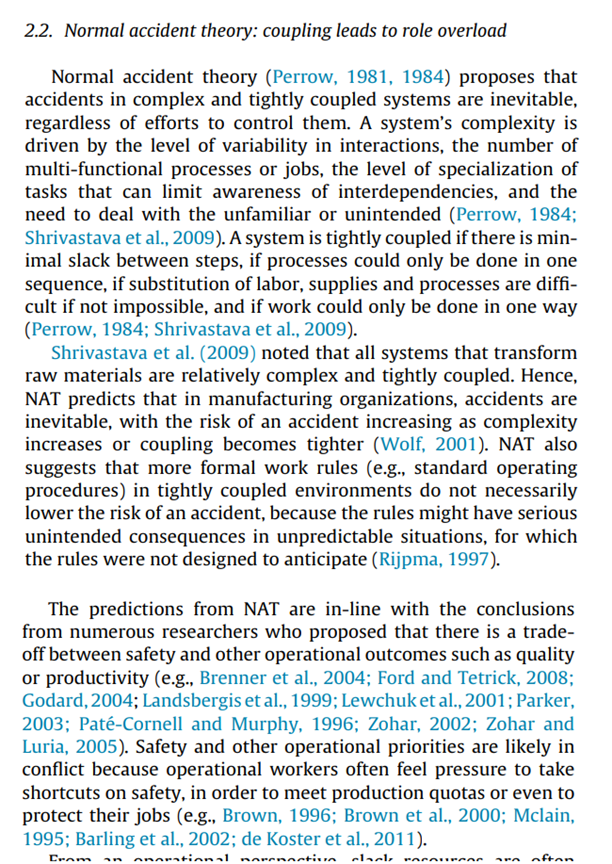
· NAT “proposes that accidents in complex and tightly coupled systems are inevitable, regardless of efforts to control them”
· And “A system’s complexity is driven by the level of variability in interactions, the number of multi-functional processes or jobs, the level of specialization of tasks that can limit awareness of interdependencies, and the need to deal with the unfamiliar or unintended”
· “A system is tightly coupled if there is minimal slack between steps, if processes could only be done in one sequence, if substitution of labor, supplies and processes are difficult if not impossible, and if work could only be done in one way”
· “Shrivastava et al. (2009) noted that all systems that transform raw materials are relatively complex and tightly coupled”
· “NAT also suggests that more formal work rules (e.g., standard operating procedures) in tightly coupled environments do not necessarily lower the risk of an accident, because the rules might have serious unintended consequences in unpredictable situations, for which the rules were not designed to anticipate”
· Further, “Safety and other operational priorities are likely in conflict because operational workers often feel pressure to take shortcuts on safety, in order to meet production quotas or even to protect their jobs”
· “From an operational perspective, slack resources are often indicative of waste and hence many operational best practices, such as lean, are focused on removing slack”
· “However, from the perspective of operational workers, reduction in slack means less time to do tasks, creating “role overload”
· “As production systems become more efficient, there is less time for workers to complete tasks and workers often feel pressured to take shortcuts” and “Slack resources are a critical way to decrease coupling”
· “The theoretical explanation for the trade-off perspective would be that operational improvements increase coupling, create role overload, which leads to an increase in accidents”
· Moreover, “Similar logic applies for improving safety. Improvement in safety takes organizational resources and requires operational workers to spend time on safety rather than production. If this perspective is correct, then if OHSAS certification leads to improved safety, it must do so by harming other operational performance outcomes”
· From the HRT perspective, “OHSAS 18001, when properly implemented, fosters many attributes of a highly reliable organization, which on average improves all operational outcomes, not just safety. If OHSAS certification is not purely ceremonial then it could provide benefits beyond an internally developed OHSMS”
Results
Key findings:
· They found that “OHSAS 18001 leads to significant increases in abnormal operational performance in terms of safety, sales, labor productivity, and profitability”
· “OHSAS certification leads to increased abnormal safety performance for the firms in the sample, even though they had above average safety performance, relative to their industry norm, prior to certification”
· “compared to similar firms, without certification, these firms also saw increased abnormal economic performance”
· “The results are unequivocal in showing that OHSAS 18001 certification increased both the economic and safety components of abnormal operational performance”
They also note that their findings provide some limited evidence of a signalling effect – that is, demonstrating a care or concern for safety among customers. Nevertheless, “The abnormal sales growth only occurred after certification, so improvements in internal processes during the implementation period are likely not driving sales or the increases would accrue earlier”.
Further, the majority of direct abnormal increase in sales in this sample occurred the year after certification, not before. So, “Obtaining the actual certification seems to be driving the increase in abnormal sales, providing support to the proposition that firms use OHSAS certification as a signaling or legitimation tool”.
There were also “real and lasting increases in all of the other abnormal operational performance metrics” following certification. So while the study methods couldn’t fully discount institutional (signalling) effects of certification, they “seem to be a small component of why a firm would pursue certification”.
The results also add to debates about the tension of trade-offs between safety and operational performance. Based on their longitudinal data they say that “The results are clear; the firms in this sample saw increases in abnormal safety performance that led to simultaneous and subsequent improvements in the economic components of abnormal operational performance”.
Regarding NAT, the findings were that 18001 “while effective in all settings, is more effective in more complex or tightly coupled contexts”. And, “The firms that NAT would suggest have the greatest risk of failure also accrue the most benefits from certification”.
Further, “results suggest that complexity and coupling are useful in predicting when the increased control that certification can create will be most beneficial”.
They discuss the relevance of HRT principles and that while not “all future failures are eliminated via certification, we do provide evidence that adopting many of the processes and cognitions associated with HRT can reduce the number of failures and increases operational effectiveness”.
Hence, HRT practices can “form a core of best operational practice”.
Further, “OHSMS certification does not induce a trade-off between safety and economic performance”.
In answering their research questions:
1. what is the general impact of OHSAS 18001 certification on operational performance?
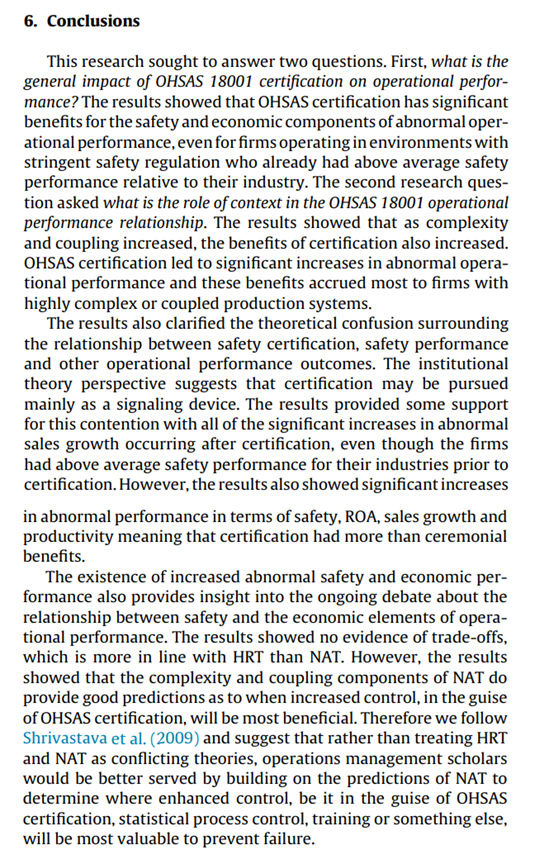
These results demonstrated that 18001 certification has significant benefits for safety and economic components of abnormal operational performance and “even for firms … who already had above average safety performance relative to their industry”.
2. what is the role of context in the OHSAS 18001 operational performance relationship?
Here the results show that “as complexity and coupling increased, the benefits of certification also increased. OHSAS certification led to significant increases in abnormal operational performance and these benefits accrued most to firms with highly complex or coupled production systems”.
Authors: Lo, C. K., Pagell, M., Fan, D., Wiengarten, F., & Yeung, A. C. (2014). OHSAS 18001 certification and operating performance: The role of complexity and coupling. Journal of Operations Management, 32(5), 268-280.
Study link: https://ira.lib.polyu.edu.hk/bitstream/10397/12203/1/JOM_OHSAS_18001_Certification.pdf
My site with more reviews: https://safety177496371.wordpress.com
LinkedIn post: https://www.linkedin.com/pulse/ohsas-18001-certification-operating-performance-role-ben-hutchinson-vigke

 SafetyInsights.org