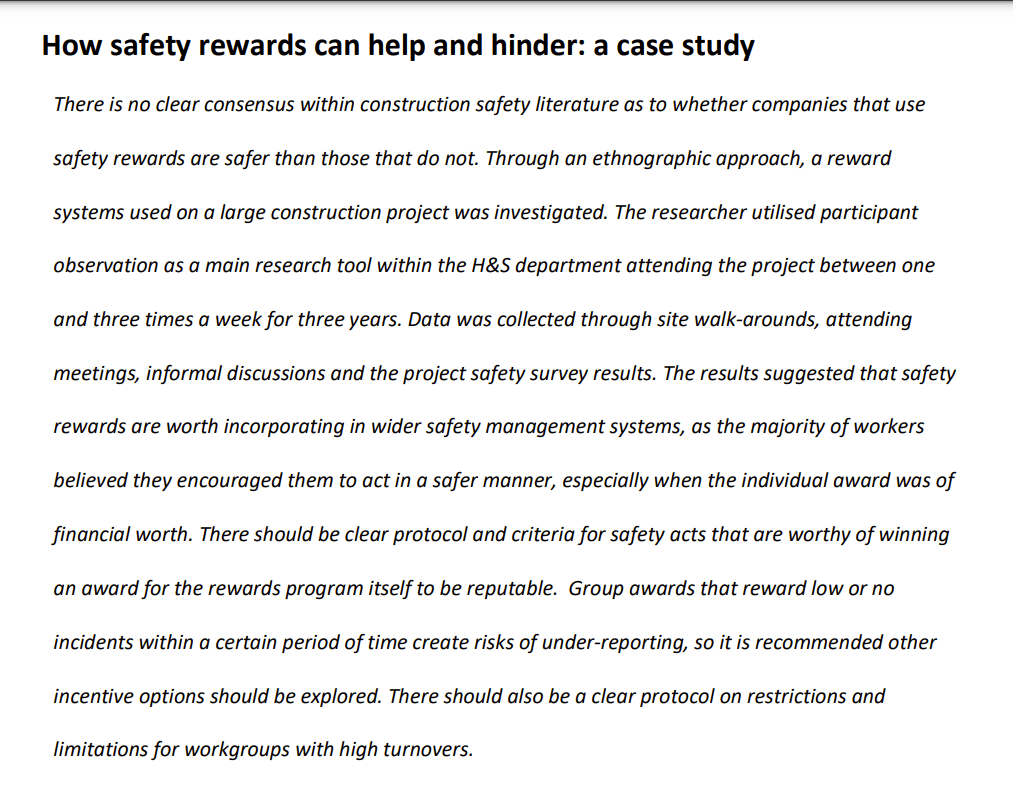
This case study explored the role of safety reward programs on a large construction project.
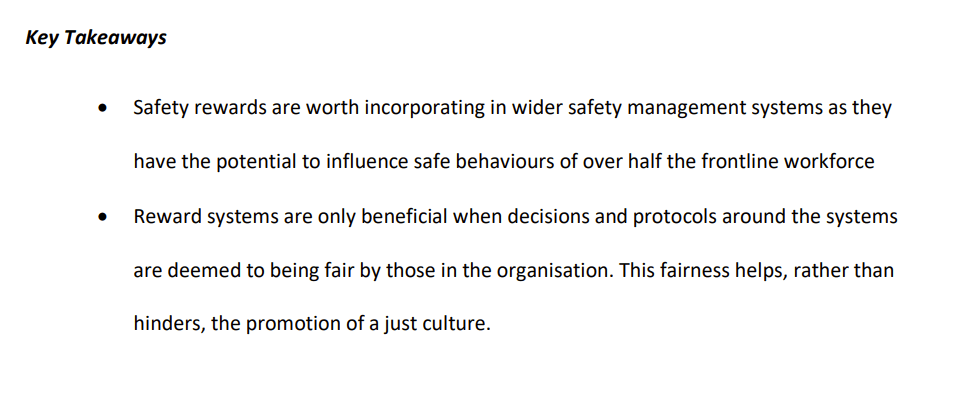
Some key findings:
· “Safety rewards are worth incorporating in wider safety management systems as they have the potential to influence safe behaviours of over half the frontline workforce”
· “Reward systems are only beneficial when decisions and protocols around the systems are deemed to being fair by those in the organisation. This fairness helps, rather than hinders, the promotion of a just culture”
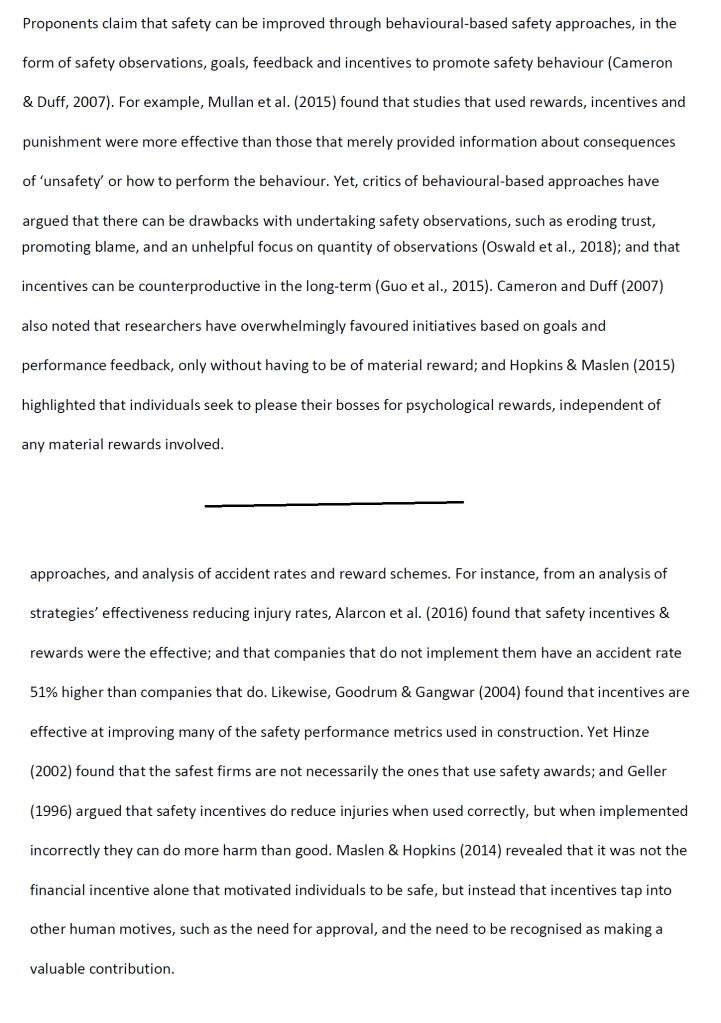
· The reward scheme on this project had both an individual- and group-based reward
· Anybody could be nominated per month, but this created some challenges – like, “in months of low nominations, there was little choice, and often winners were from the departments that were pro-actively engaging with the award system”
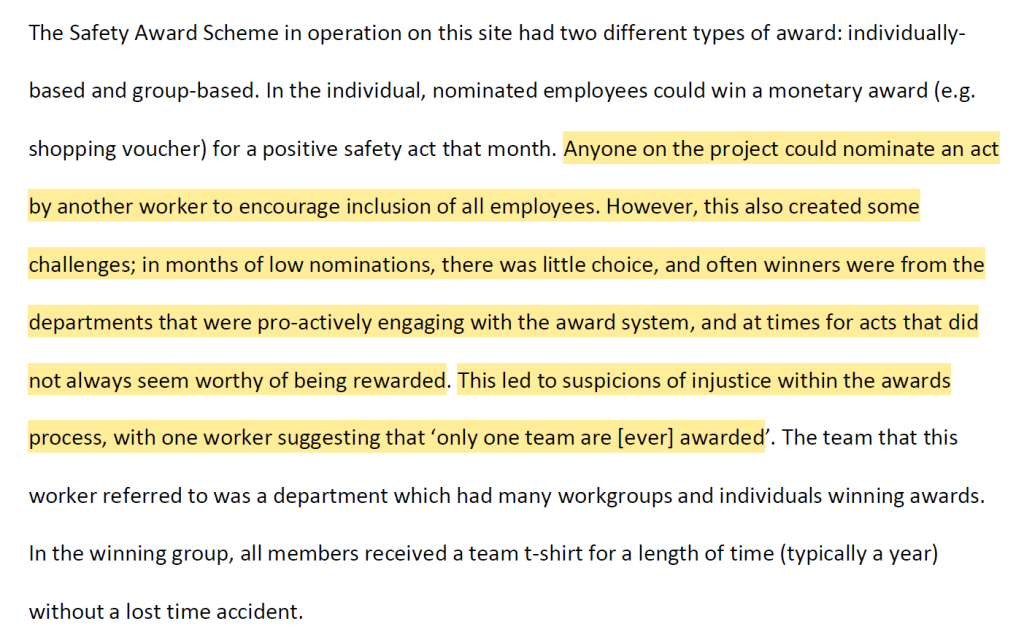
· This approach “ led to suspicions of injustice within the awards process”
· A survey of 424 respondents indicated that the majority of workers believed the reward scheme had a positive influence over their own behaviours
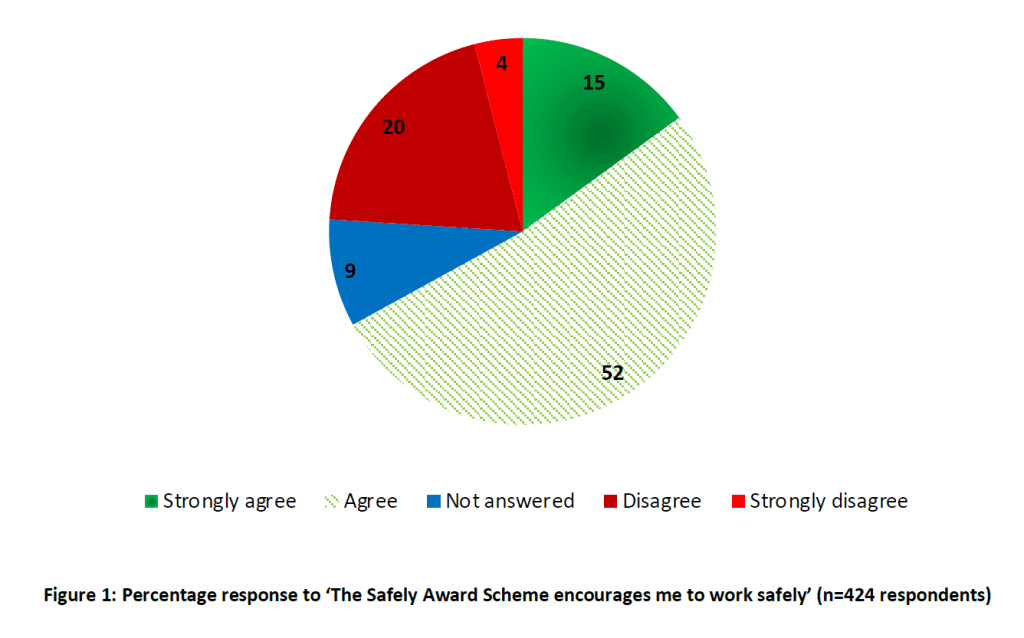
· Nevertheless, awards “should therefore be designed and detailed with care, as the findings show they are susceptible to unexpected challenges and undesirable behaviours”
· For instance, “in one of the H&S meetings, a H&S advisor warned others of a previous experience: ‘We need to careful with the award. On my last job, guys started a fire, so they could put it out in an attempt to win the award!’
· For team awards there was confusion over the criteria for teams with transient workforce and high turnover, and hence, the awards may not be distributed, or distribute fairly “creating feelings of injustice amongst workers”
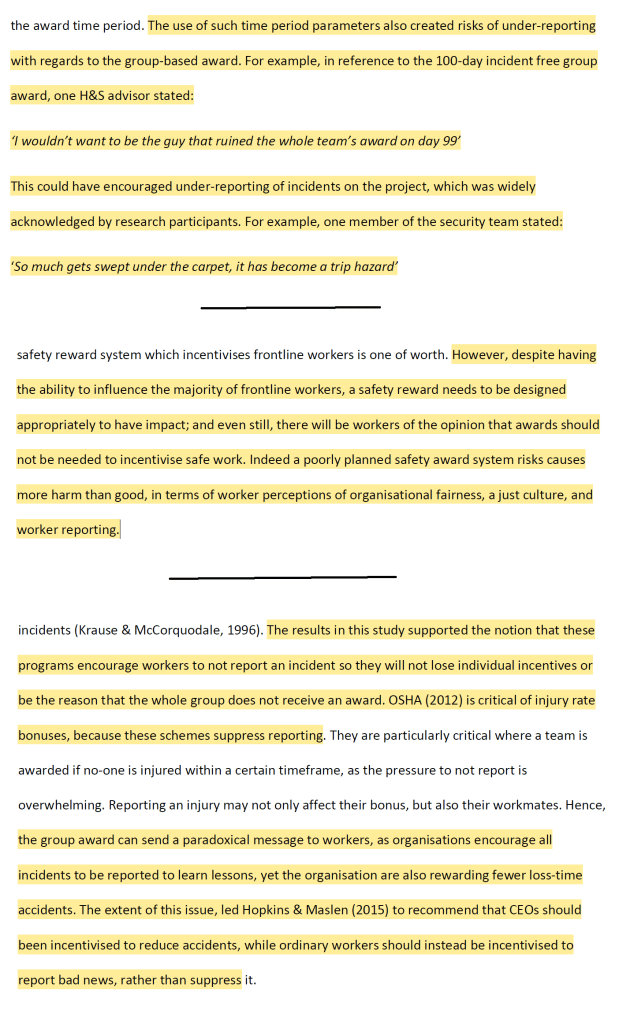
· The use of a time period for awards, e.g. no injuries over 100 days, also “created risks of under-reporting with regards to the group-based award”
· And “one H&S advisor stated: ‘I wouldn’t want to be the guy that ruined the whole team’s award on day 99”
· Hence, rewards can encourage “under-reporting of incidents on the project, which was widely acknowledged by research participants”
They note that while rewards may be beneficial, a “poorly planned safety award system risks causes more harm than good, in terms of worker perceptions of organisational fairness, a just culture, and worker reporting”.
And, rewards can be paradoxical, since they send a message to workers that all incidents need to be reported but the organisation also rewards fewer injuries.
Hence “The extent of this issue, led Hopkins & Maslen (2015) to recommend that CEOs should been incentivised to reduce accidents, while ordinary workers should instead be incentivised to report bad news, rather than suppress it”.
Ref: Oswald, D, Sherratt, F & Smith, S 2019, ‘How safety rewards can help and hinder: a case study’, Professional Safety.
Study link: https://www.pure.ed.ac.uk/ws/portalfiles/portal/80749211/Post_ReviewPSJ_Safety_rewards.pdf
My site with more reviews: https://safety177496371.wordpress.com

 SafetyInsights.org