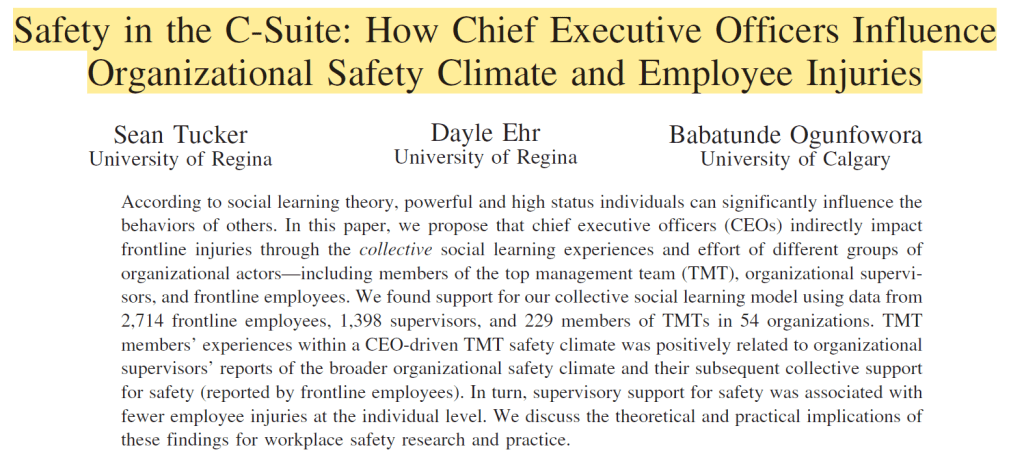
A really interesting study exploring if and how CEOs influence worker injuries.
Data via >2.7k frontline workers, 1.4k supervisors and 229 top management team (TMT) in 54 organisations.
Providing background:
- “According to social learning theory, powerful and high status individuals can significantly influence the behaviors of others. In this paper, we propose that chief executive officers (CEOs) indirectly impact frontline injuries through the collective social learning experiences”
- “inaccurate, romanticized beliefs about the role of top leaders in achieving organizational outcomes (Meindl, Ehrlich & Dukerich, 1985) may explain why many believe CEOs ultimately drive safety performance, when in fact they may actually have little influence in this domain”
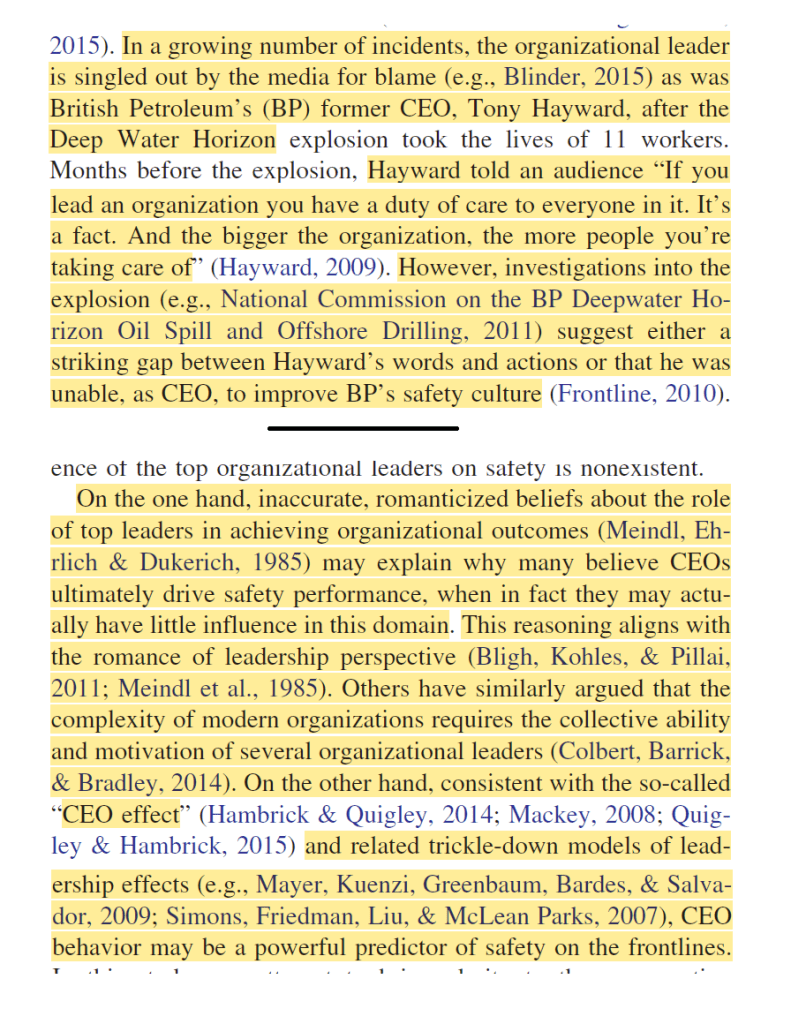
- “This reasoning aligns with the romance of leadership perspective”, nevertheless, “consistent with the so-called “CEO effect” … and related trickle-down models of leadership effects … CEO behavior may be a powerful predictor of safety on the frontlines”
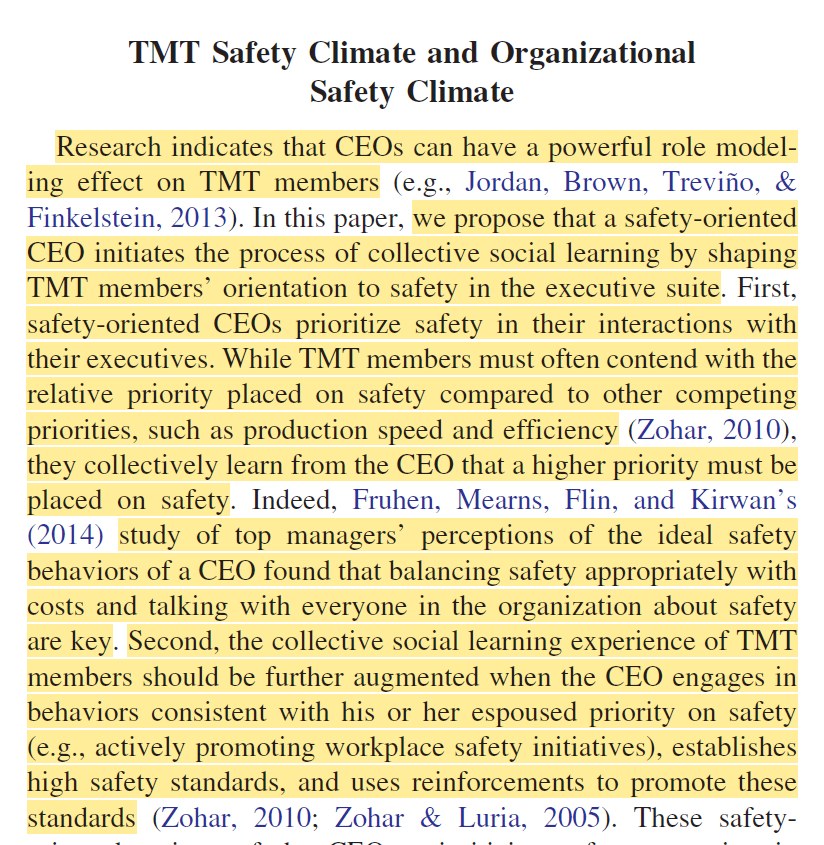
- “Research indicates that CEOs can have a powerful role modelling effect on TMT members”
- “safety-oriented CEOs prioritize safety in their interactions with their executives. While TMT members must often contend with the relative priority placed on safety compared to other competing priorities, such as production speed and efficiency (Zohar, 2010), they collectively learn from the CEO that a higher priority must be placed on safety”
Key findings were:
- “we find that CEOs affect workplace safety, although their influence is largely indirect and relies on the collective efforts of distinct groups of organizational actors”
- “We found that executives’ experiences of a CEO-driven TMT safety climate were positively related to organizational supervisors’ perceptions of organizational safety climate, which, in turn, influenced frontline employees’ reports of supervisors’ collective support for safety”
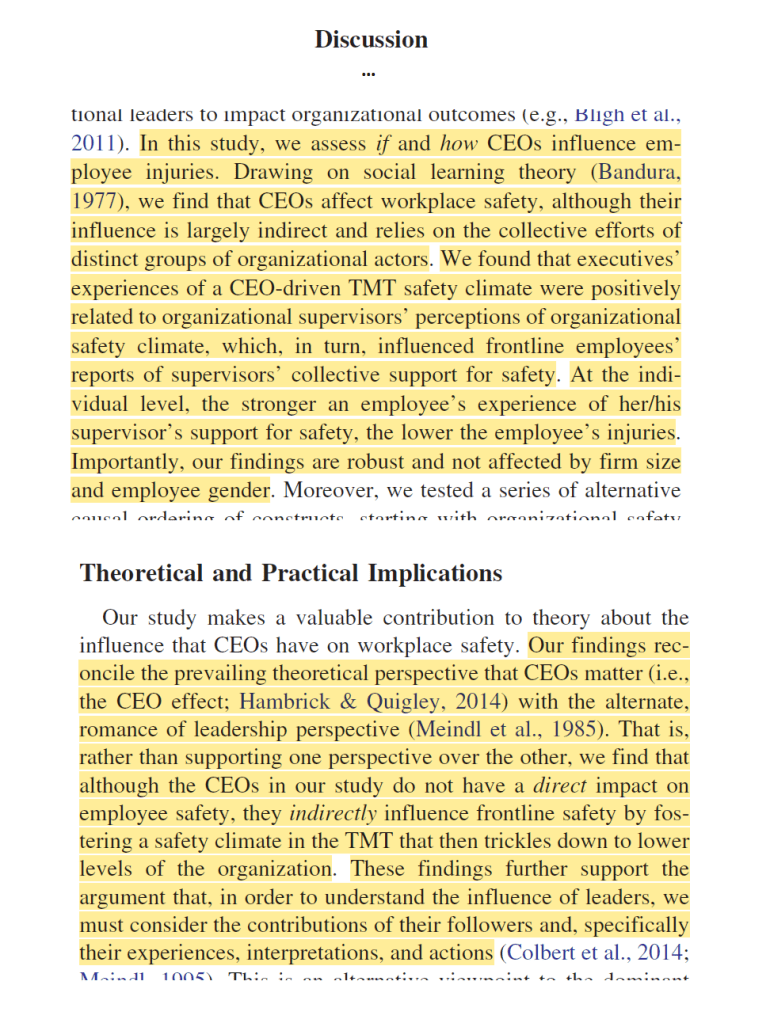
- “At the individual level, the stronger an employee’s experience of her/his supervisor’s support for safety, the lower the employee’s injuries”
- “we find that although the CEOs in our study do not have a direct impact on employee safety, they indirectly influence frontline safety by fostering a safety climate in the TMT that then trickles down to lower levels of the organization”
- Thus “in order to understand the influence of leaders, we must consider the contributions of their followers and, specifically their experiences, interpretations, and actions”
- “This is an alternative viewpoint to the dominant assumption in leadership research and some public discourse, which tends to be leader-centric and disproportionately weighs role-based leader’s behaviors in achieving organizational outcomes”
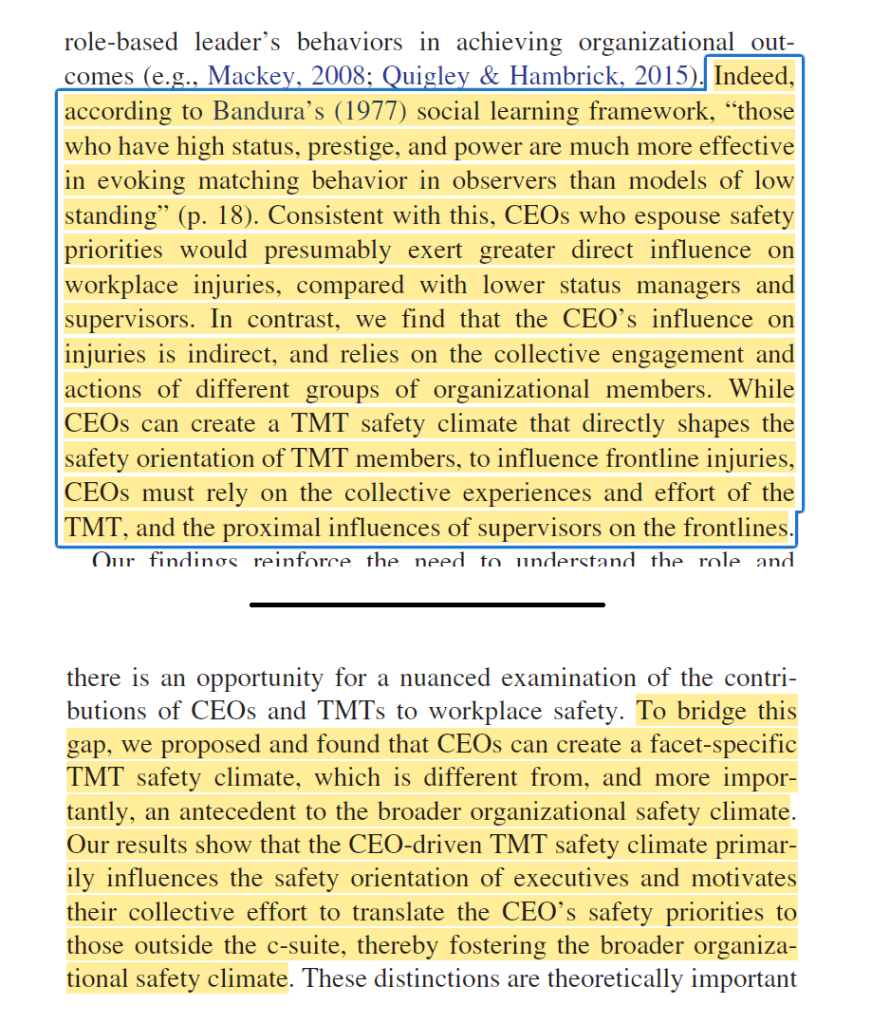
- “CEOs who espouse safety priorities would presumably exert greater direct influence on workplace injuries, compared with lower status managers and supervisors. In contrast, we find that the CEO’s influence on injuries is indirect, and relies on the collective engagement and actions of different groups of organizational members”
Interestingly, they found that “CEOs can create a facet-specific TMT safety climate, which is different from, and more importantly, an antecedent to the broader organizational safety climate”.
And, “CEO-driven TMT safety climate primarily influences the safety orientation of executives and motivates their collective effort to translate the CEO’s safety priorities to those outside the c-suite, thereby fostering the broader organizational safety climate.
Some limitations were present, e.g. cross-sectional (hence causality isn’t possible, nor do we know the directionality), and they relied on self-reported injury.
Ref: Tucker, S., Ogunfowora, B., & Ehr, D. (2016). Safety in the c-suite: How chief executive officers influence organizational safety climate and employee injuries. Journal of applied psychology, 101(9), 1228.
Study link: https://psycnet.apa.org/journals/apl/101/9/1228.pdf
My site with more reviews: https://safety177496371.wordpress.com

 SafetyInsights.org