
A fascinating ethnographic study about how high-security prison guards make sense of hazardous work conditions.
Note: This is a dense 28 page paper, and I’ve skipped a lot; I’m using a lot of direct quotes.
I highly recommend checking out the full paper (I’m also biased because they referenced one of my studies on enabling devices).
Providing background:
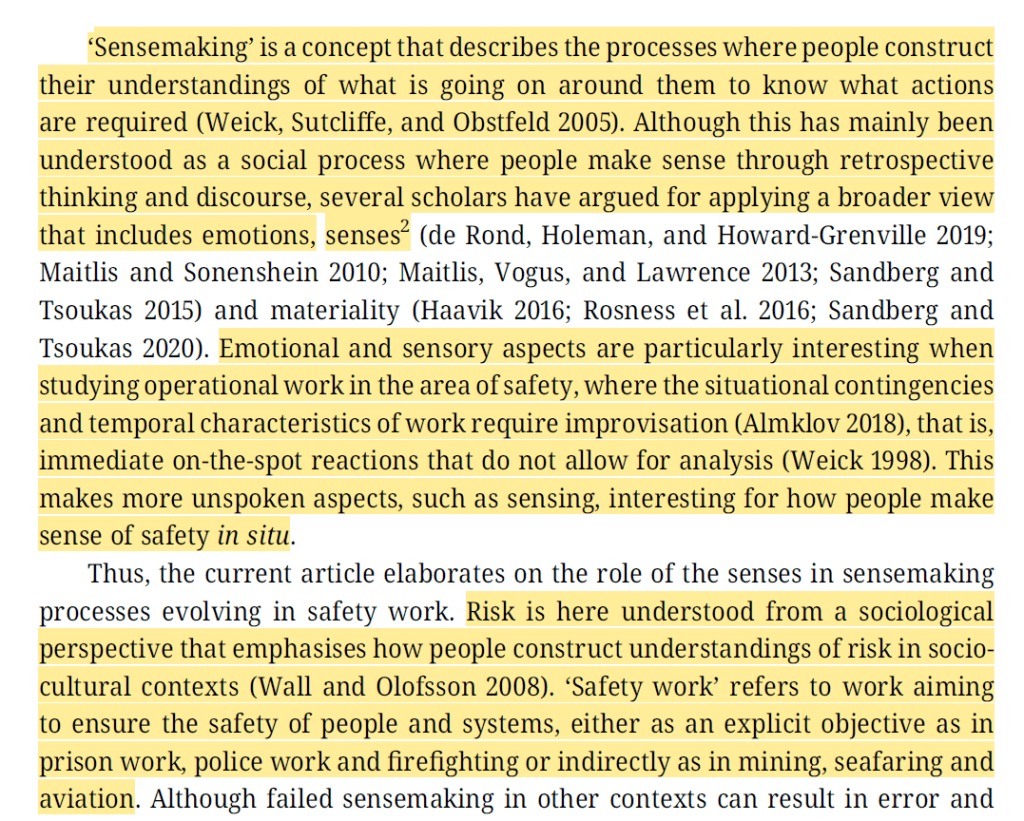
· “‘Sensemaking’ is a concept that describes the processes where people construct their understandings of what is going on around them to know what actions are required”
· Although much work has described sensemaking as a social process via retrospective thinking and discourse, others highlight the important nature that includes emotions, senses and materiality
· “Emotional and sensory aspects are particularly interesting when studying operationalwork in the area of safety, where the situational contingencies and temporal characteristics of work require improvisation”
· “Whereas safety can be seen as a ‘dynamic non-event’, Hollnagel points out that this focus
· ‘does obviously not mean that nothing happens’ (2014, p. 23). Still, most studies on sensemaking in organisations focus on sensemaking efforts triggered by major events … or at least in ‘high tempo’ work settings where sensemaking processes become more visible”
· Despite the prior focus of major events in sensemaking, “minor events and everyday work practices are important to study, both because sensemaking in such situations is more common and because of the potential of minor events becoming major if the initial sensemaking efforts fails”
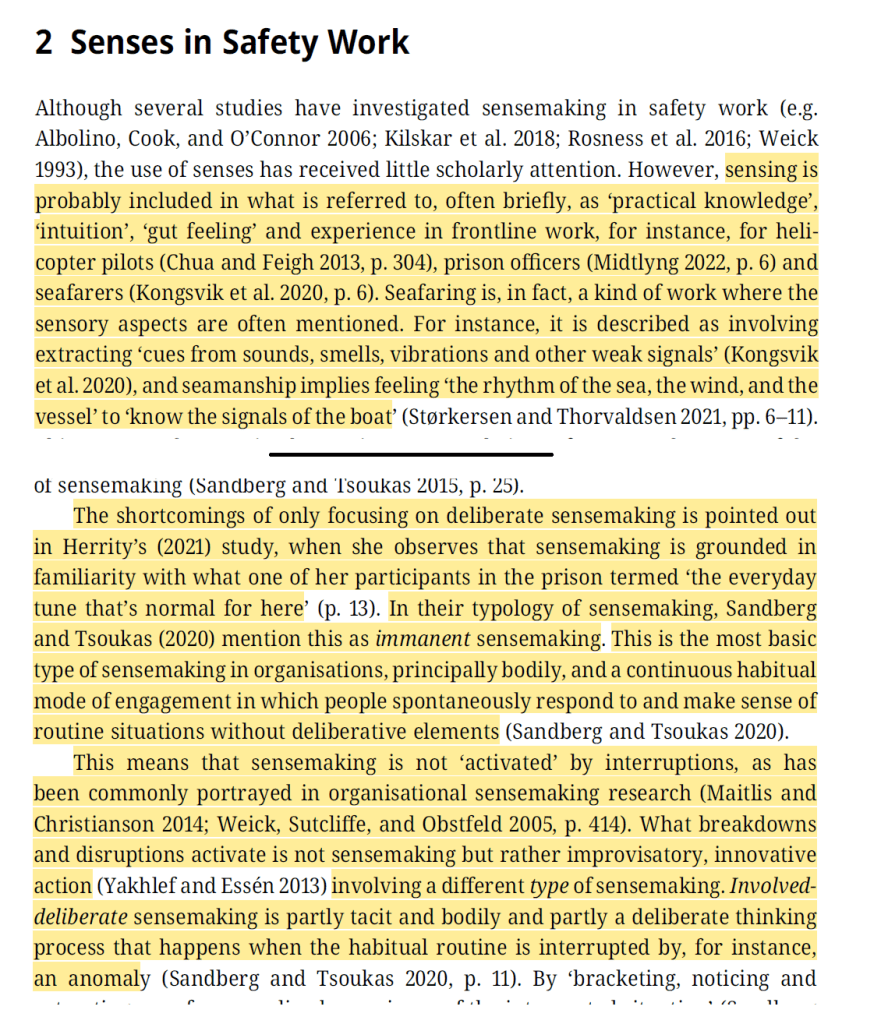
· Sensing is said to be “probably included in what is referred to, often briefly, as ‘practical knowledge’, ‘intuition’, ‘gut feeling’ and experience in frontline work”
· They note that “this perspective on sensemaking does not see socio-material work environments as consisting of freestanding entities that we subsequently attach meaning to but, rather, as relational ensembles of people, objects and tools that constitute a meaningful context for sensemaking”
· For example, “For a pilot flying an aircraft, a cockpit is ‘not an array of externally related objects to be contemplated, as it would be for an outsider, but a meaningful whole that is available for action”
· And therefore, “embodiment, such as bodily sensations, sensory knowing, felt experiences, and emotions, are an integral part of sensemaking … because our entwinement with the work environment is constituted bodily through sensory engagement”
· While Weick et al. have argued that “organisations are ‘talked into existence’, which underlines the mainly cognitive and discursive focus of this research” where sensemaking research has neglected the ‘body’ element of sensemaking
· In contrast, others have criticised the myopic focus on deliberate sensemaking, rather than sensemaking “grounded in familiarity with what one of her participants in the prison termed ‘the everyday tune that’s normal for here’”
· This has been called “immanent sensemaking”, and is the “most basic type of sensemaking in organisations, principally bodily, and a continuous habitual mode of engagement in which people spontaneously respond to and make sense of routine situations without deliberative elements”
· Hence, not all sensemaking is activated by interruptions or ambiguity, rather “What breakdowns and disruptions activate is not sensemaking but rather improvisatory, innovative action …involving a different type of sensemaking”
· They say that for operational safety work, studying the immanent sensemaking and the transition from immanent to more involved-deliberate sensemaking is interesting
Also, before moving into the main findings, the author also discusses related concepts. I’ve skipped most of this, but for instance:
· The “making of sense” has been conceptualised in different ways in different fields. Cognitive psychology has looked at how individuals make sense of the world and how cognitive processes select, interpret and respond to environmental cues
· Also research on intuition, like in NDM, “explains intuition as ‘pattern matching’ in which people use their experience as a repertoire of patterns that ‘highlight the most relevant cues, provide expectancies, identify plausible goals, and suggest typical types of reactions”
· So while “The concept of intuition is compatible with parts of sensemaking processes”, it’s not the same processes and sensemaking is a much broader concept than intuition
· That is, “Intuition will always be a result of sensemaking processes, but sensemaking processes are not necessarily connected to intuition”

Results
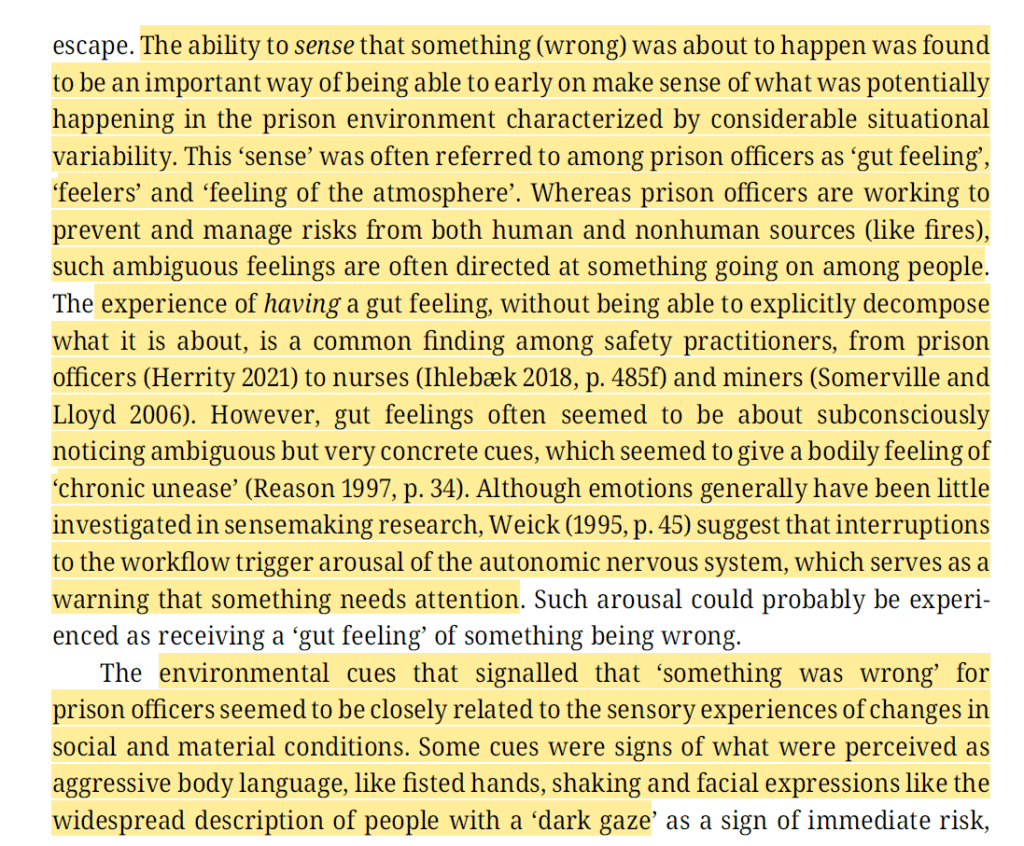
Prison officer’s ability to sense that something wrong was about to happen was found to be an important way of early sensemaking about what was potentially about to happen within the prison.
This sense was referred to among officers as ‘gut feeling, ‘feelers’ or ‘feeling of the atmosphere’.
It’s said that the “experience of having a gut feeling, without being able to explicitly decompose what it is about, is a common finding among safety practitioners, from prison officers (Herrity 2021) to nurses (Ihlebæk 2018, p. 485f) and miners”.
Gut feelings “often seemed to be about subconsciously noticing ambiguous but very concrete cues, which seemed to give a bodily feeling of ‘chronic unease’”.
The “environmental cues that signalled that ‘something was wrong’ for prison officers seemed to be closely related to the sensory experiences of changes in social and material conditions”. For instance, cues like aggressive body language, facial expressions and gazes.
Reacting to these cues are a basic human skill, but for officers this was an immersed skill where officers have a fine-tuned awareness of details. Officers were continually piecing together several streams of information – visual, sound etc. Like the volume of the TV was “unusually loud”, or prisoners in different areas or groups than usual.
People new to the environment would lack these salient cues. Moreover “unpacking” the basis of gut feelings, this kind of knowledge needed to be developed by bodily enactment, by repeated experiences that made their ‘bodies become a source of information’ related to safety”.
Moreover, “Sound seemed to be a particularly important sensory input for the prison officers’ sense of safety, being ‘extremely important’ according to one officer”.
Officers knew “what sounds belong here”, and some would undertake “listening rounds” during a night shift; walking the wing to listen for unusual sounds. Hence, “differentiation between ‘regular sounds’ and ‘anomalous sounds’ was important”.
Further, the absence of sounds was also important. So that “The sound of silence was a special kind of silence that gave a feeling of unease in the absence of the expected flow of sounds”.
Sensing that Something is Wrong
Regarding officers, “the body is trained so that it ‘seeks out, and responds to, modulations or inflections in the environment to which it is attuned”. Their sensemaking was based on the construction of a sensory norm for each specific environment within the prison.
The author referred to this process as “tacit sensory ‘maps’”, which cover their areas of responsibility; and include what sounds, sights and smells belong to whom, where and when; and what does or doesn’t represent risk or safety.
The sensory maps were also used to know when action was not needed, allowing an economy of effort. Hence, “the officers involved deliberate sensemaking were activated, like the nurses in Ihlebæk’s study, ‘only when a deviation from normality is detected”.
However, a limitation of this norm-deviance categorisation sensemaking is based on the expectation that sensory input categorised as ‘normal’ was expected to remain stable. Hence, “the stability in performance provided by habitual immanent sensemaking could also disturb the sensemaking process because of rigidity, especially when facing the unfamiliar”.
Therefore, “in addition to being useful, safety practitioners’ immanent sensemaking could be vulnerable through its habitual aspects”.
Prospective Attentiveness
Officers would also occasionally divide their attention during conversation with the researcher, like directing their head upwards to listen, or suddenly becoming quiet during conversation. They were reported to have a “bodily readiness that could be difficult to spot from the outside”.
Officers were constantly scanning the environment, taking sensory input from the social and material environment. This immanent sensemaking “served as a necessary precursor to know when to act by being able to notice and, consequently, react to very small discrepant cues at a very early stage”.
The author discussed how while habitual performance is about repetition, attentive habitual performance is a more creative process. It is a key characteristic of skill. Further, “Habituated bodily skills have an adjustability to respond to varying circumstances incorporate salient features of the world”.
The ability for officers to anticipate features of the prison was closely connected to their prospective attentiveness. This attentiveness “could happen long before the cues were interrupting any ongoing activity and often before the officers knew what it was about even if the officers could not put their finger on what the feeling was about, they responded to the sense that something was wrong”.
When the researcher asked an officer how they knew the difference between worrying and non-worrying sounds, one answered “I cannot tell the difference, but I know I must react”. This highlights that “sensemaking based on the use of senses can contribute to quick responses to weak signals through prospective attentiveness”.
The author quotes another researcher, who called this process having “a ‘feel for the game’, which is not about what one ‘sees but what he fore-sees’”. Hence, compared to some other work which suggests that sensemaking is often a retrospective process of reflection, this study suggests sensemaking also works prospectively.
Shared Tacit Understandings
People, like new officers or the researcher, “Lacking specialised sensory skills for sensemaking sometimes made it challenging to follow important aspects of safety work”.
For officers working closely, their “use of senses seemed to contribute to tacit, bodily and shared understandings of ‘what is going on’”. This wasn’t always verbal – officers would pick up on small changes in body language of other officers, like a raise or turn of their head.
Cut off from the Senses
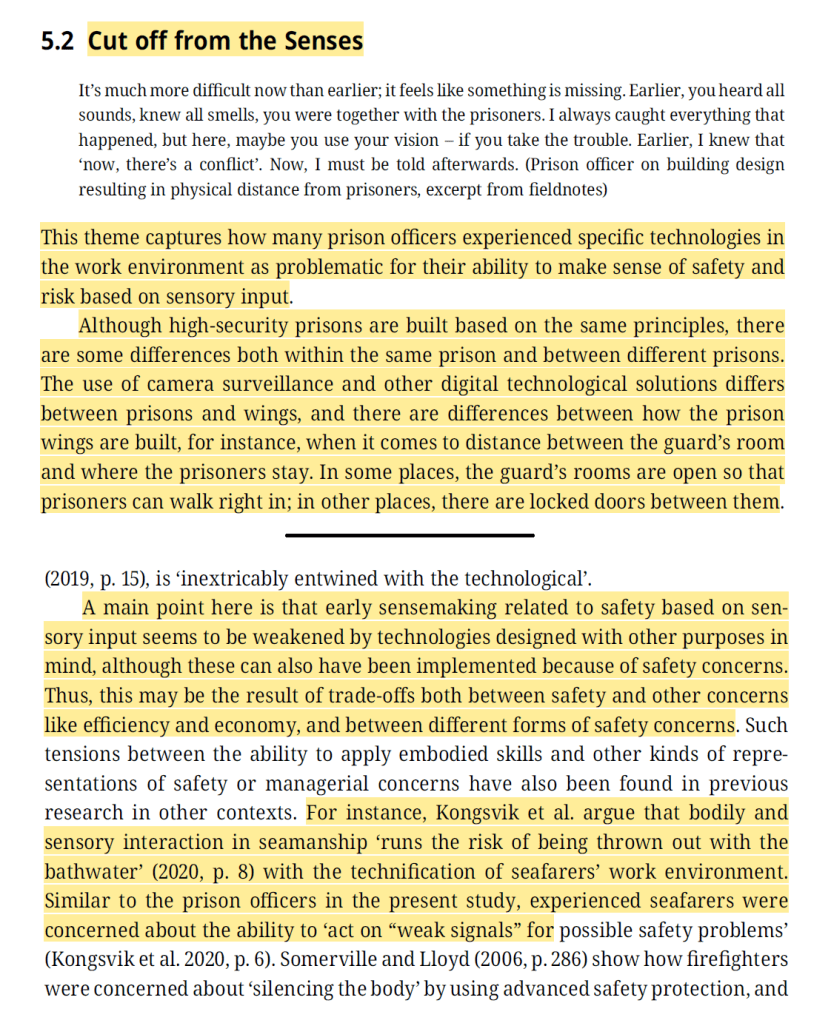
“This theme captures how many prison officers experienced specific technologies in the work environment as problematic for their ability to make sense of safety and risk based on sensory input”.
The author provided examples of how modern designs for prison which separate the guard’s room from the wings, or increasing use of cameras has increased the physical distance between prisoners and officers. Increasing use of cameras had also had the effect of reducing physical presence of officers in prison wings.
One officer relayed that reductions in officers due to an increase in cameras was “false safety’ because of what he perceived as a not so reliable system”.
Further, with such physical distance now between guards to the wings, “ ‘one is very cut off from the senses, which I always have used so actively as a prison officer. Hence, “early sensemaking related to safety based on sensory input seems to be weakened by technologies designed with other purposes in
Similar examples have been found in other industries, like seafaring technology that disconnects seafarers form the bodily and sensory interaction, and that “Similar to the prison officers in the present study, experienced seafarers were concerned about the ability to ‘act on “weak signals” for environment”.
Further, the “way frontline workers are ‘cut off’ from sensory input could be understood as organisational ‘sensebreaking” (emphasis added).
Weick argues that in the early stages of sensemaking, things must be “translated into a ‘common currency for communicational exchanges’ so that the tacit knowledge becomes more explicit, simpler, more ordered and, consequently, usable and relevant”.
This process can however “be challenging because higher value is often given to quantitative, measurable and formal knowledge (Perin 2005; see also Almklov, Rosness, and Størkersen 2014; Almklov and Antonsen 2014) which can also hold a symbolic value that can give the impression that risks have been managed, even if this is not the case (Hutchinson, Dekker, and Rae 2022)”.
Further, while Weick argues that organisations are “talked into existence”, the author extends this suggesting that “organisations are also performed into existence through frontline workers’ occupation-specific sensory sensemaking practices”.
For making sense of the senses in sensemaking, they suggest two points in the design of work. One is because of the importance of the senses, “physical closeness is a premise”. I’ve skipped the second.
Author: Midtlyng, Grethe. “Sensing that Something is Wrong: On the Role of Senses in Sensemaking in Frontline Safety Work” Journal of Organizational Sociology, 2024
Study link: https://doi.org/10.1515/joso-2023-0034
My site with more reviews: https://safety177496371.wordpress.com
LinkedIn post: https://www.linkedin.com/pulse/sensing-something-wrong-role-senses-sensemaking-work-ben-hutchinson-r30zc

 SafetyInsights.org