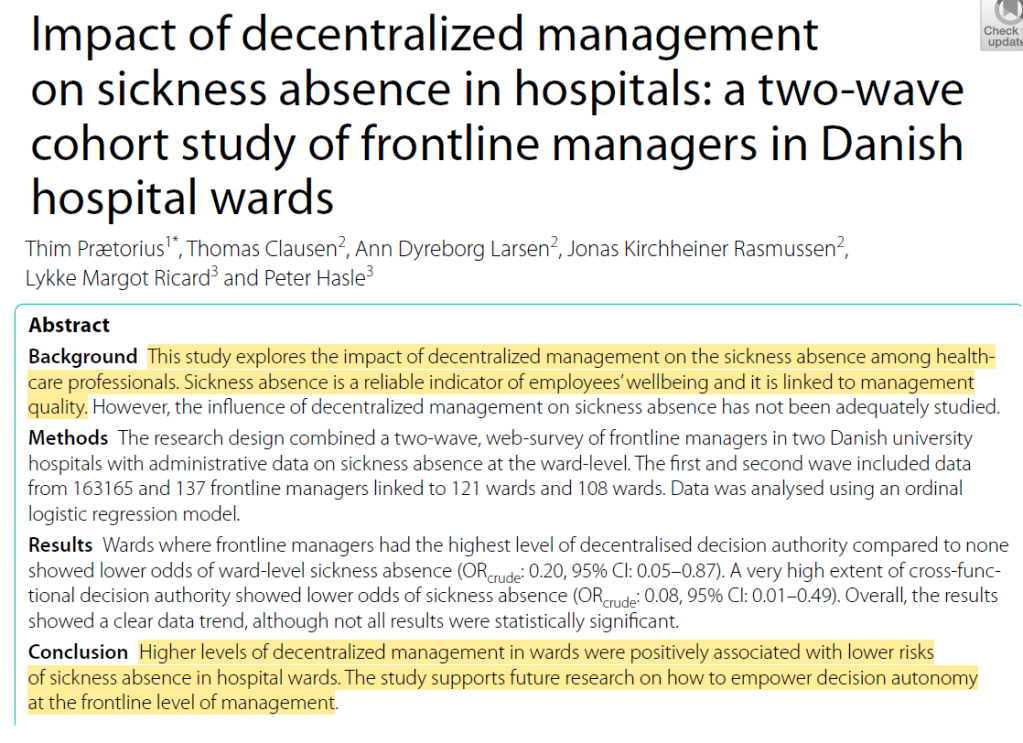
How does a decentralised management structure impact staff sickness absence? Fairly promisingly, according to this new study.
A two-wave, web-survey of >300 frontline managers in two Danish university hospitals was undertaken.
For background:
· “Sickness absence is a reliable indicator of employees’ wellbeing and it is linked to management quality”
· “We break the concept of decentralized management into vertical decision authority (who make decisions about what in the hospital) [19] and cross-functional decision authority (who make decisions outside their own occupation in the hospital)”
· “Centralization refers to a situation where decision-making power rests with a central person or team in the center or at the top of the organizational hierarchy”
· “decentralization means that the decisionmaking power is delegated to frontline managers or employees within an organization, and organizations do it because of the potential it has for improving operations and task completion”
· “A high level of decentralization allows employees to make decisions on their own and empower their autonomy”
· “Moving decision authority to the frontline manager in hospitals enhance the room for exercising supportive and flexible leadership behaviours”
· Delegating decisionmaking to the frontline manager also enhances a more enabling management structure by offering employees access to information, resources, and opportunities to influence decisions”

Key results:
· “Wards where frontline managers had the highest level of decentralised decision authority compared to none showed lower odds of ward-level sickness absence
· “A very high extent of cross-functional decision authority showed lower odds of sickness absence”
· “Overall, the results showed a clear data trend, although not all results were statistically significant”
· “our study provides additional backing for supporting frontline managers to manage in a way that fosters collaboration [44] and wellbeing at work [7] capable of developing a sustainable psychosocial work environment”
· “By focusing on enhancing frontline managers’ decision authority in hospital settings and on improving other aspects of the psychosocial work environment, it should be possible to reduce sickness absence levels and, hence, improve work attendance of hospital employees”

Concluding, they say the findings:
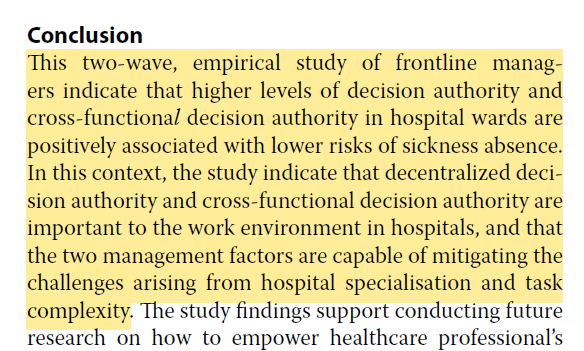
“indicate that decentralized decision authority and cross-functional decision authority are important to the work environment in hospitals, and that the two management factors are capable of mitigating the challenges arising from hospital specialisation and task complexity”.
Ref: Prætorius, T., Clausen, T., Dyreborg Larsen, A., Kirchheiner Rasmussen, J., Ricard, L. M., & Hasle, P. (2024). BMC Health Services Research, 24(1), 816.
Study link: https://link.springer.com/article/10.1186/s12913-024-11234-2
My site with more reviews: https://safety177496371.wordpress.com

 SafetyInsights.org
One thought on “Impact of decentralized management on sickness absence in hospitals: a two-wave cohort study of frontline managers in Danish hospital wards”