Just a brief one today – this study is one of MANY looking at machine learning and big data to draw trends out of incident data.
Normally I pass on these studies, but I found this one had an interesting result.
They explored:
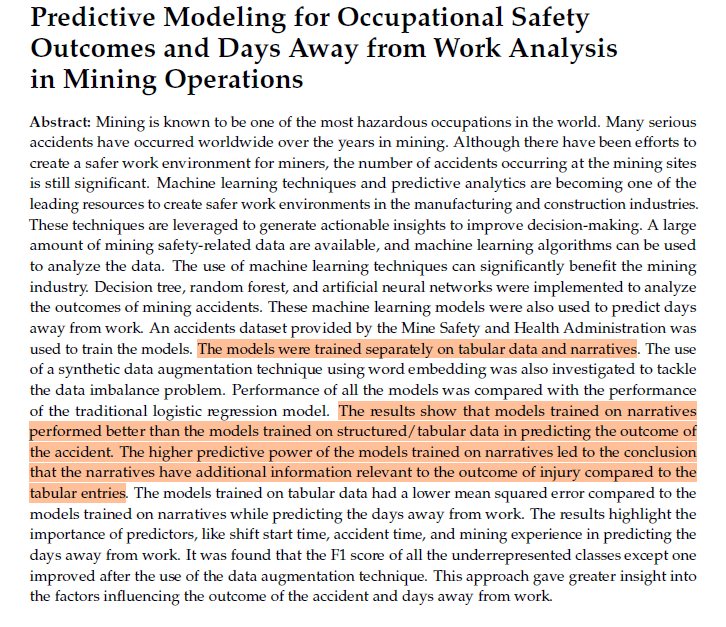
(1) Do text narratives have enough information to predict the outcome of the injury compared to the tabular data
(2) can text narratives be used to predict days away from work?
That is, they compared the use of unstructured narratives, as you’d often find reported in investigations and statements, versus a fixed-field structured dataset (categorisation of factors…which you might find in your incident database and ICAMs etc.).
Focusing more on building multiple, sometimes overlapping narratives is something increasingly promoted in the adaptive spheres (and elsewhere) for learning following incidents, normal work etc. But of course, this isn’t unique to the adaptive perspectives.
In any case, they found:
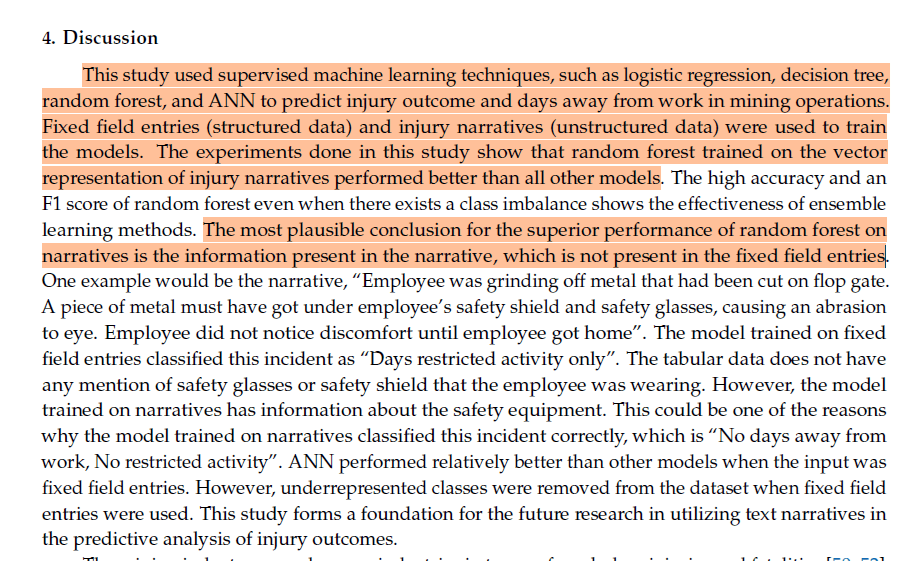
· “The results show that models trained on narratives performed better than the models trained on structured/tabular data in predicting the outcome of the accident”
· “The higher predictive power of the models trained on narratives led to the conclusion that the narratives have additional information relevant to the outcome of injury compared to the tabular entries”
· Nevertheless, “The models trained on tabular data had a lower mean squared error compared to the models trained on narratives while predicting the days away from work”
· “It is interesting to note that the only information missing from the narratives that is present in the fixed field entries is the shift start time, accident time, and the experience of the miner”
While they focused more on the predictive side of incidents, there’s broader value in these findings that narratives produce thicker descriptions of work, constraints etc. and that they contain information that the tabulated assessments don’t.
In contrast, for the predictive side, the structured data performed better than narratives for days away from work.
This likely suggests a combination is most effective, but with a bias towards more detailed narratives?
Just one study – no not keen to overextend the findings, but meh, narratives are more useful.
Ref: Yedla, A., Kakhki, F. D., & Jannesari, A. (2020). Predictive modeling for occupational safety outcomes and days away from work analysis in mining operations. International journal of environmental research and public health, 17(19), 7054.
Study link: https://doi.org/10.3390/ijerph17197054
My site with more reviews: https://safety177496371.wordpress.com

 SafetyInsights.org
One thought on “Narratives in incident investigations found to outperform structured categorised factors in accident prediction”