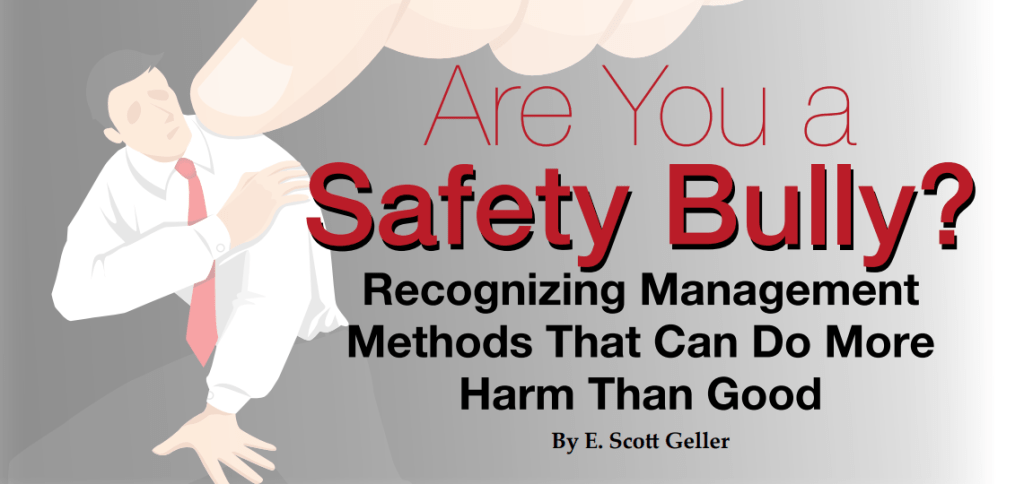
An interesting 2014 article from Scott Geller in Professional Safety, discussing how management approaches to safety can be a form of bullying and imposition of power.
What he calls a safety bully.
He suggests “This article challenges such self-talk by exploring how some common characteristics of traditional safety management can be perceived as bullying and, thereby, limit workers’ genuine involvement”
Some extracts:
- Behavior-Based Safety: “A person who believes that most injuries are caused by employee behavior can be viewed as a safety bully”
- “This belief could influence a focus on the worker rather than the culture or management systems, or many other contributing factors”
- “As Deming (1991) warns, “Don’t blame people for problems caused by the system When safety programs are promoted on a premise such as “95% of all workplace accidents are caused by behavior,” one can understand why union leaders object vehemently and justifiably to such programs”
- “Claiming that behaviors cause workplace injuries and property damage places blame on the employee and dismisses management responsibility. Most worker behavior is an outcome of the work culture, the system”
- “It is wrong to presume that behavior is a cause of an injury or property damage. Rather, behavior is one of several contributing factors, along with environmental and engineering factors, management factors, cultural factors and person-states”
- Oversimplifying Human Dynamics: “Marketing posters and conference speeches often oversimplify the role of human behavior and dispositional states on workplace injuries”
- “ Such oversimplification is a disservice … More importantly, these tactics are misleading and can result in safety bullying”
- “focusing on a limited number of person traits or states as the cause of an injury can be perceived as fault-finding and stifle the search for and discovery of critical contributing factors”
- “It can also limit or bias the interpersonal conversations needed to identify the system factors that influence human factors”
- Misuse of discipline: “Traditional safety discipline is generally a form of top-down control with negative consequences”
- This includes workers getting “a negative lecture from the manager or supervisor whose safety record was tarnished by the injury” – an example of safety bullying
- Investigating to Find a Root Cause: “A common myth in safety holds that injuries are caused by one critical factor, the root cause”, and if you ask enough questions you will arrive at this magical cause
- “Conducting an investigation to find a singular root cause could be considered bullying. This approach can put employees on the defensive, even preventing the disclosure of hazards or barriers to safe work practices”
- Even the term ‘investigation’ implies “fault finding rather than fact finding”
- “An analysis, not an investigation, is needed to sort through this complex web of contributing factors. Using a systems approach in this analysis can help one determine which factors can be changed”
- “Environmental factors are usually easiest to define and improve, followed by behavioral factors. Most difficult to define and change directly are person-states”
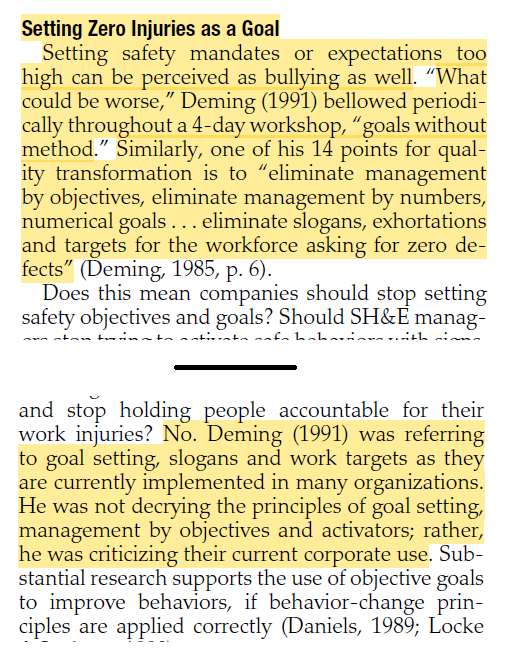
- Setting Zero Injuries as a Goal: “Setting safety mandates or expectations too high can be perceived as bullying as well”
- Deming noted in “one of his 14 points for quality transformation is to “eliminate management by objectives, eliminate management by numbers, numerical goals . . . eliminate slogans, exhortations and targets for the workforce asking for zero defects”
- This doesn’t mean companies should stop setting safety goals, but referring to how companies typically set goals, slogans and work targets
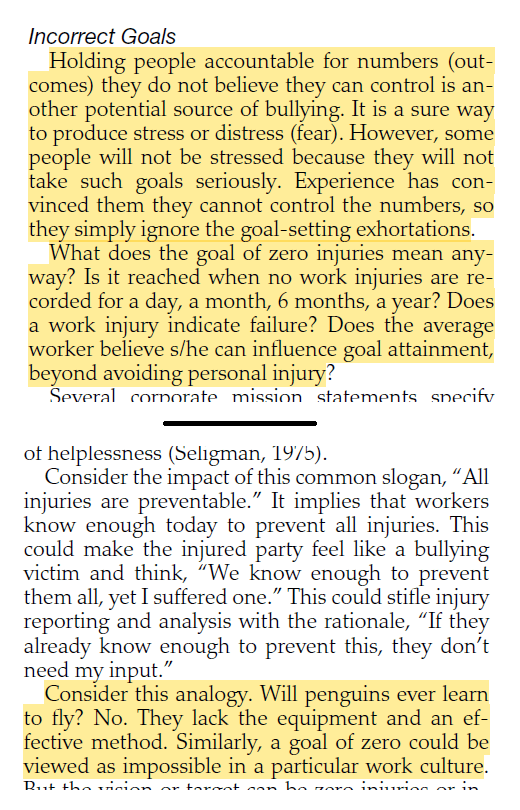
- Incorrect Goals: “Holding people accountable for numbers (outcomes) they do not believe they can control is another potential source of bullying”
- And, “It is a sure way to produce stress or distress (fear)”
- How does one reach zero? Is it “reached when no work injuries are recorded for a day, a month, 6 months, a year? Does a work injury indicate failure? Does the average worker believe s/he can influence goal attainment, beyond avoiding personal injury?”
- Do workers believe they can influence the system and cultures to avoid injuries? “Consider this analogy. Will penguins ever learn to fly? No. They lack the equipment and an effective method. Similarly, a goal of zero could be viewed as impossible in a particular work culture”
Ref: Geller, E. S. (2014). Are you a safety bully: recognizing management methods that can do more harm than good. Professional Safety, 59(01), 39-44.
Study link: https://aeasseincludes.assp.org/professionalsafety/pastissues/059/01/F3Geller_0114.pdf
My site with more reviews: https://safety177496371.wordpress.com

 SafetyInsights.org
One thought on “Are You a Safety Bully? Recognizing Management Methods That Can Do More Harm Than Good”