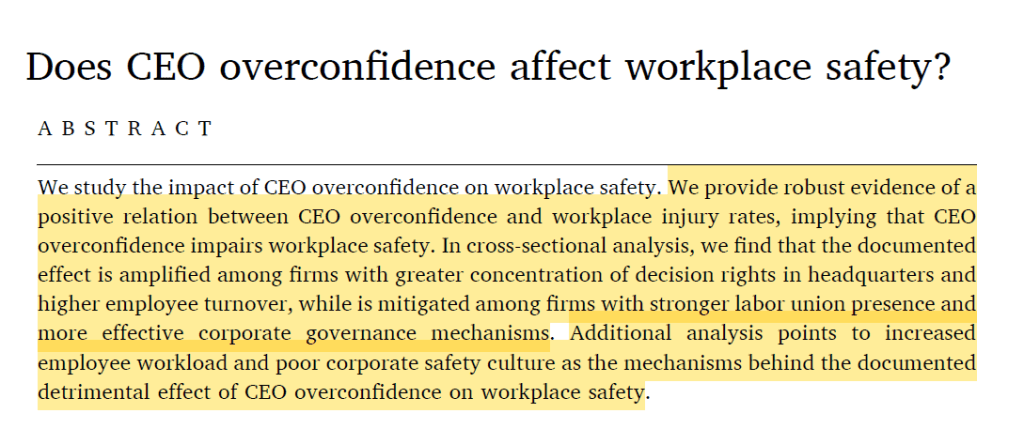
Does CEO overconfidence affect workplace safety?
This studied the relationship between CEO overconfidence and workplace safety.
Data was drawn from OSHA and firm financial performance and CEO compensation.
For background:
- “Overconfidence reflects the tendency of individuals to think they are better than they really are on relevant characteristics, such as ability, judgment, or prospects for successful outcomes (Hirshleifer et al., 2012)”
- “Individuals exhibit higher levels of overconfidence when they are (or perceive to be) in control and are committed to or emotionally invested in the outcome (Weinstein, 1980)—settings that characterize CEOs as the key corporate decision makers, implying that overconfidence bias is reinforced among CEOs”
- “Consistent with this, CEO overconfidence has been shown to influence a wide range of corporate decisions including investments, capital structure, and innovations”
- “prior literature suggests that CEOs influence corporate policies by “setting the tone at the top”, which results in their personality traits becoming imprinted on the firm”
- “Consistent with this notion, a growing stream of research highlights that CEOs play a critical role in developing a climate of organizational safety by role modelling their workplace safety-related values and behaviours to lower-level managers and supervisors”
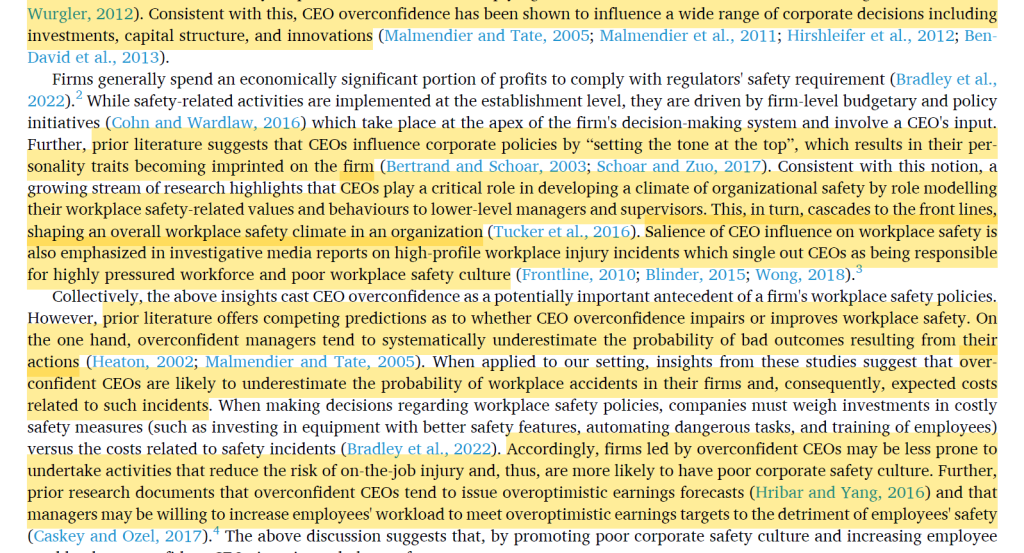
- “the above insights cast CEO overconfidence as a potentially important antecedent of a firm’s workplace safety policies”
- “overconfident CEOs are likely to underestimate the probability of workplace accidents in their firms and, consequently, expected costs related to such incidents”
- “When making decisions regarding workplace safety policies, companies must weigh investments in costly safety measures (such as investing in equipment with better safety features, automating dangerous tasks, and training of employees) versus the costs related to safety incidents (Bradley et al., 2022)”
- “Accordingly, firms led by overconfident CEOs may be less prone to undertake activities that reduce the risk of on-the-job injury and, thus, are more likely to have poor corporate safety culture”
- “prior research documents that overconfident CEOs tend to issue overoptimistic earnings forecasts (Hribar and Yang, 2016) and that managers may be willing to increase employees’ workload to meet overoptimistic earnings targets to the detriment of employees’ safety”
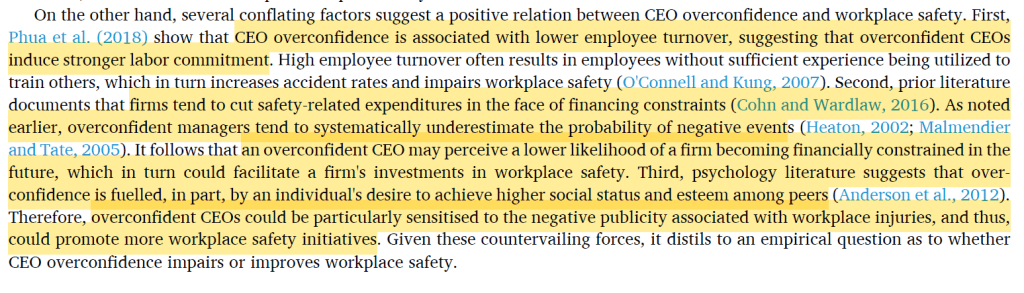
- “overconfident managers tend to systematically underestimate the probability of negative events … It follows that an overconfident CEO may perceive a lower likelihood of a firm becoming financially constrained in the future, which in turn could facilitate a firm’s investments in workplace safety”
Key findings were:
- “positive relation between CEO overconfidence and workplace injury rates, implying that CEO
- overconfidence impairs workplace safety”
- “In cross-sectional analysis, we find that the documented effect is amplified among firms with greater concentration of decision rights in headquarters and higher employee turnover, while is mitigated among firms with stronger labor union presence and more effective corporate governance mechanisms”
- “increased employee workload and poor corporate safety culture as the mechanisms behind the documented detrimental effect of CEO overconfidence on workplace safety … consistent with the notion that overconfident CEOs tend to allocate more workload to employees”
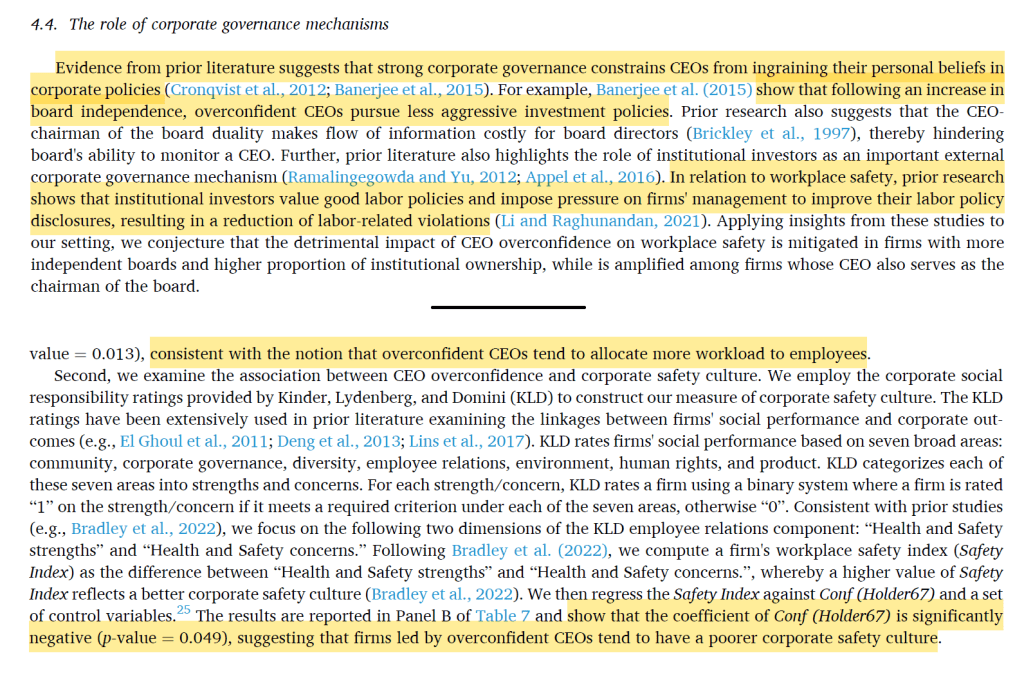
- Next they compare CEO overconfidence on corporate safety culture scores, saying “firms led by overconfident CEOs tend to have a poorer corporate safety culture”
- “Our study extends the literature on both CEO overconfidence and workplace safety by casting CEO overconfidence as an important antecedent of a firm’s workplace safety policies”
- “corporate board members should be mindful of the adverse effect of CEO overconfidence on workplace safety when assessing the cost-benefit balance of employing overconfident CEOs”
Ref: Chen, Y., Ofosu, E., Veeraraghavan, M., & Zolotoy, L. (2023). Does CEO overconfidence affect workplace safety?. Journal of Corporate Finance, 82, 102430.
Study link: https://doi.org/10.1016/j.jcorpfin.2023.102430
My site with more reviews: https://safety177496371.wordpress.com

 SafetyInsights.org