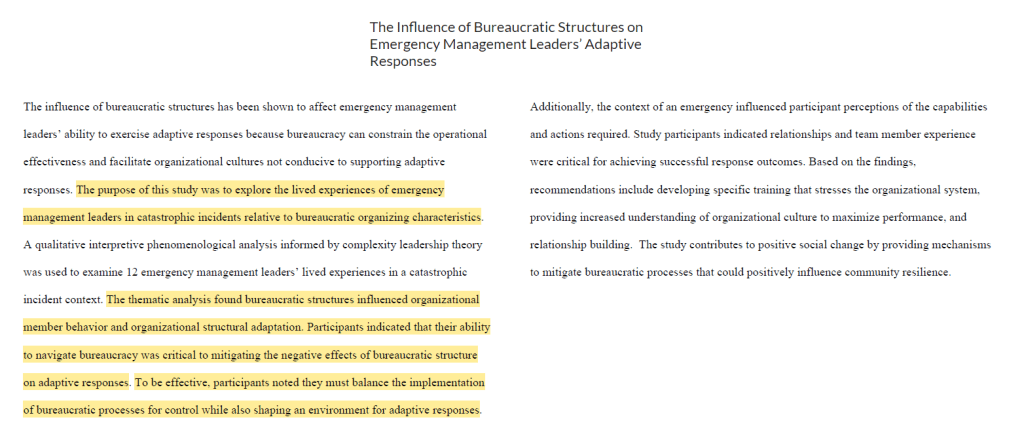
This PhD dissertation from Anthony M. R. may interest people – it explored how bureaucratic structures influence or hamper adaptive responses of emergency management leaders, drawing on complex adaptive systems.
Some findings:
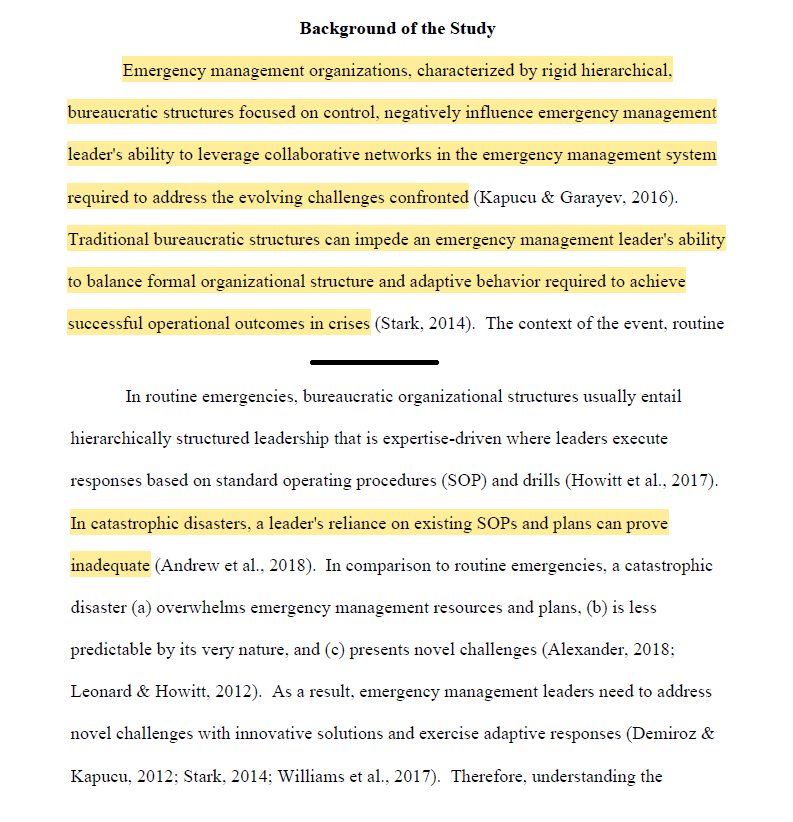
· “Traditional bureaucratic structures can impede an emergency management leader’s ability to balance formal organizational structure and adaptive behavior required to achieve successful operational outcomes in crises”
· “Emergency management organizations, characterized by rigid hierarchical, bureaucratic structures focused on control, negatively influence emergency management leader’s ability to leverage collaborative networks”
· “No plan survives first contact with the enemy, and in a catastrophic incident, it’s the same, you want to have the flexibility within your systems to be able to go off-script, but you want to be able to do it in a trusted environment”
· “bureaucratic organizational structural characteristics can limit organizational adaptability and influence successful response outcomes during a catastrophic incident”
· “When faced with bureaucratic operational constraints, participants described how emergency management leader decisiveness and processes adaptation were critical skills needed to achieve required outcomes in a catastrophic incident”
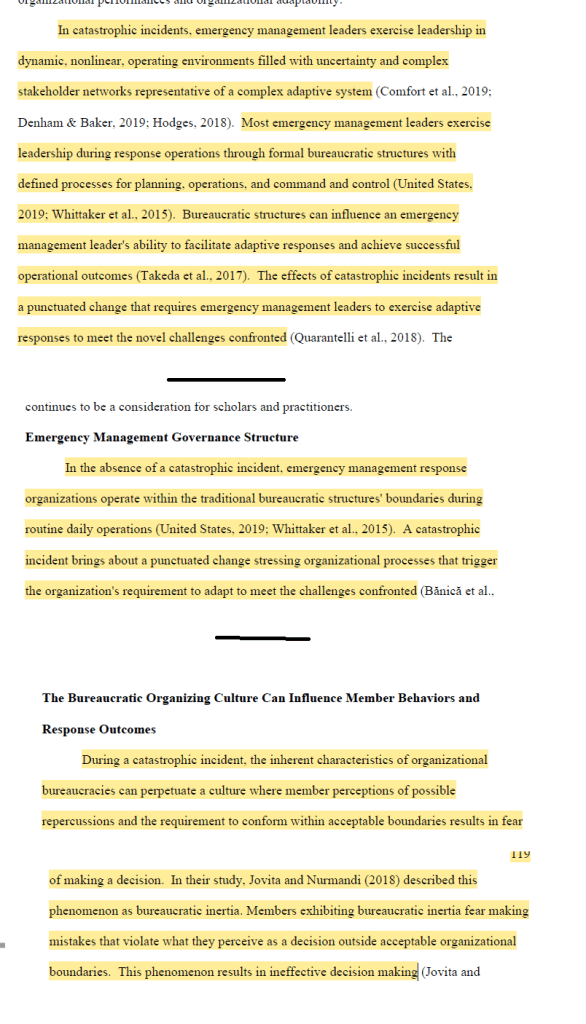
· “the organization’s size influenced the degree of bureaucracy. The larger the organization, the greater the bureaucratic influence”
· “effective response operations require emergency management leaders to navigate layers of bureaucracy in a catastrophic incident”
· “routine emergencies were primarily addressed at the local first responder level following SOPs
· with organic resources .. because of the limited effects on societal systems, routine emergencies are mitigated through existing plans or by local first responders following SOPs”
· In contrast, in a catastrophic incident, “organizational structure is forced to adapt to address the overwhelming effects on the emergency management system. This organizational adaptation is manifested by establishing an emergency operations center, modifying plans, or integrating additional external resources”
· “Emergency management leaders in catastrophic incidents need to exercise adaptive responses and operational flexibility”
· “the structure provided by formalized processes within bureaucratic structures provided a foundation for organizational adaptation” and a “framework established by codified plans and procedures provided a baseline to adapt from to meet the novel challenges resulting from the effects of a catastrophic incident”
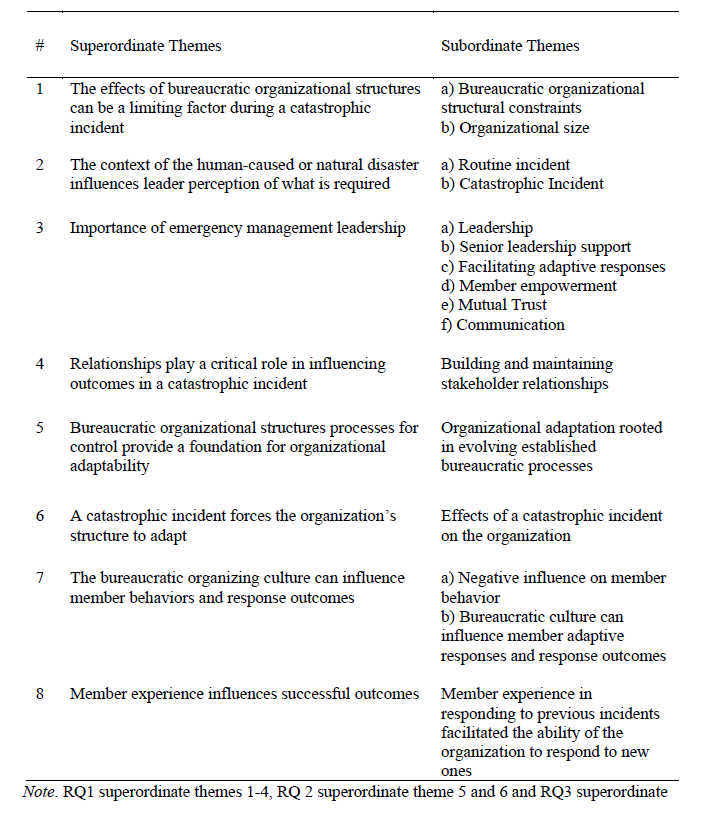
· “the goal of the emergency management leader was to balance the bureaucratic process of control with the requirement to adapt to meet the challenges confronted”
· “When the two were in equilibrium, bureaucratic processes contributed to successful operational outcomes by providing a degree of control without constraining adaptive responses”
· “the effects of a catastrophic incident leave little room for rigidity in methods of operation characteristic of bureaucratic processes. To maintain a rigid and inflexible organizing methodology would not support the need for adaptive responses necessary in catastrophic incidents”
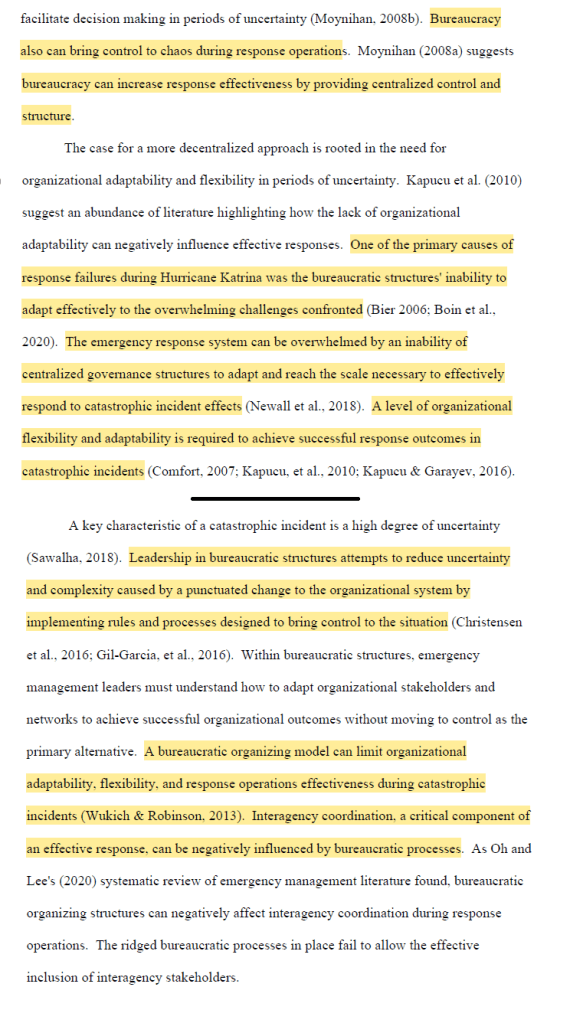
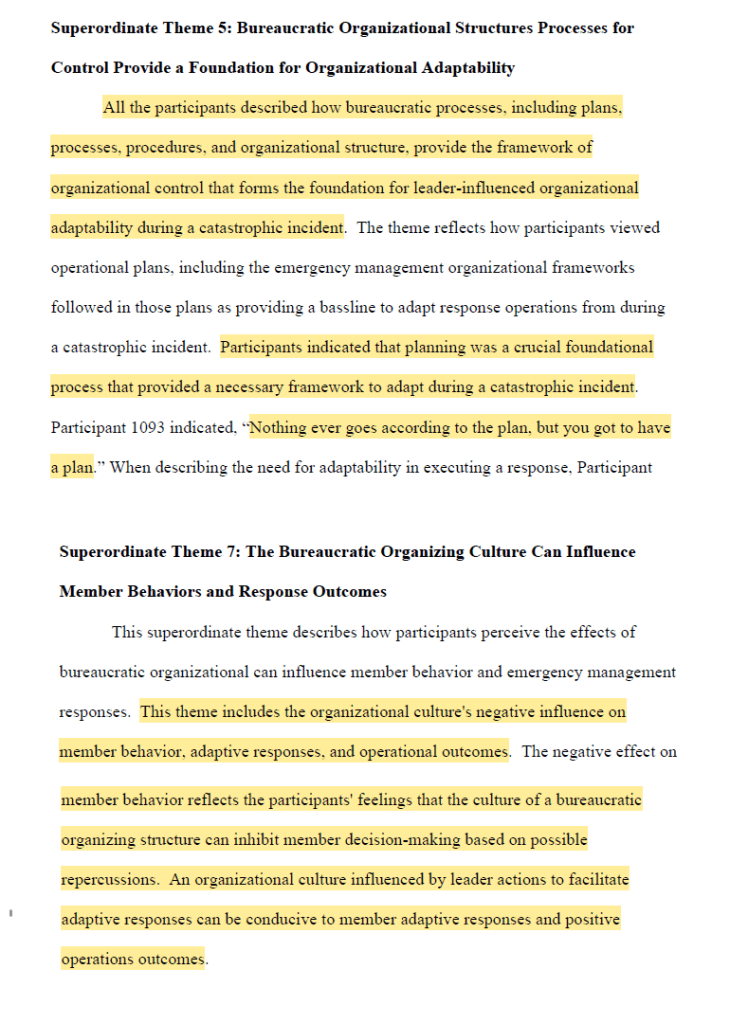
· “During a catastrophic incident, the inherent characteristics of organizational bureaucracies can perpetuate a culture where member perceptions of possible repercussions and the requirement to conform within acceptable boundaries results in fear of making a decision”
· This fear has been described as “bureaucratic inertia”, and “Members exhibiting bureaucratic inertia fear making mistakes that violate what they perceive as a decision outside acceptable organizational boundaries. This phenomenon results in ineffective decision making”
Ref: Riscica, Anthony M., “The Influence of Bureaucratic Structures on Emergency Management Leaders’ Adaptive Responses” (2022). Walden Dissertations and Doctoral Studies. 13092
Study link: https://scholarworks.waldenu.edu/cgi/viewcontent.cgi?article=14363&context=dissertations
My site with more reviews: https://safety177496371.wordpress.com

 SafetyInsights.org