This coronial inquest describes a fatality after a young worker was struck by an item of drill rig, called an ‘ST-80 Roughneck tool’.
Many design issues were raised – e.g. confusing interface, mode confusion, overreliance on admin controls and ‘error traps’.
I’ve skipped a lot – but some notable points:
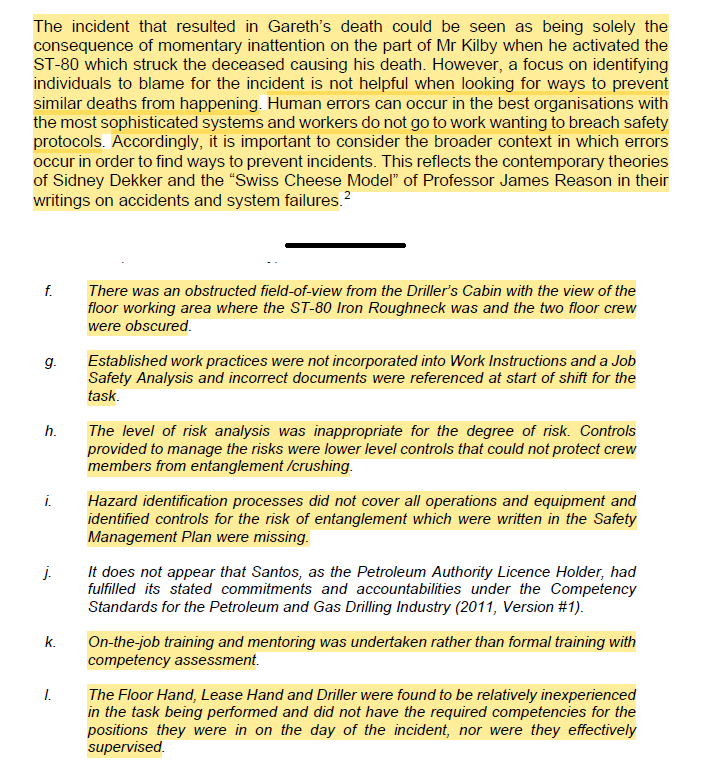
- “The incident that resulted in Gareth’s death could be seen as being solely the consequence of momentary inattention”, however, “a focus on identifying individuals to blame for the incident is not helpful when looking for ways to prevent similar deaths from happening”
- “Human errors can occur in the best organisations with the most sophisticated systems and workers do not go to work wanting to breach safety protocols”
- “it is important to consider the broader context in which errors occur in order to find ways to prevent incidents. This reflects the contemporary theories of Sidney Dekker and the “Swiss Cheese Model” of Professor James Reason”
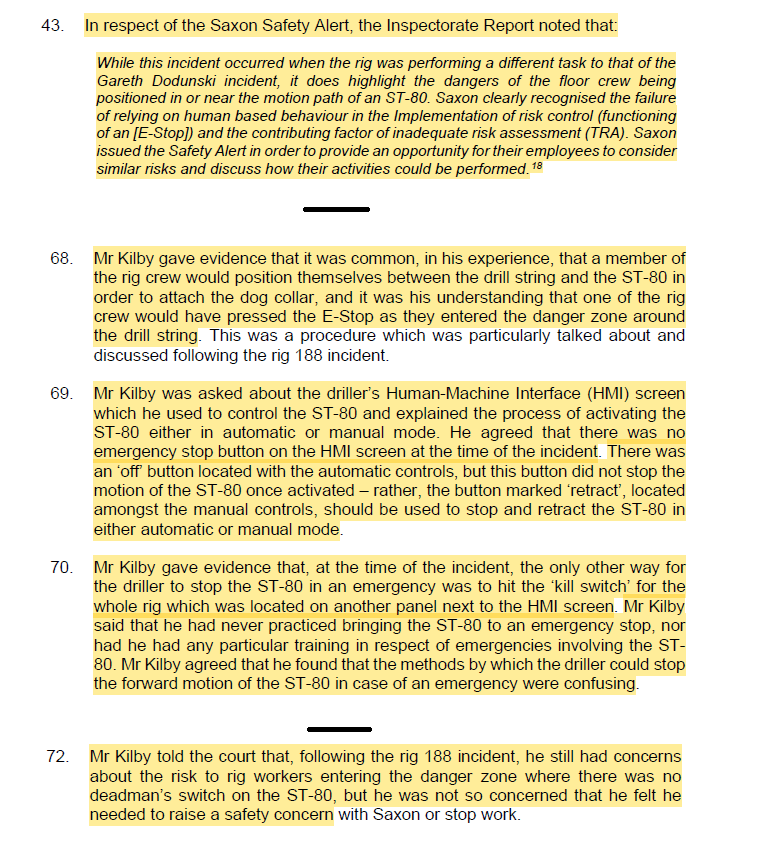
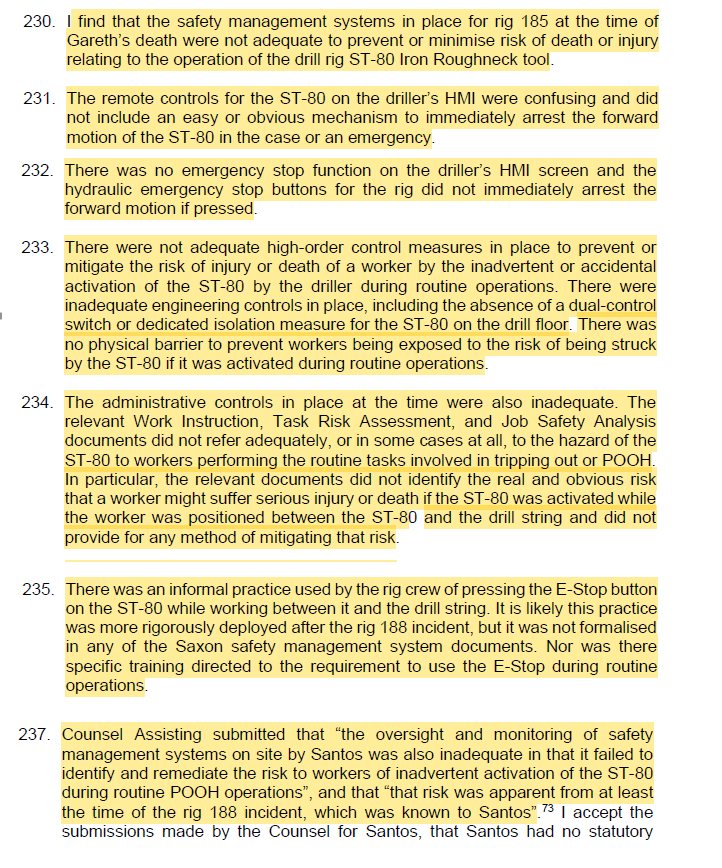
- “the safety management systems in place for rig 185 at the time .. were not adequate to prevent or minimise risk of death or injury relating to the operation of the drill rig ST-80 Iron Roughneck”
- The remote controls and instrumental panels were “confusing and did not include an easy or obvious mechanism to immediately arrest the forward motion of the ST-80 in [emergencies]”
- The drilling controls were “confusing and likely to produce an error such as the one that occurred” – hence, an error trap
- There was no “emergency stop function on the driller’s HMI screen and the hydraulic emergency stop buttons for the rig did not immediately arrest the forward motion if pressed”
- “There were not adequate high-order control measures in place to prevent or mitigate [fatal injuries]” via inadvertent or accidental activation of the ST-80
- There was also “inadequate engineering controls in place, including the absence of a dual-control switch or dedicated isolation measure for the ST-80 on the drill floor” and no physical barriers in place
- Admin controls were also said to be inadequate, e.g. Work Instruction, Task Risk Assessment, and Job Safety Analysis documents “did not refer adequately, or in some cases at all, to the hazard of the ST-80 to workers performing the routine tasks involved in tripping out or POOH”
- Further, “There was an informal practice used by the rig crew of pressing the E-Stop button on the ST-80 while working between it and the drill string”; this practice was “not formalised” in the safety processes, nor did any specific training exist directing the use of the E-stop during routine ops
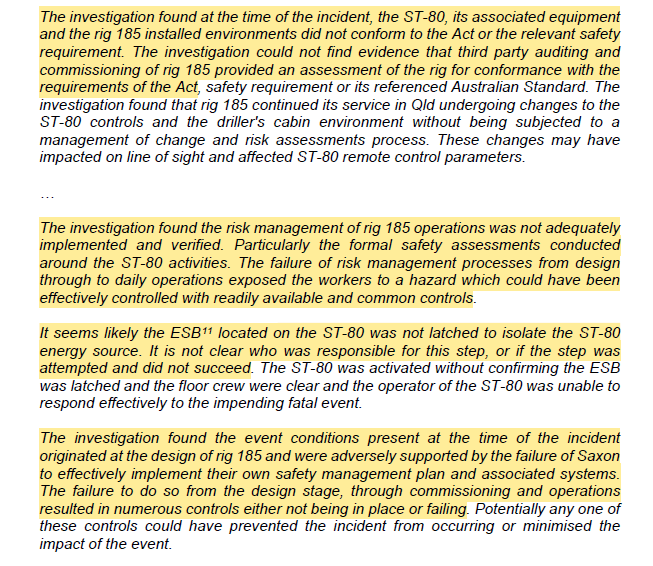
- There was an obstructed “field-of-view from the Driller’s Cabin with the view of the floor working area where the ST-80 Iron Roughneck was and the two floor crew were obscured”
- The “ level of risk analysis was inappropriate for the degree of risk. Controls provided to manage the risks were lower level controls that could not protect crew members from entanglement /crushing”
- HAZID processes didn’t cover all operations and equipment, and controls for entanglement risks specified in the SMS were absent
- “On-the-job training and mentoring was undertaken rather than formal training with competency assessment”
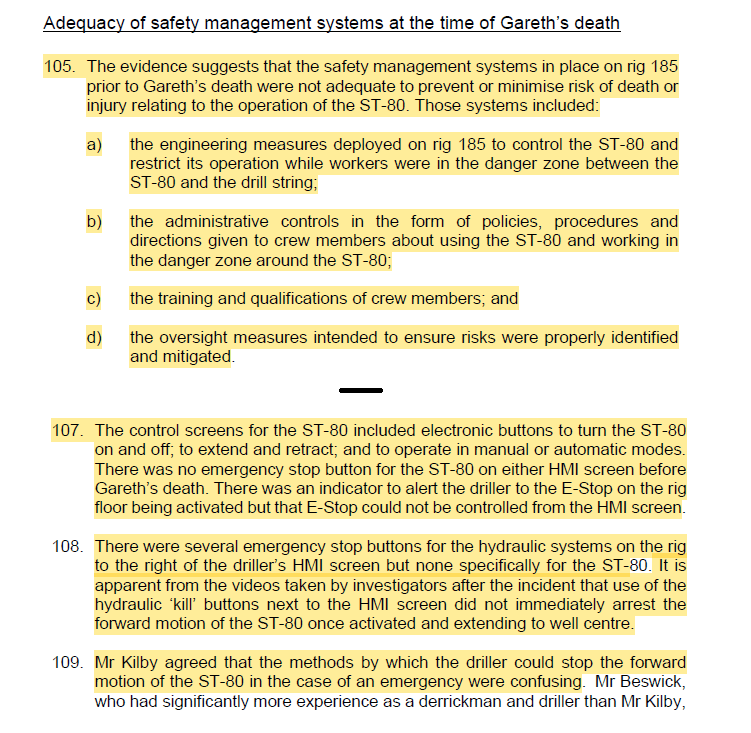
- Investigations “not find evidence that third party auditing and commissioning of rig 185 provided an assessment of the rig for conformance” to legislation and standards
- Changes had also been made to the ST-80 controls and driller’s cabin “without being subjected to a management of change and risk assessments process”, which may have affected driller visibility and control parameters
- “ The investigation found the event conditions present at the time of the incident originated at the design of rig 185 and were adversely supported by the failure of Saxon to effectively implement their own safety management plan and associated systems. The failure to do so from the design stage, through commissioning and operations resulted in numerous controls either not being in place or failing”
- It was said to be common practice that rig crew would “position themselves between the drill string and the ST-80 in order to attach the dog collar”, and use of the E-stop in routine practices
- The driller control screen had “no emergency stop button on the HMI screen at the time of the incident”, and while there was an ‘off’ button on the controls, this “not stop the motion of the ST-80 once activated”
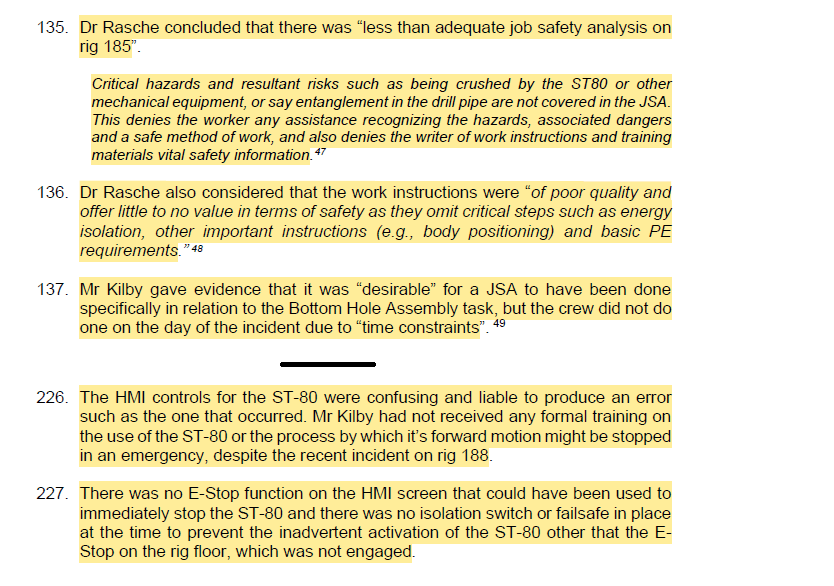
- Evidence provided was that they “had never practiced bringing the ST-80 to an emergency stop, nor had he had any particular training in respect of emergencies involving the ST-80”
- Changes to the control panel “put more responsibility on the driller and was therefore less safe for the workers on the rig floor”
- There was also “no deadman’s switch on the ST-80, but he was not so concerned that he felt he needed to raise a safety concern with Saxon or stop work”
- “Prior to Gareth’s death, there was no other isolation measure that could be used by the rig crew to prevent the ST-80 from being inadvertently activated while workers were on the rig floor”
- “the work instructions were “of poor quality and offer little to no value in terms of safety as they omit critical steps such as energy isolation, other important instructions (e.g., body positioning) and basic PE requirements.”
Ref: CORONERS COURT OF QUEENSLAND. (2023). Inquest into the death of Gareth Leo DODUNSKI

Report link: https://www.coronerscourt.qld.gov.au/__data/assets/pdf_file/0004/798718/dodunski-gareth-findings.pdf
My site with more reviews: https://safety177496371.wordpress.com

 SafetyInsights.org
One thought on “Coronial inquiry: fatal drill rig design, poor machine interface and numerous error traps”