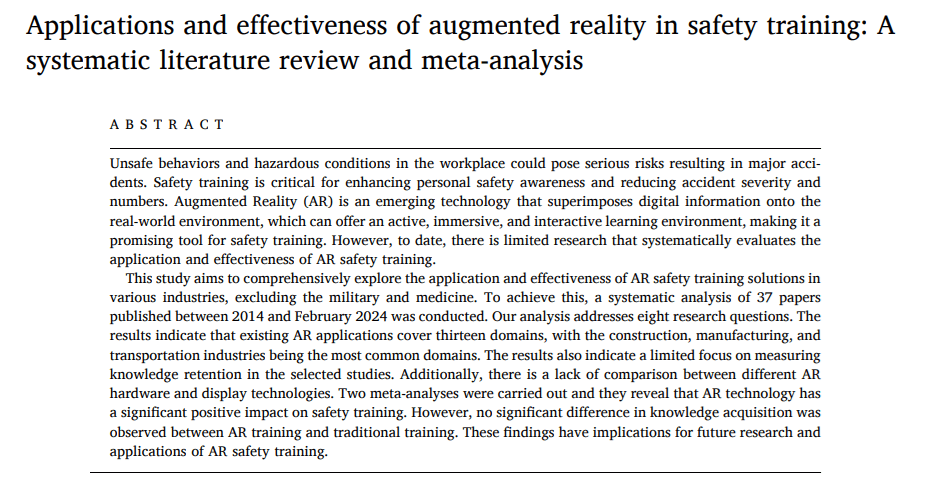
This systematic review and meta-analysis may interest people – it explored the use and effectiveness of AR safety training solutions across 13 industries.
Some findings:
· “Results indicate that AR has a significant positive impact on safety training”
· The meta-analysis “revealed a significant positive effect of AR technology on safety training, demonstrating its substantial impact”
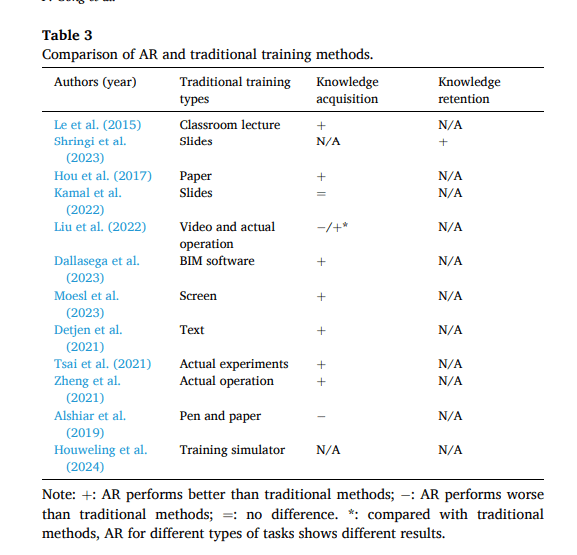
· “No difference was found between AR and traditional training in knowledge acquisition”
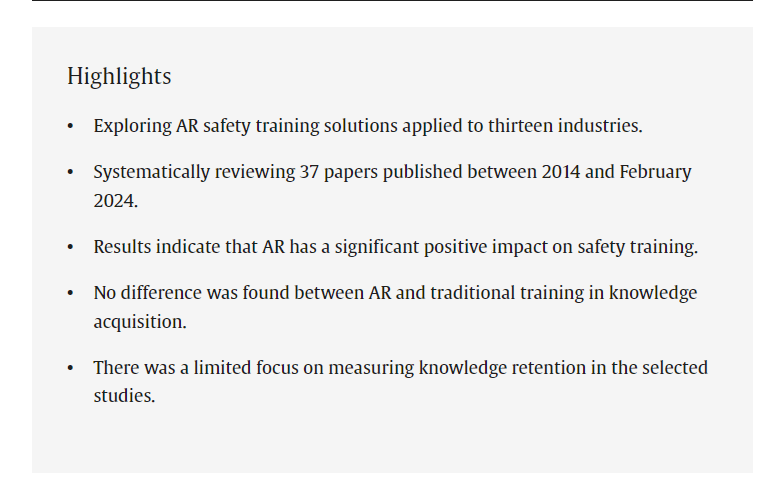
· “There was a limited focus on measuring knowledge retention in the selected studies”
· “Thirteen areas were identified where AR can be applied effectively for safety training”
· “Among these areas, construction, manufacture, and transportation safety training were the most extensively explored”
· “The measurement types used in the selected research applications primarily include user experience, knowledge acquisition, and knowledge retention”
· “Regarding knowledge acquisition and retention.. the findings indicate that only three studies published in 2022 and 2023 reported measurements of knowledge retention. The retention periods included in these studies were limited to 1 week and 2 weeks”
· “When examined across different domains, it was found that the construction industry emphasizes hazard prevention, the manufacturing industry focuses on training individuals to correctly use equipment and tools, and the transportation industry places importance on risk perception and driving safety”
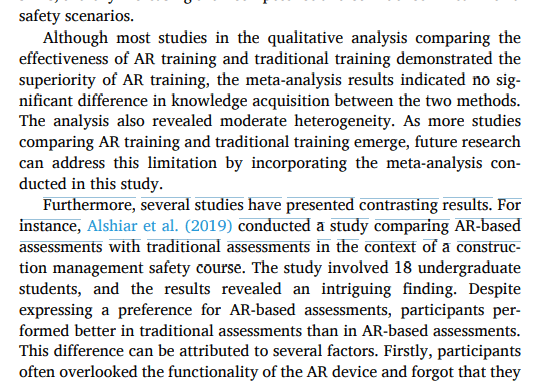
· “several studies have presented contrasting results. For instance, Alshiar et al. (2019) conducted a study comparing AR-based assessments with traditional assessments in the context of a construction management safety course. The study involved 18 undergraduate students, and the results revealed an intriguing finding. Despite expressing a preference for AR-based assessments, participants performed better in traditional assessments than in AR-based assessments”
For why AR may be effective, they suggest:
· “AR training enhances trainee engagement by capturing their attention and promoting active participation through the immersive and interactive nature”
· “By integrating virtual elements into the real-world setting, AR fosters a sense of reality and relevance, leading to deeper engagement and improved knowledge retention”
· “AR training stimulates active learning behavior as trainees interact with virtual objects and perform tasks replicating real-world scenarios. This hands-on approach facilitates experiential learning, enabling trainees to develop practical skills and decision-making abilities”
“AR training piques the interest of participants by offering a novel and immersive experience”
Ref: Gong, P., Lu, Y., Lovreglio, R., Lv, X., & Chi, Z. (2024). Applications and effectiveness of augmented reality in safety training. Safety Science, 178, 106624.
My site with more reviews: https://safety177496371.wordpress.com

 SafetyInsights.org