Risk Controls Identified in Action Plans Following Serious Incident Investigations in Secondary Care: A Qualitative Study
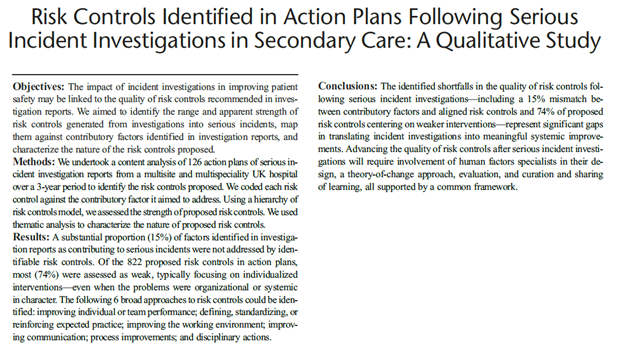
This study explored the range and apparent strength of risk controls generated from investigations into serious incidents.
126 action plans of serious incident investigation reports from a multisite UK hospital over a 3 year period were evaluated.
For background:
- “studies consistently suggest that many risk controls are suboptimal,7–10 such that the risk of recurrence remains, while at the same time creating potential for waste and misdirection of effort”
- “The U.S. Veteran Affairs (VA) has proposed a hierarchy of actions4 classifying them as “stronger,” “medium,” or “weaker,” based on their ability to address hazards and their dependence on human intervention”
- “Top-tier actions or risk controls, like hazard elimination via tested technology, are deemed more effective but potentially challenging to implement, in contrast with lower-tier actions like training”
Results
They found:
- “A substantial proportion (15%) of factors identified in investigation reports as contributing to serious incidents were not addressed by identifiable risk controls”
- Of the 822 proposed risk controls in action plans, “most (74%) were assessed as weak, typically focusing on individualized interventions—even when the problems were organizational or systemic in character”
- Six broad approaches to risk controls were identified: improving individual or team performance; defining, standardizing, or reinforcing expected practice; improving the working environment; improving communication; process improvements; and disciplinary actions
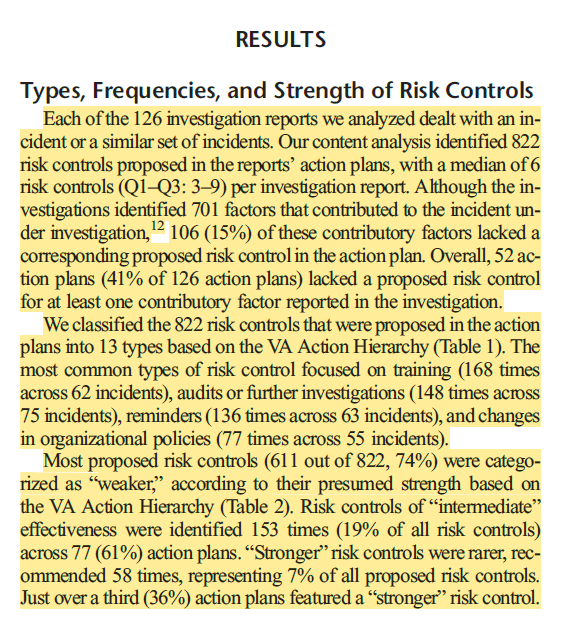
- 15% of contributory factors “lacked a corresponding proposed risk control in the action plan”
- 52 out of 126 action plans (41%) lacked a proposed risk control for at least one contributory factor reported in the investigation
Types of risk controls
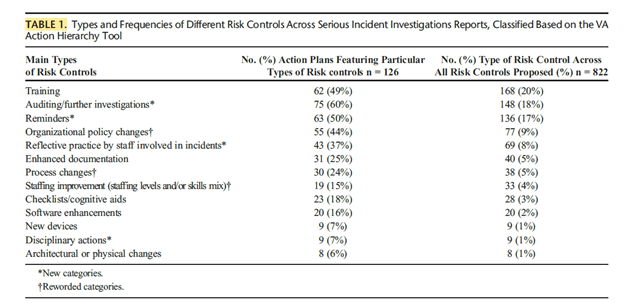
The most common risk control types focused on training, audits or further investigations, reminders, and changes in organisational policies.
Strength of risk controls
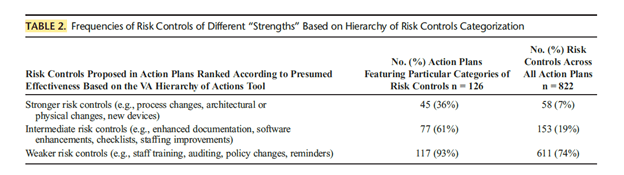
Most proposed risk controls (74%) were categorised as “weaker”, according to their presumed strength based on the VA action hierarchy.
Intermediate strength controls were identified in 19% of risk controls. Stronger controls were more rare, accounting for 7% of all proposed risk controls.
Just over a third (36%) of action plans featured a “stronger” risk control, and sometimes no risk controls were proposed, and in other cases only weaker actions were recommended.
No risk controls were recommended for 24% of contributory factors involving preconditions for unsafe acts, which included environmental conditions, impaired communication, staff well-being, patient-related and team dynamics.
When risk controls were proposed for preconditions, “the most common were auditing/further investigations (39 of 223 preconditions, 17%), reminders (27 of 223 preconditions, 12%) and staff training (22 of 223 preconditions, 10%); hence, “This means that they were predominantly weaker risk controls”.
In contrast ,when organisational factors were identified as contributory factors (operational process, resource management, cultures etc.), only 17% were not followed by any risk control measures. The most common risk controls for organisational factors were policy changes, staffing improvements, process changes.
The most common strategy for controlling risk across the board were interventions aimed at individuals or group performance; many of these were weaker, like training exercises, written reflections, and feedback.
The paper said that reminders were often proposed as controls to reinforce local policies or to create awareness of hazardous situations. Despite this, “their potential role in controlling risk was sometimes questionable”.
Risk controls aimed at improving work environment issues, like staffing, technology and physical infrastructure “were identified only rarely (74 times (9% of all risk controls) across 45 (36%) action plans)”
Only rarely (1% of all 822 risk controls) did risk controls take a disciplinary form. “Punitive actions appeared to be recommended inconsistently, with apparently similar errors resulting in completely different risk controls”.
Discussing the findings, they note:
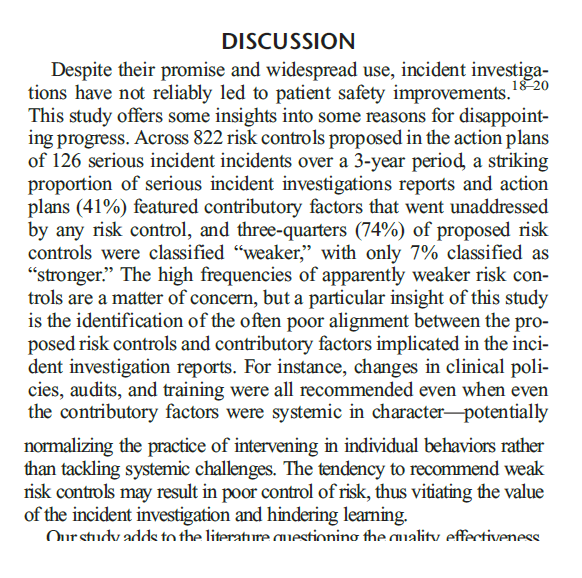
- “Despite their promise and widespread use, incident investigations have not reliably led to patient safety improvements”
- “.Across 822 risk controls proposed in the action plans of 126 serious incident incidents over a 3-year period, a striking proportion of serious incident investigations reports and action plans (41%) featured contributory factors that went unaddressed by any risk control, and three-quarters (74%) of proposed risk controls were classified “weaker,”with only 7% classified as “stronger”
- “The high frequencies of apparently weaker risk controls are a matter of concern”
- However, “a particular insight of this study is the identification of the often poor alignment between the proposed risk controls and contributory factors implicated in the incident investigation reports”
- Moreover, “changes in clinical policies, audits, and training were all recommended even when even the contributory factors were systemic in character—potentially normalizing the practice of intervening in individual behaviors rather than tackling systemic challenges”
- “One reason for the often poor match between risk controls and contributory factors may lie in a perceived imperative for investigators to recommend less resource-intense risk controls within the scope of influence of the organization”
- “More effective risk controls may also require specialist expertise—such as human factors engineering to design forcing functions or new devices—that may not be available to organizations”
Authors: Peerally, M. F., Carr, S., Waring, J., Martin, G., & Dixon-Woods, M. (2023). Risk controls identified in action plans following serious incident investigations in secondary care: a qualitative study. Journal of Patient Safety, 10-1097.
Study link: https://doi.org/10.1097/PTS.0000000000001238
My site with more reviews: https://safety177496371.wordpress.com
LinkedIn post: https://www.linkedin.com/posts/benhutchinson2_activity-7228475265088151552-3MIC?utm_source=share&utm_medium=member_desktop

 SafetyInsights.org
One thought on “Risk Controls Identified in Action Plans Following Serious Incident Investigations in Secondary Care: A Qualitative Study”