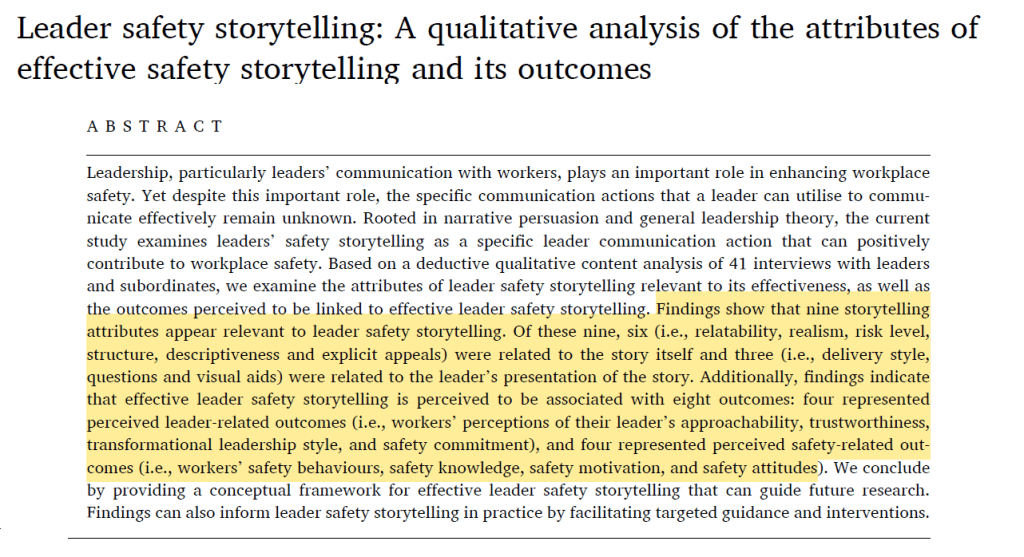
This studied the use of leader safety storytelling as a specific leader communication and its outcomes.
Data included interviews with 41 leaders and team members.
For background:
· “Higher-quality leader safety messaging is also associated with improved worker safety performance and decreased lost time due to injuries”
· “the existing literature points to leaders having a critical role in workplace safety and that communication is a key tool for their influence”
· As yet, leader storytelling has received limited attention in the safety literature, which they find surprising since “storytelling has been cited as one of the most promising ways leaders can communicate safety messages”
· One prior study based on interviews with leaders in rail, they identified four man themes for effective stories, such that stories need to be: 1) coherent and understandable 2) factual 3) structured and delivered rigorously 4) personalised to the Audience
· “storytelling is typically a verbal act involving re-telling a near miss or accident event”, and while there is limited research in safety, it has been extensively studied in other fields, like health promotion and consumer behaviour
· The “theory of narrative persuasion proposes that storytelling is effective through its ability to implicitly impart knowledge and influence attitudes and behaviour via subconscious avenues of persuasion”
· Effective storytelling results when “a story is well-crafted and well-told based on specific attributes that engage the recipient cognitively and arouse emotional reactions”
· Further, this “reduces scrutiny of the details presented in the story, thus increasing the likelihood that the audience will adopt story-consistent information, attitudes and behaviours”

Results
Key findings:
· Nine storytelling attributes appear relevant to leader storytelling
· Of these nine, six were related to the story itself (relatability, realism, risk level, structure, descriptiveness and explicit appeal), while three were related to the leader’s presentation of the story (delivery style, questions, and visual aids”)
· Further, effective leader storytelling was perceived to be associated with eight outcomes: four linked to leader-related outcomes (workers’ perceptions of their leader’s approachability, trustworthiness, transformational leadership style, and safety commitment), while four were linked with perceived safety-related outcomes, that is, perceived by the audience (workers’ safety behaviours, safety knowledge, safety motivation, and safety attitudes)
They say that the “idea that a story must be well-crafted to be effective suggests the importance of specific attributes that impact story quality”. Discussing other findings, they note that others found that the delivery style of a leader when communicating, like a captivating tone, animated facial expressions, confident and dynamic interaction style achieved a greater impact in communicating their message.

Others have argued that “the most immediate impact of leader behaviour (such as safety storytelling) is on workers’ perceptions of the leader”. Leader storytelling is a specific safety communication action which may shape worker perceptions in many ways.
This includes storytelling acting as an inspirational form of comms that “may be used by leaders to illustrate their vision and stimulate striving for goals”. They found that other domains of storytelling research, while having some generalisability (e.g. story-related and presentation-related attributes), still didn’t fully account for safety leader storytelling.
Hence, “risk level, questions, and visual aids were necessary additions, and our understanding of attributes like realism and relevance required refinement” and further, these findings highlight that “leader safety storytelling is a distinct form of storytelling, requiring its own specific framework of attributes”.
They also found that when a leader’s safety storytelling was effective, the leader was “perceived to be more trustworthy and open to having conversations (general and safety-specific) with workers”. They were also seen, to a lesser extent, to place more priority on an individual’s safety.
They further argue that “rather than perceiving the leader as inspirational and visionary, the key aspects of transformational leadership conveyed through effective safety storytelling are individualised concern and intellectual stimulation”.
Unpacking some specific findings, it’s observed:
· “When discussing the relatability of the story, participants observed that their familiarity with the story setting and plot, as well as its relevance to their job, were important characteristics of an effective safety story”
· Having a connection with the protagonist created a more relatable story
· Realism/factuality was indicated by both leaders and workers as important – for instance, “In discussing realism, they most commonly referred to effective safety stories as being “the ones that are factual and have happened”
· Further, “safety stories may differ from generic stories in requiring factual accuracy. It also represents a difference between leader safety storytelling and the wider narrative persuasion literature, which reports that factuality does not impact story effectiveness”
· More severe incidents as stories were seen to be more effective than less severe
· Structure of stories was said to be important and “For the structure to be most effective, it needed to be cohesive and clear about how the events led to the outcome”
· The length of the story was also important, where more effective stories were seen to be brief, succinct and to the point
· Descriptive stories, relating specific and “often graphic, details about the setting, plot and characters” was more effective; as one participant said, these descriptive stories was “kind of just visually in your mind”
· “participants found that the inclusion of an epilogue-like statement that explicitly indicated how the story was relevant to the recipients increased its effectiveness”
· A leader’s delivery style, including verbal and non-verbal manner of delivery was important. This could be maintaining eye contact, confident body language, a “smooth but animated voice”, with an appropriate tone and more
· Asking questions and involving participants in the story was more effective – like periodically stopping the story and asking for input, asking questions etc. to invoke “emotional impact”
· Use of visual aids were also seen to be more effective, like photos, videos etc.

Authors: Benetti, P. J., Kanse, L., Fruhen, L. S., Parkes, K. R., & Stephenson, E. K. (2024). Leader safety storytelling: A qualitative analysis of the attributes of effective safety storytelling and its outcomes. Safety Science, 178, 106618.
Study link: https://doi.org/10.1016/j.ssci.2024.106618
My site with more reviews: https://safety177496371.wordpress.com
LinkedIn post: https://www.linkedin.com/pulse/leader-safety-storytelling-qualitative-analysis-its-ben-hutchinson-yx0vc

 SafetyInsights.org