This coronial inquiry likely won’t reveal anything earth shattering or novel to anybody – but it reinforced some useful perspectives on searching for systemic factors over individual blame.
It describes a fatal marine accident between two vessels.
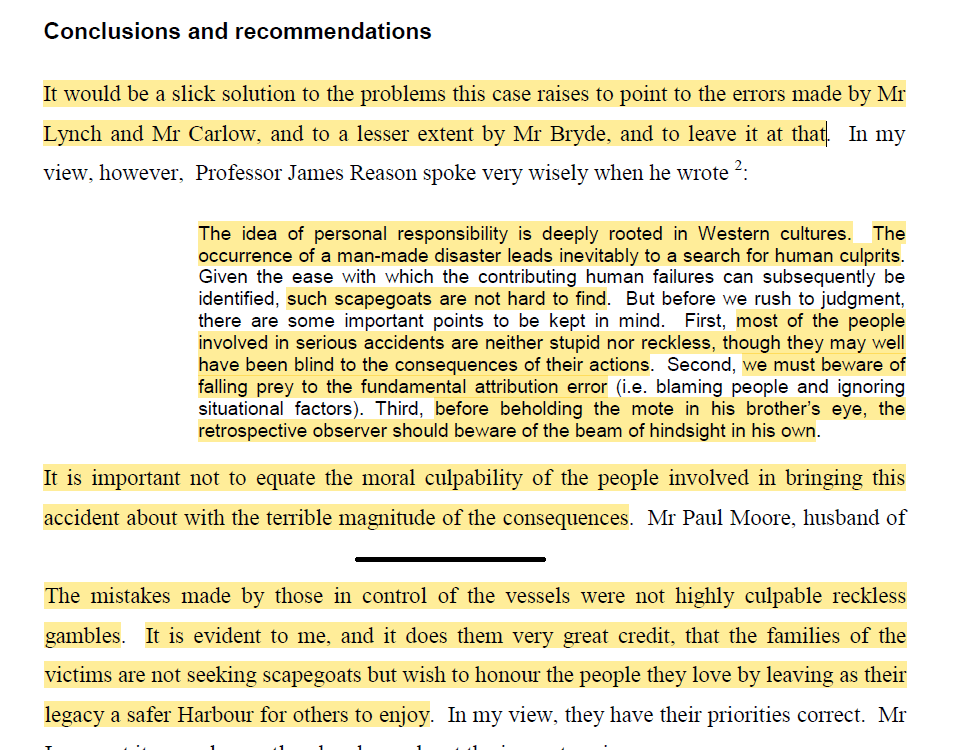
The coroner notes:
- “It would be a slick solution to the problems this case raises to point to the errors made by [people] and to leave it at that”
- However, as per James Reason, “The idea of personal responsibility is deeply rooted in Western cultures” and the “occurrence of a man-made disaster leads inevitably to a search for human culprits”
- “Given the ease with which the contributing human failures can subsequently be identified, such scapegoats are not hard to find”
- Most people involved in serious accidents “are neither stupid nor reckless, though they may well have been blind to the consequences of their actions”
- Moreover, “The mistakes made by those in control of the vessels were not highly culpable reckless gambles”
- “we must beware of falling prey to the fundamental attribution error (i.e. blaming people and ignoring situational factors)”
- “It is important not to equate the moral culpability of the people involved in bringing this accident about with the terrible magnitude of the consequences”
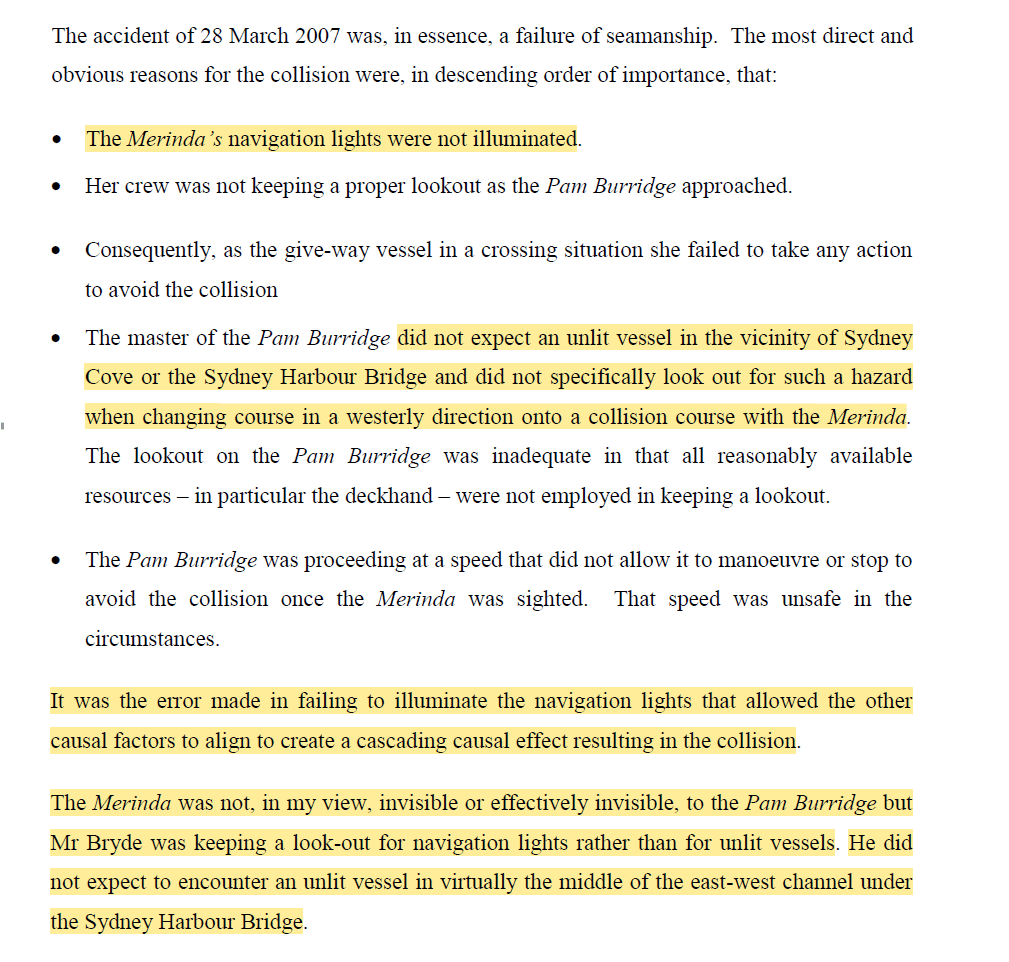
- It was found that the smaller vessel didn’t illuminate its lights and hence, “The master of the [larger vessel]did not expect an unlit vessel in the vicinity … and did not specifically look out for such a hazard when changing course”
- “The Merinda was not, in my view, invisible or effectively invisible, to the Pam Burridge but Mr Bryde was keeping a look-out for navigation lights rather than for unlit vessels. He did not expect to encounter an unlit vessel in virtually the middle of the east-west channel”
- “Apart from human errors, there were systemic problems that contributed to bring this accident about”
- “Underlying the Merinda’s failure to illuminate the navigation lights was the lack of a clear procedure in that vessel for docking and for getting underway”
- “NSW maritime legislation and regulations allowed two relatively inexperienced boat operators to take a substantial, passenger-carrying vessel out on the Harbour at night with a full complement of passengers”
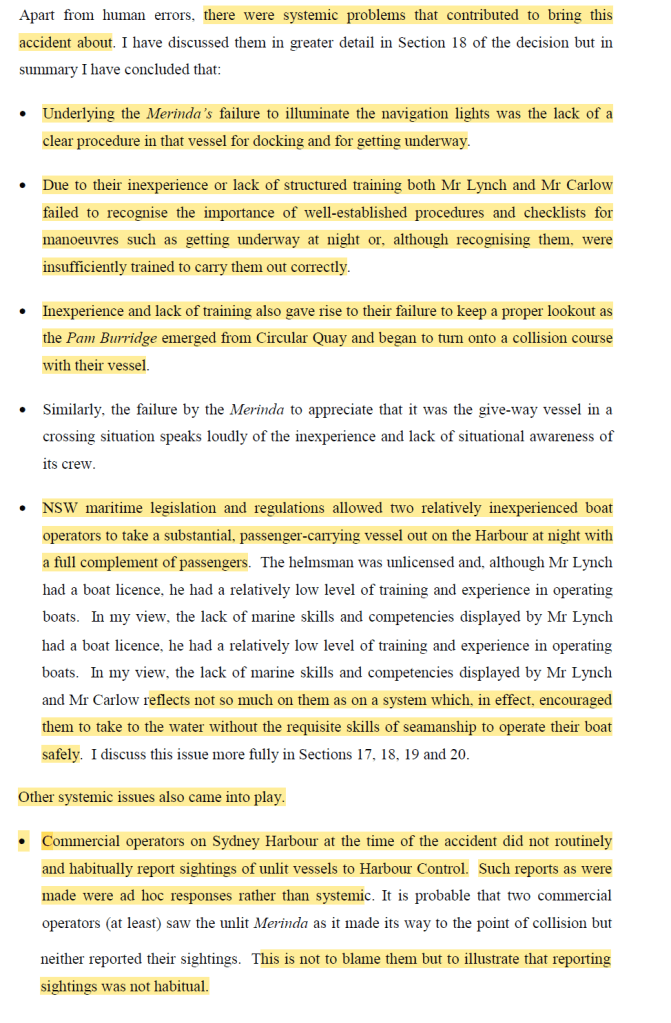
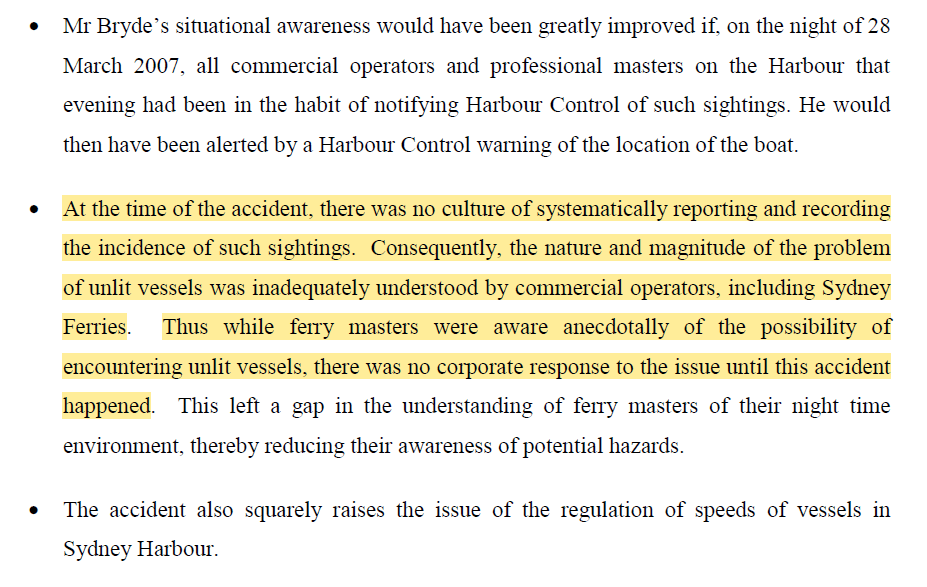
- “Commercial operators on Sydney Harbour at the time of the accident did not routinely and habitually report sightings of unlit vessels to Harbour Control” and “This is not to blame them but to illustrate that reporting sightings was not habitual”
- “At the time of the accident, there was no culture of systematically reporting and recording the incidence of such sightings. Consequently, the nature and magnitude of the problem of unlit vessels was inadequately understood by commercial operators, including Sydney Ferries
- “Thus while ferry masters were aware anecdotally of the possibility of encountering unlit vessels, there was no corporate response to the issue until this accident happened”
Ref: BLINN, ENGERT, INNES AND MOORE; Inquest into the deaths of Alan Blinn, James Engert, Morgan Innes and Simone Moore [2010] NSWCorC 1 (23 February 2010)

My site with more reviews: https://safety177496371.wordpress.com

 SafetyInsights.org
3 thoughts on “Coronial inquiry: Not hard to find human ‘culprits’ and “we must beware of falling prey to the fundamental attribution error (i.e. blaming people and ignoring situational factors)””