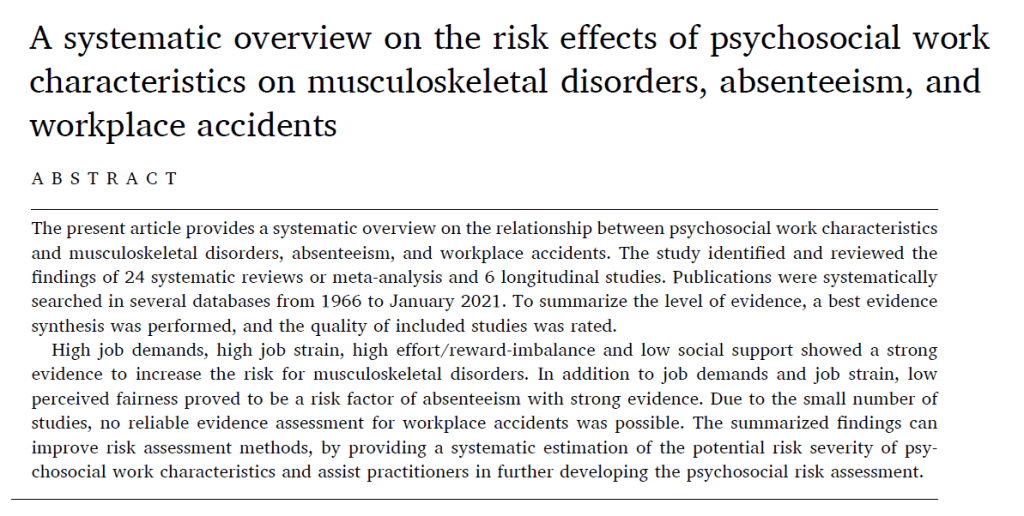
A systematic overview on the risk effects of psychosocial work characteristics on musculoskeletal disorders, absenteeism, and workplace accidents
This evaluated the evidence on relationships between psychosocial work characteristics on musculoskeletal disorders, absenteeism and workplace accidents.
30 meta-analyses and systematic reviews met inclusion for evaluation (It’s from 2021 – so while recent, still misses a lot of newer research which has emerged).
WAY too many findings to cover here.
Findings:

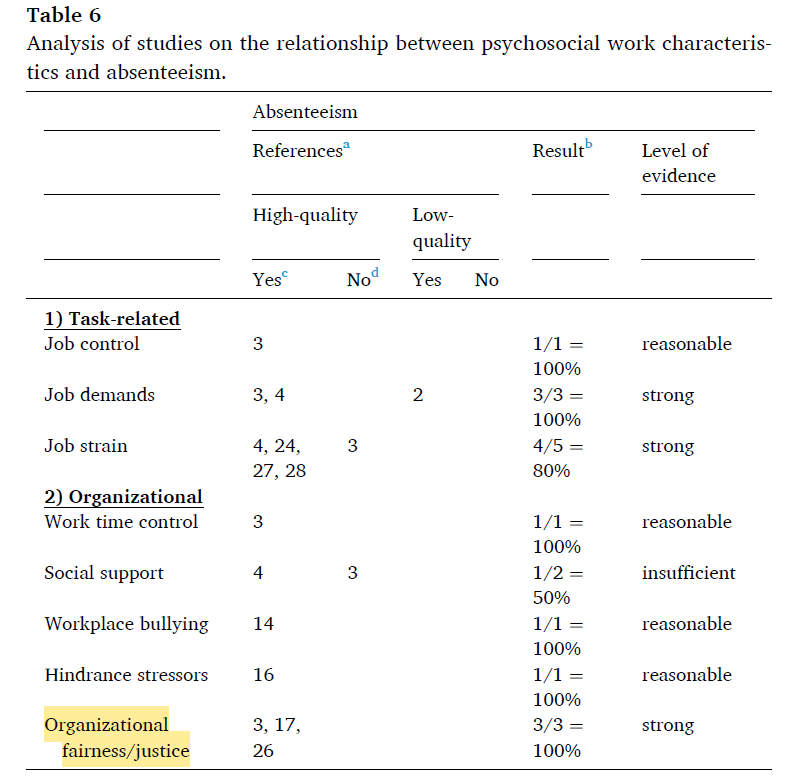
· “Strong evidence to be a risk factor for musculoskeletal disorders and absenteeism was found for the following work characteristics: High job demands, high job strain, high effort-reward imbalance, low social support, and low perceived fairness”
· Reasonable evidence of a risk factor was found for: “Low job control, low work time control, high workplace bullying, high hindrance stressors, high role conflict, and interpersonal conflicts”
· Insufficient evidence was found for the following risk factors: “monotonous work, number of work hours, few rest break opportunities, work pace, challenge stressors, low job security and role ambiguity”
· “there is insufficient evidence that psychosocial work characteristics are related to an increased risk for accidents, as only a few studies were available so far”
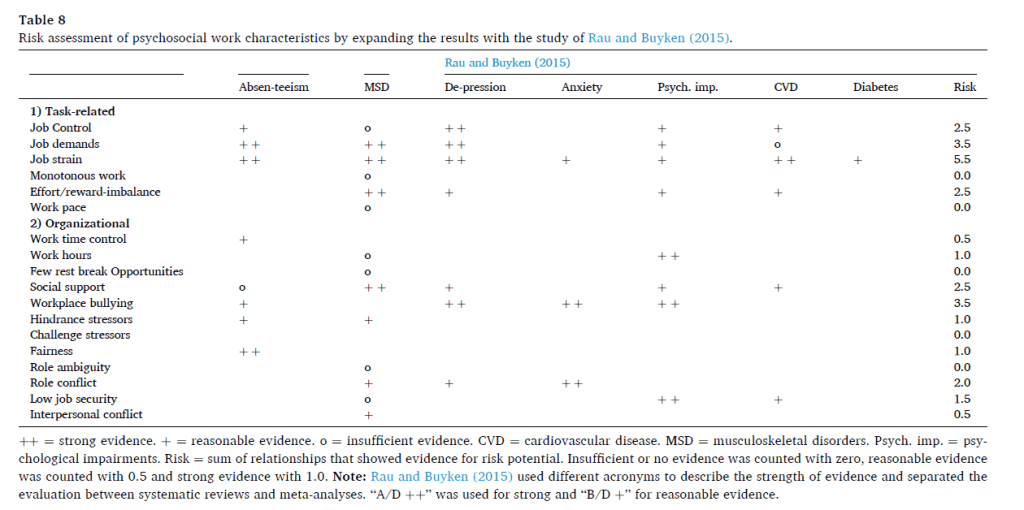
· “job demands alone, workplace bullying, and social support also reveal a strong evidence to be risk factors for health”
· “Most other show evidence that they are risk factors for at least one health related-outcome and should therefore be part of a risk assessment”
· “there is strong evidence that perceived fairness and reasonable evidence that work time control should also be included in a risk assessment”
[** Given the strong evidence with organisational fairness and justice, this may be further evidence of benefits of restorative justice and JC approaches.]
As expected, several limitations were present. E.g. They didn’t include other moderating or mediating factors, like leadership, climate etc. Some psychosocial work characteristics are said to be captured in a very abstract level. Also, as there’s a lot of research since 2021 not captured here.
Ref: Taibi, Y., Metzler, Y. A., Bellingrath, S., & Müller, A. (2021). A systematic overview on the risk effects of psychosocial work characteristics on musculoskeletal disorders, absenteeism, and workplace accidents. Applied ergonomics, 95, 103434.
Study link: https://doi.org/10.1016/j.apergo.2021.103434
My site with more reviews: https://safety177496371.wordpress.com

 SafetyInsights.org
One thought on “A systematic overview on the risk effects of psychosocial work characteristics on musculoskeletal disorders, absenteeism, and workplace accidents”